8–15% Replies: Deliverability-First Cold Email for Professional Services
Deliverability-first cold email tactics for professional services: 3-email sequences, 50–125 word messages, templates, and metrics to book meetings.

8–15% Replies: Deliverability-First Cold Email for Professional Services
Yes, cold email still works for professional services when you pair a tight ideal client profile with a hyper-relevant first line, a 50 to 125 word value-led message, a single low-friction call to action, and consistent deliverability hygiene. Consulting, legal, accounting, and advisory firms that treat outreach as insight-led communication rather than a sales blast consistently outperform firms sending generic pitches.
TL;DR:
- Focusing on high-quality, specific target accounts and decision-makers ensures a better response rate than mass emailing lower-fit prospects.
- Personalization signals like recent trigger events or mutual contacts significantly increase reply rates over generic, uncustomized outreach.
- Proper infrastructure, including deliverability hygiene and automated sequencing, is critical for success, as poor setup accounts for most failures.
- Reply and booking rates are more reliable measures of success than open rates, especially given recent email privacy protections.
- Using managed platforms that handle targeting, warm-up, and follow-up can significantly elevate reply rates and overall outreach effectiveness in professional services.
RunleadpilotBuild Your Outbound PipelineLeadPilot identifies prospects, personalizes outreach, manages follow-ups, and hands warm replies to your human team.Explore LeadPilot
Table of Contents
- What Makes A Professional Services Cold Email Actually Work
- Why Cold Email Can Outperform Other Channels For Services Buyers
- How To Build An ICP And Choose The Right Decision-Makers
- The Anatomy Of A High-Converting Cold Email
- Ready-To-Use Templates For Common Outreach Scenarios
- Designing Sequences And Coordinating Multi-Channel Touches
- Deliverability Basics Every Firm Needs Before Sending
- What To Track And How To Judge Real Success
- What A Deliverability-First Approach Actually Looks Like In Practice
- The Overlooked Truth About Cold Email For Professional Services
- How Runleadpilot Handles The Deliverability-First Approach For You
- Sources
What Makes A Professional Services Cold Email Actually Work
Start with the checklist, not the copywriting. Most failed campaigns skip the setup and jump straight to drafting subject lines, which is backward.
Before you write a single word, you need to know exactly who you’re emailing and why they’d care. Here’s the sequence that actually moves the needle:
- Define your ICP and name the specific decision-makers (title, department, seniority) who own the budget or the pain point.
- Build a list of 100 target accounts rather than 1,000. Quality of fit beats volume at this stage.
- Draft three templates mapped to distinct use cases (cold first-touch, referral, trigger event).
- Plan a three-email sequence spaced 3 to 7 days apart.
- Set up deliverability checks (SPF, DKIM, DMARC, warmed inbox) before you send a single message.
- Track reply rate and meetings booked from day one, not opens.
Pro Tip: A job posting is one of the most underused personalization signals in professional services outreach. If a target company just posted for a “Head of Finance” or “Director of Operations,” that’s a direct clue about a gap your service fills right now, and referencing it in your first line makes the email feel researched instead of blasted.
Why Cold Email Can Outperform Other Channels For Services Buyers
Professional services deals tend to be large enough that spending 15 extra minutes personalizing a single email is a rational use of time. Compare that to e-commerce outreach, where margins per customer rarely justify the same effort. Consulting and advisory buyers also hire on trust and demonstrated judgment, not features, and a well-written email can prove both in a way a product demo can’t.
Industry benchmarks back this up: professional services and consulting report higher reply rates than many other sectors, and personalization can multiply reply rates several times over compared with generic sends. That gap exists because a services buyer’s evaluation criteria are almost entirely about competence and fit, and a first line that shows you understand their specific situation does more persuasive work than any feature list.
Warm introductions still beat cold outreach outright. When a mutual connection exists, reply rates jump well above what cold sends achieve on their own, which is why smart outreach programs mine for warm paths before defaulting to cold lists. But when no warm path exists, a sharp, researched cold email is the next best lever, and it’s the one most firms leave underused.
How To Build An ICP And Choose The Right Decision-Makers
Your ideal client profile needs to be specific enough that a stranger could read it and immediately know who qualifies. Vague profiles (“mid-size companies that need consulting”) produce vague emails that get ignored.
Capture these fields at minimum:
- Role and title variants (a “Head of Finance” at one company might be a “VP Finance” at another).
- Company size, by employee count and revenue band.
- Industry vertical and any regulatory context that shapes their priorities.
- Geographic scope, especially if your service has jurisdiction-specific relevance.
- Trigger events: funding rounds, leadership changes, new office openings, compliance deadlines.
Who you target changes by service line. A strategy consulting firm generally wants C-suite access, since those decisions get made at the top. Accounting and tax advisory firms do better targeting CFOs or heads of finance directly, since that’s who owns the pain. Legal and HR advisory services usually convert best through general counsel or heads of HR, who are the ones fielding the actual risk.
For sourcing, LinkedIn Sales Navigator boolean searches (combining title, industry, and headcount filters) remain one of the most reliable free-to-cheap methods, alongside company news pages and press release aggregators for trigger events. Skip purchased lists entirely. They carry outdated contacts, tank deliverability, and rarely match your actual ICP criteria.
Pro Tip: Run a quick data-quality pass before any send: confirm the person still holds that title, verify the email format matches the company’s domain convention, and cut any contact you can’t validate through a second source.
The Anatomy Of A High-Converting Cold Email
Every part of a professional services cold email has one job: reduce friction to the next sentence. Get any piece wrong and the whole message stalls.
Subject line. Keep it under 60 characters. Skip anything that reads like marketing copy (“Boost Your Firm’s Revenue!”) and lean on specificity instead. Test a curiosity-driven line against a direct-benefit line across the same list segment, and judge the winner by replies, not opens. For more subject line mechanics, this breakdown of subject lines that get opened covers testing structure in more depth.
First line. This is the single highest-leverage sentence in the email. It needs to prove, in under 15 words, that you did actual research. Three patterns work consistently for consulting and advisory outreach:
- Trigger reference: “Saw the press release on your Chicago office opening. Congrats. Curious how you’re handling state tax registration across the new jurisdiction.”
- Mutual contact: “[Name] mentioned you’re rebuilding the finance function ahead of your Series B. Wanted to reach out directly.”
- Insight-led observation: “Noticed your last three job postings are all for compliance roles. Usually a sign the regulatory workload just outgrew the current team.”
Body. One sentence proving relevance (often the first line does this already), one sentence stating the outcome you help clients reach, and a single low-friction call to action. Total length: 50 to 125 words. Anything longer starts losing readers who are scanning on a phone between meetings, and best-practice templates consistently land in this range.
Call to action. Ask for one thing. “Worth a 15-minute call next week?” beats “Let me know if you’d like to schedule a call, or if you’d prefer I send over a proposal, or if you’d rather loop in someone else on your team.” Multiple asks kill momentum.
Common mistakes to cut in your editing pass: a second CTA buried in the closing line, an attachment that trips spam filters, a subject line that oversells what the email delivers, and any paragraph that could be deleted without losing meaning.
Ready-To-Use Templates For Common Outreach Scenarios
Each template below runs 50 to 125 words and swaps in a hyper-relevant first line based on the scenario. Copy the structure, not the exact wording. The personalization is what makes it work.
- Cold first-touch (ICP match). Reference a specific operational detail (team size, recent hire, service gap) and state one outcome you deliver for similar firms. Close with a single meeting ask. Expect this to perform at the lower end of your reply-rate range since there’s no existing signal beyond fit.
- Trigger event outreach. Lead with the specific event (funding, expansion, leadership change) and tie your service directly to what that event creates. This category tends to outperform plain ICP sends because the timing does the persuading for you.
- Mutual referral or intro. Name the mutual contact in the first line and keep the ask soft. Warm-adjacent outreach like this consistently reply-rates higher than fully cold sends.
- Value-first content send. Offer a specific insight, benchmark, or short resource relevant to their situation before asking for anything. Works well for buyers not yet in an active search.
- Personalized video or asset outreach. A 30 to 60 second video referencing their specific business can lift replies meaningfully above text-only sends for high-value target accounts, though it costs more production time per prospect.
- Breakup email. Sent after two to three unanswered touches. Keep it short, remove pressure, and leave the door open. These often outperform the earlier touches because they signal you’re not going to keep chasing.
Personalize the first line differently in every version, even when the rest of the template stays the same.
Designing Sequences And Coordinating Multi-Channel Touches
A single email rarely closes a deal, but a well-timed sequence changes the math. One follow-up alone can lift reply rates by roughly 40 to 50 percent compared to the initial touch, and a three-email sequence typically outperforms any single send substantially.
A practical cadence for professional services:
- Three-email sequence: initial touch, then follow-up at day 4, then a breakup email at day 9 to 10.
- Five-email sequence for higher-value accounts: add a LinkedIn connection request after email two and a short personalized video before the breakup email.
- Space touches 3 to 7 days apart. Faster feels aggressive; slower loses momentum.
Personalized video outreach can produce a two to three times reply lift over text-only sequences when the video is genuinely specific to the recipient, which makes it worth reserving for your top-tier target accounts rather than every prospect on the list.
Operationally, tag each sequence by ICP segment and service line so you can measure performance by category, not just in aggregate. Set a clear handoff rule: any reply showing genuine interest, even a soft “tell me more,” routes straight to a human, not another automated touch. For a deeper look at cadence structure, this guide to sequences that book meetings walks through the timing logic in more detail.
Deliverability Basics Every Firm Needs Before Sending
None of the copywriting above matters if your emails land in spam. Deliverability is the operational foundation, and it’s the piece most firms underinvest in.
- Use a dedicated sending domain or subdomain, separate from your primary company domain, so a deliverability issue never touches your main inbox reputation.
- Warm up new inboxes gradually over two to three weeks before running full volume, and continue monitoring bounce and spam complaint rates as you scale.
- Rotate sending across multiple warmed inboxes rather than pushing everything through one address. This is exactly the kind of setup managed warmup tools handle automatically if you’d rather not build it by hand.
- Start small teams at 30 to 50 emails per inbox per day and scale up only as bounce and complaint rates stay low.
- Never buy or scrape lists in bulk. Bad data is the fastest way to burn a domain’s reputation.
Pro Tip: Under CAN-SPAM, every commercial email needs accurate sender information, a real physical address, and a working unsubscribe mechanism. Skipping any of these isn’t just a compliance risk. It also signals to spam filters that the sender is untrustworthy.
What To Track And How To Judge Real Success
Opens stopped being a reliable signal years ago. Apple’s Mail Privacy Protection and similar features inflate open rates artificially, so chasing that number tells you almost nothing about whether your message landed. Reply rate and meetings booked are the metrics that actually reflect performance.
| Metric | What it measures | Why it matters |
|---|---|---|
| Qualified reply rate | Percentage of sends generating a genuine response | Direct signal of message relevance |
| Meetings booked per 1,000 emails | Volume efficiency of the full sequence | Ties outreach directly to pipeline |
| Pipeline value per meeting | Revenue potential per booked call | Connects outreach to actual business impact |
| Reply-to-meeting conversion | How well replies convert to booked calls | Flags weak follow-up or scheduling friction |
For A/B testing, run each variant across at least a few hundred sends before drawing conclusions. Smaller samples produce noise, not insight. Test one variable at a time (subject line, first line, CTA phrasing) and review results on a two-week cadence rather than daily, since reply patterns need time to stabilize.
What A Deliverability-First Approach Actually Looks Like In Practice
Firms that treat cold email as a serious channel, not a side project, tend to separate two jobs: the strategic work of targeting and messaging, and the operational grind of inbox management and warmup. Trying to do both manually is where most solo consultants and small teams burn out.
Founders running deliverability-first outreach have reported reply rates in the 8 to 15 percent range, a meaningful jump over the low single digits typical of unmanaged cold sends with no domain hygiene behind them.
That gap usually comes down to infrastructure, not copywriting talent. A small team of one to five people with no dedicated SDR usually benefits most from a managed platform that handles domain setup and warmup automatically. A team of 20 or more with an existing sales operations function might reasonably keep list-building in-house and use software only for sending and tracking. The dividing line is whether someone on your team has the bandwidth to babysit sender reputation daily. Most professional services firms don’t, which is exactly where they lose the most ground.
The Overlooked Truth About Cold Email For Professional Services
Most advice on this topic treats cold email like a numbers game: send more, personalize a little, follow up twice, done. That framing undersells what’s actually happening when a services buyer reads an email from someone they’ve never met. They’re not evaluating your offer. They’re evaluating your judgment, in real time, based on eleven sentences.
That’s why the conventional wisdom about volume is backward for this category. A consulting or advisory firm sending 50 sharply targeted emails a week, each with a first line that proves genuine research, will out-book a firm sending 500 generic ones almost every time. The economics of professional services support this: your deal sizes are large enough that spending real time on each message is rational, not a luxury.
Where most firms actually fail isn’t the writing. It’s the infrastructure behind it. They write a decent email, send it from an unwarmed domain, skip the follow-up sequence, and conclude that “cold email doesn’t work for us.” It wasn’t the message. It was everything holding the message up that never got built.
Prioritize deliverability and sequencing before you obsess over subject line cleverness. A great email from a burned domain reaches nobody.
— Harsh
How Runleadpilot Handles The Deliverability-First Approach For You
There are platforms that run the entire outreach workflow, from finding your ideal client profile to handing you the warm reply, without you managing inbox warmup or chasing follow-ups by hand.
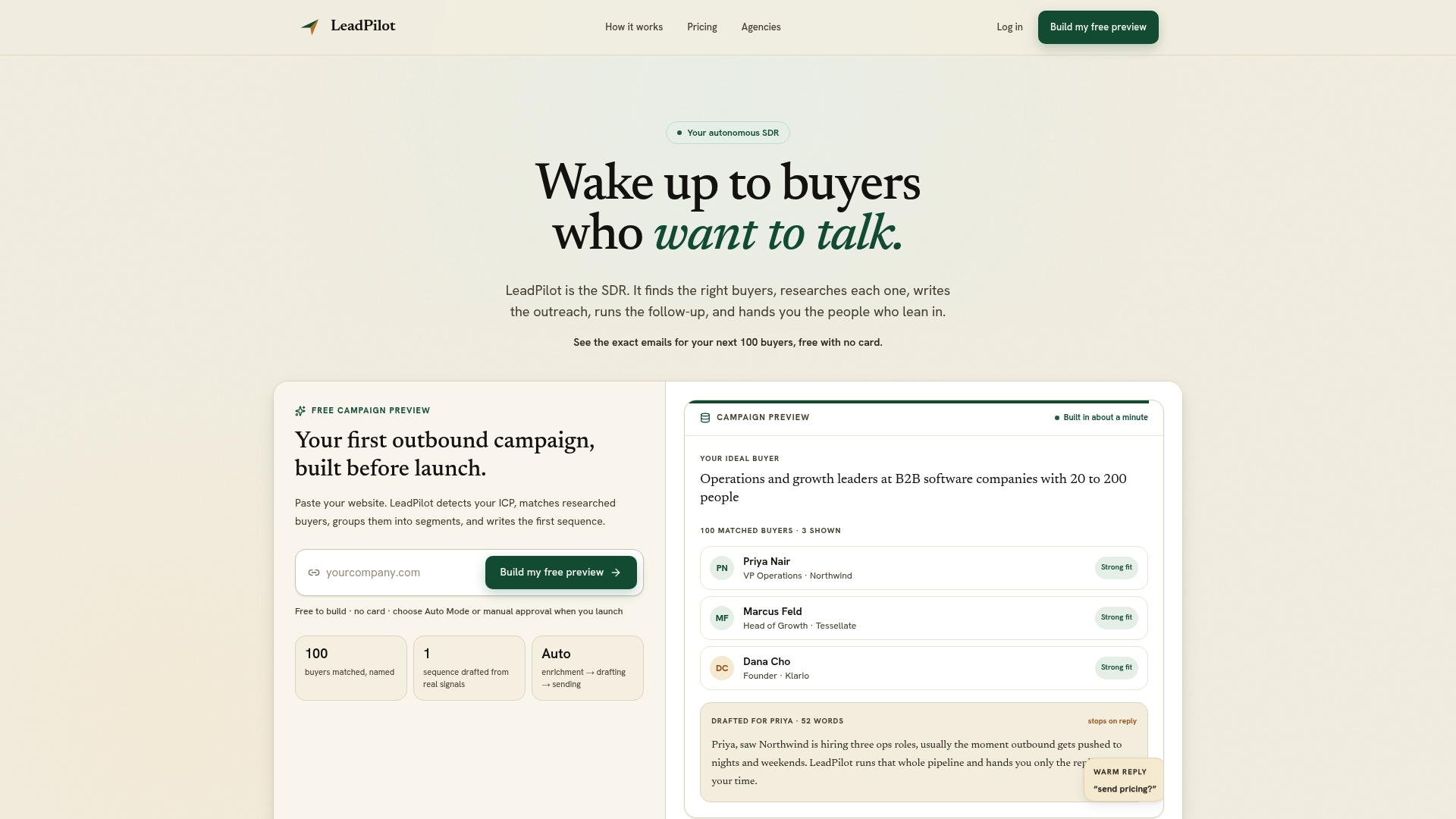
Some platforms can read your website to identify an ideal customer profile, source and research matching decision-makers, and draft personalized cold emails built from real signals like trigger events and job postings. They also manage sending domains and inboxes for deliverability, run follow-up sequences automatically, and route any warm reply straight to your team for the human conversation. That last part matters most in professional services, where trust gets built in the reply thread, not the initial send.
This setup fits best for consulting and advisory founders and lean sales teams that want managed infrastructure instead of building warmup and sequencing from scratch. If you want to see how it maps to your own firm before committing to anything, you can build a free campaign preview and review the targeting and messaging LeadPilot generates for your specific service line, or look at the full cold email automation feature set directly.
Sources
For deeper detail on the tactics covered above, the Superhuman outreach email examples guide breaks down benchmark reply rates by sector, and the Sendspark B2B template library covers template structure and multi-channel sequencing in more depth. For a professional-services-specific walkthrough of message structure, see Muhammad Helmy’s guide to cold outreach for professional services. For lead nurturing after the reply comes in, BabyLoveGrowth’s lead nurturing guide covers the conversion side.
- Outreach email examples that get responses | Superhuman blog
- Outreach email templates: 8 B2B examples | Sendspark blog