How to Manage Replies to Cold Email Without Losing Deals
Learn how to effectively manage replies to cold emails and maximize deal potential. Transform responses into opportunities with targeted action.

How to Manage Replies to Cold Email Without Losing Deals
Treat every reply as the halfway point of the deal, not the finish line. Sort it into a lane, act inside that lane’s SLA window, stop every scheduled sequence touch immediately, and give the reply one job to do. Nothing else in cold outreach wastes more pipeline than a good reply sitting in an inbox for two days while a follow-up email still fires on autopilot.
There are six lanes: positive, information request, objection, not now, referral, and negative. Each one gets a different SLA and a different play, but the mechanics underneath are the same everywhere.
- Hot replies (clear buying interest): respond promptly.
- Warm replies (questions, mild interest, referrals): respond within a few hours.
- Everything else (not now, objections, negative): respond by end of business day.
Three rules never bend: a human reply stops all sequences across every channel, opt-out language triggers global suppression on the spot, and every reply gets exactly one goal. Stack two asks in a reply and you’ll usually get zero answers instead of one.
Key Takeaways
Fast, lane specific replies paired with hard sequence stop rules convert more cold email prospects than clever copy ever will.
| Point | Details |
|---|---|
| Sort every reply into a lane | Use the six lanes (positive, info request, objection, not now, referral, negative) before writing anything back. |
| Match speed to lane urgency | Answer hot replies in 15 minutes, warm replies in 2 hours, and the rest same business day. |
| Stop sequences on any reply | A human reply must halt every scheduled touch across all channels and mailboxes automatically. |
| Give each reply one job | Combine an acknowledgment, a direct answer, and a single next step, never two competing asks. |
| Let automation carry the load | Platforms like LeadPilot apply sentiment detection and sequence stop across sending domains so SLAs hold at scale. |
Table of Contents
- How Do You Classify and Triage Cold Email Replies?
- What Response Times Actually Drive Conversion?
- Why Sequence Stop and Suppression Matter More Than the Reply Itself
- What Should Your Reply Templates Actually Say?
- How Automation and a Managed Platform Enforce the Playbook
- What the Data Actually Says About Reply Discipline
- Let LeadPilot Handle the Reply Plumbing for You
- Sources
How Do You Classify and Triage Cold Email Replies?
Most reps read a reply and start typing. That’s the mistake. The first move is classification, because the lane determines everything downstream: who owns it, how fast it needs an answer, and what the message is even trying to accomplish.
Here’s how to sort replies into their lanes fast:
- Positive — words like “interested,” “sounds good,” “let’s talk,” or a direct question about scheduling. Treat any calendar-adjacent language as hot.
- Information request — questions about pricing, process, or proof (“how does this work,” “what does it cost,” “do you have case studies”). Warm tier.
- Objection — pushback with a reason attached (“we already use X,” “not the right time for budget reasons”). Still warm, because an objection with detail is a live conversation.
- Not now — a timing statement with no objection (“check back in Q3,” “swamped until next quarter”). Standard tier.
- Referral — “not the right person, try [name]” or “loop in my colleague.” Standard tier, but time-sensitive before the thread goes cold.
- Negative/remove — “not interested,” “remove me,” “unsubscribe,” or anything hostile. Immediate suppression, no SLA needed because the action is instant.
The action per lane is always the same shape: stop the sequence the moment a reply lands, assign an owner, then work the SLA clock. Automation can pre-sort most of this using sentiment scoring and keyword rules, flagging anything with scheduling language or a question mark as hot or warm before a rep even opens the thread.
Pro Tip: Build your keyword rules around punctuation, not just vocabulary. A reply ending in a question mark converts at a different rate than a flat statement, even when the words are nearly identical.
What Response Times Actually Drive Conversion?
Speed beats polish. A rushed but timely reply consistently outperforms a perfectly worded reply sent a day late, because interest decays fast once a prospect’s attention moves on to the next thing in their inbox.
The SLA windows aren’t arbitrary. Hot replies need a response inside 15 minutes because that’s roughly the window before a prospect switches tasks and the “I was just thinking about this” moment evaporates. Warm replies get 2 hours because questions and mild interest survive a short delay but not a full day. Everything else can wait until the same business day without meaningfully hurting conversion.
Ownership needs to be explicit, not aspirational. Three models work:
- By lane: your best closer takes positive and objection replies; an SDR or ops person handles information requests and not-now replies.
- By rotation: whoever is “on call” for the hour owns whatever lands, useful for smaller teams without dedicated roles.
- By account owner: whoever originally sent the campaign keeps every reply from their contacts, preserving the relationship thread.
None of this works without routing that actually surfaces replies fast. A unified inbox that pulls from every sending address into one shared view, paired with push notifications the moment a reply lands, is the only way to hit a 15-minute SLA at any real volume. Track first-response time and percentage of replies answered inside SLA as your two core operational metrics. Reply speed and disciplined follow-through explain most of the performance gap between average and top-performing outbound teams; it isn’t usually the offer that’s broken.
Why Sequence Stop and Suppression Matter More Than the Reply Itself
Nothing kills trust faster than a prospect who just replied to you personally receiving an automated follow-up two days later. It reads as proof nobody was actually paying attention, and it undoes whatever goodwill the reply itself created.

The fix is a hard technical rule: any human reply, from any address, stops every scheduled touch tied to that contact across every mailbox and channel. This has to be automatic, not a manual step someone remembers to do under deadline pressure. Failing to stop a sequence after a reply is one of the fastest ways to burn a prospect who was otherwise warming up.
Opt-out handling needs the same rigor:
- Treat “remove me,” “unsubscribe,” “stop emailing,” and similar phrases as instant, non-negotiable suppression triggers.
- Suppress globally, not just on the current campaign. The same contact should never resurface in a different list next quarter.
- Log every reply outcome in your CRM immediately, with a tag for lane and disposition, so “not now” contacts get resurfaced on a date instead of vanishing.
- Mark negative replies as permanent suppressions, and mark referrals with the new contact’s name so the next campaign doesn’t start from zero.
Good data hygiene here isn’t a compliance checkbox. It’s what keeps your sender reputation and your team’s credibility both intact over the next twelve months of outbound.
What Should Your Reply Templates Actually Say?
Templates aren’t scripts to copy word for word. They’re the minimum structure each lane needs so a rep isn’t staring at a blank cursor while the SLA clock runs. A good reply has a clear opener, gives the direct answer first, and closes with one defined next step. That’s usually three to five sentences for a standard reply, shorter for quick confirmations.
Here’s the minimal structure for each lane:
-
Positive: One line acknowledging their interest, referencing their own words if possible. Optionally one line of value. Then propose two named times in their time zone, with a calendar link as the fallback, not the primary ask. Example: “Glad this landed at a good time, Sarah. Does Tuesday at 10am or Wednesday at 2pm ET work, or grab a slot here: [link].”
-
Information request: Give them a forced choice instead of an open-ended answer. “Happy to cover that. Want me to focus on (1) pricing, (2) how the process works, or (3) results from similar teams?” Follow with 2 to 3 bullets on whichever they picked, then attach the meeting ask. Forced-choice replies reduce friction compared to a naked calendar link because the prospect doesn’t have to think about what to ask next.
-
Objection: Two sentences of factual, non-defensive answer, then attach the meeting ask directly to it. Don’t let the objection response stand alone. Example: “Totally fair, most teams we work with already had something in place. The difference usually shows up in [specific detail] — worth 15 minutes to compare notes?”
-
Not now: Respect the stated timing exactly. Ask permission for a specific future date or quarter, then move the record to a dated nurture lane. “Makes sense. Mind if I circle back in early Q3?”
-
Referral: Thank them in-thread, ask for a warm intro rather than just a name, then open a fresh thread naming the referrer in the first line if the intro doesn’t happen.
-
Negative/remove: One gracious sentence, honor the unsubscribe immediately with no follow-up questions, and log it as targeting data for future list building.
Pro Tip: Never combine two lanes in one reply. A prospect who asks a pricing question AND raises a mild objection gets one reply addressing the more urgent of the two, with a note to follow up on the second point after the call is booked.
How Automation and a Managed Platform Enforce the Playbook
Manually running this playbook works at low volume. It falls apart the moment you’re sending to hundreds of prospects a week across multiple sending domains, because no team can watch six inboxes in real time.

This is where sentiment classification and automated reply detection earn their keep. Two automations pay for themselves almost immediately: sequence stop, which prevents a replied contact from ever getting another automated touch, and sentiment flagging, which sorts a reply into its lane the second it lands instead of waiting for a human to read it. Wiring sequence stop and global suppression across every sending domain and mailbox means the rule works the same everywhere, not just on the primary account.
A managed outbound platform like LeadPilot builds this plumbing in rather than leaving it to manual review: reply detection flags hot and warm messages automatically, sequences halt the instant a human reply arrives, and every reply routes to a named owner through a unified inbox that keeps the original sender identity intact. That last part matters more than it sounds. A prospect who replied to “Alex” expects the next message to still sound like Alex.
The teams that convert the most replies aren’t writing better responses. They’re building the plumbing that guarantees a fast, focused response happens every single time, whether or not someone remembers to check the inbox.
What the Data Actually Says About Reply Discipline
Most advice on cold email reply handling focuses on what to write. That’s backward. The research points somewhere else entirely: the gap between teams that convert replies and teams that don’t is almost never the sentence quality. It’s whether the sequence actually stopped, whether the reply got answered inside the window that mattered, and whether someone was actually assigned to own it.
Conventional wisdom treats a reply like a mini negotiation that needs the perfect response. In practice, a forced-choice question and two named times will out-convert a beautifully worded paragraph with a generic calendar link, because friction kills replies faster than mediocre phrasing does. The prospect isn’t grading your prose. They’re deciding whether replying again is worth their next two minutes.
If you fix one thing this week, fix the plumbing before the copy. Get sequence stop working across every mailbox, get a routing system that surfaces hot replies in minutes instead of hours, and only then worry about whether your objection response is worded well enough. Teams that skip straight to template writing without building the enforcement layer underneath end up with great replies to prospects who already got annoyed by a stray follow-up.
— Harsh
Let LeadPilot Handle the Reply Plumbing for You
Building sequence stop, sentiment detection, and unified routing across multiple sending domains is a real engineering project, not a checkbox in most sequencers. Runleadpilot is built around that gap: it’s a managed, AI-powered outbound platform where reply detection, sequence stop, and global suppression run automatically across every mailbox from day one, and warm replies hand off to your team the moment they’re flagged, not after someone happens to check the inbox.
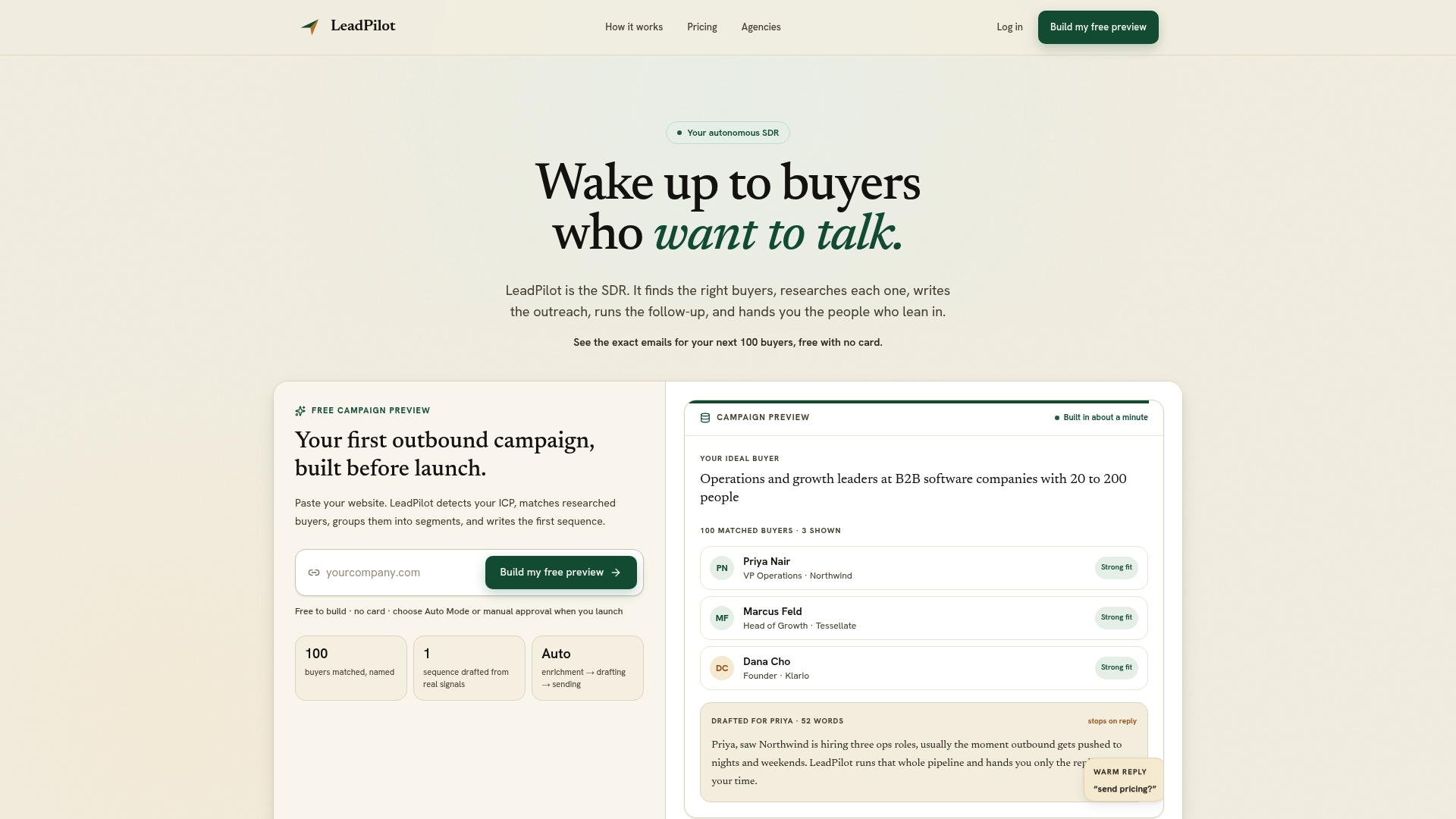
That means you get the operational discipline this playbook describes without hiring an ops person to build and maintain it. Runleadpilot also researches your ideal customers, writes the initial outreach from real signals on their business, and manages dedicated sending domains for deliverability, so the reply volume you’re triaging is already qualified before it lands. If you’re ready to see what that looks like for your own outbound, build a free campaign preview and see how the reply handoff works before committing to anything.