Best Time to Send Cold Emails: A Data-Backed Playbook
Discover the optimal days and times to send cold emails. Boost your open rates by targeting the right moments for outreach.

Best Time to Send Cold Emails: A Data-Backed Playbook
The best time to send cold emails is Tuesday through Thursday, between 8 and 11 a.m. in your prospect’s local time zone. That window shows up again and again across Shopify’s aggregated email data and Omnisend’s outreach research, and it works because it catches people right after they clear their overnight inbox but before the day’s meetings swallow their attention.
Monday mornings are still catch-up mode. Fridays are already checked out. Midweek mornings sit in the sweet spot where someone has time to actually read a subject line instead of just triaging it.
Here’s your move this week: pick one segment of your list, split it in half, and test Tuesday at 9 a.m. local time against Thursday at 10 a.m. local time. Run it for two weeks minimum before you draw any conclusions.
Key Takeaways
Cold email performance depends more on matching send time to the recipient’s local workday than on chasing a single universal “best hour.”
| Point | Details |
|---|---|
| Best days | Tuesday through Thursday consistently outperform Monday and Friday for B2B cold outreach. |
| Best time windows | Target 7 to 11 a.m. or 1 to 3 p.m. in the recipient’s local time zone. |
| Time zones matter most | Schedule by recipient local time, not sender time, to avoid a common and fixable performance drain. |
| Test one variable at a time | Run day-of-week or time-of-day tests separately over at least one full week before deciding a winner. |
| Prioritize reply rate | Track opens and clicks, but weigh reply rate highest when the goal is a conversation. |
| Automate the mechanics | Runleadpilot handles local-time scheduling, staggered sends, and follow-up cadence so timing tests run without manual tracking. |
Table of Contents
- Which Days of the Week Work Best for Cold Outreach?
- What Time of Day Gets the Most Opens and Replies?
- How Does the Best Send Time Change by Industry and Email Type?
- How Do You Schedule Cold Emails Across Time Zones?
- When Should You Send Follow-Up Emails?
- How Do You Test and Measure Your Own Optimal Send Time?
- What Are Some Ready-to-Use Send Schedules?
- Why Timing Alone Won’t Save a Bad List
- How LeadPilot Helps You Find and Execute Your Best Send Times
- Sources
Which Days of the Week Work Best for Cold Outreach?
Tuesday, Wednesday, and Thursday consistently beat Monday and Friday for B2B cold email. Quarvio’s timing analysis puts Tuesday and Thursday at the top of the list, and Mailneo’s research backs that up, naming Tuesday 9 to 11 a.m. and Thursday 10 a.m. to noon as its safest open windows.
Monday underperforms for a simple reason: most professionals spend the first hour or two clearing weekend backlog, not reading pitches from strangers. Friday has the opposite problem. Attention drifts toward the weekend by early afternoon, and inboxes get a lighter skim than a real read.
That doesn’t mean you should abandon Monday and Friday entirely.
- If you’re running high email volume, spreading sends across five days protects your sending domain from spikes that trigger spam filters.
- Some outbound teams find Monday afternoon or Friday morning still convert if the subject line is sharp enough to cut through the noise.
- Full-week distribution also helps you stay under daily sending caps if you’re managing multiple inboxes.
Pro Tip: Start every new campaign with a Tuesday or Thursday send as your control group, then branch out from there once you have real reply data for that specific list.
What Time of Day Gets the Most Opens and Replies?
Two windows do most of the heavy lifting for B2B cold email: 7 to 11 a.m. and 1 to 3 p.m., both measured in the recipient’s local time zone. Quarvio’s data identifies these as the two strongest blocks, and the logic tracks with how people actually work. Morning is inbox triage time. Early afternoon is the second wave, right after lunch, before the 3 p.m. meeting crunch sets in.
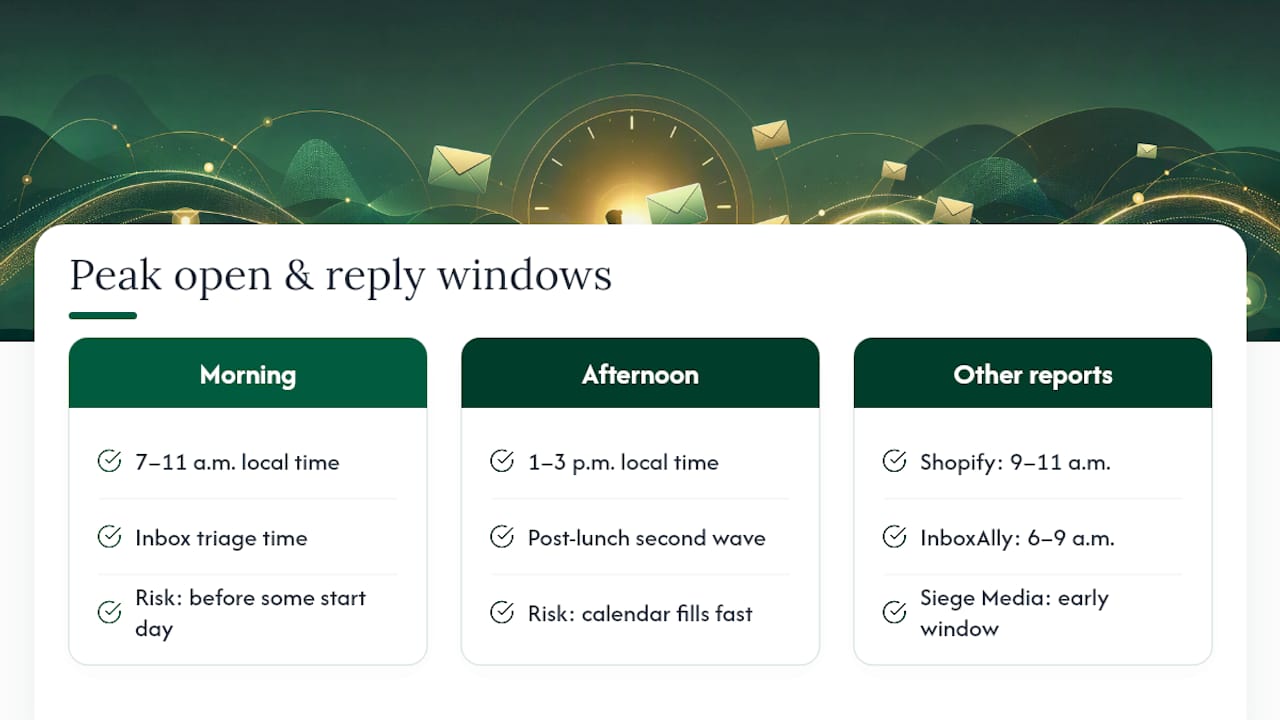
Not every study lands on the same exact hour. Shopify’s data points to 9 to 11 a.m. as the strongest general window, while InboxAlly’s guide has seen success even earlier, in the 6 to 9 a.m. range for certain B2B lists. A separate case study from Siege Media found strong performance in that same early window for their own outreach sample, though the researchers note the exact peak depends heavily on the list and time zone mix.
Each window comes with a trade-off. Sending at 7 a.m. lands you at the top of the inbox, but you risk arriving before some recipients have even started their day. Mid-morning, around 9 to 11 a.m., balances visibility against the reality that people are already fielding calls and Slack messages. Afternoon sends catch a real second look, but they’re competing against a calendar that’s filling up fast. None of these windows is wrong. They’re just tuned to different rhythms, which is exactly why testing your own list matters more than copying someone else’s chart.
How Does the Best Send Time Change by Industry and Email Type?
Your prospect’s job doesn’t run on a generic clock, and neither should your send schedule. A CFO checking email at 6:45 a.m. before markets open behaves nothing like a plant manager who doesn’t sit down at a desk until his shift ends at 3 p.m.
- Finance and banking: Earlier starts, often 7 to 9 a.m. local time, line up with market-open routines.
- Manufacturing and logistics: Shift schedules matter more than the clock on the wall. Early-shift start or end-of-shift windows can beat standard “business hours” advice entirely.
- Professional services (legal, consulting, accounting): Morning and mid-afternoon both work, since these roles often have blocked-off admin time in both slots.
- Marketing and agency contacts: Wider tolerance for send time, since inbox habits in this group skew toward frequent, all-day checking.
Email type matters just as much as industry. Cold outreach aimed at booking a reply behaves differently than a promotional blast aimed at a click, and a newsletter built for long-term nurture doesn’t need to fight for the same narrow window at all. If your goal is a reply, prioritize the hours when someone has a few free minutes to type something back, not just glance and archive. When in doubt, map your test schedule to the daily workflow of the specific job title you’re targeting, not a generic “B2B” bucket.
How Do You Schedule Cold Emails Across Time Zones?
Sending on your own clock instead of the recipient’s is one of the most common, and most fixable, mistakes in cold outreach. A campaign that goes out at 9 a.m. Eastern lands at 6 a.m. Pacific, well before most West Coast prospects are even awake, and Quarvio’s research flags time-zone mismatch as a routine cause of underperformance that has nothing to do with your copy.
The fix is straightforward in principle, harder in practice without the right setup:
- Segment your list by region or time zone before you build the send schedule.
- Set each segment’s send window to local business hours, not your own.
- Stagger the sends so you’re not blasting hundreds of emails in the same sixty-second window, which can itself look suspicious to spam filters.
When you’re evaluating cold email automation software, look specifically for recipient-local scheduling and automatic time-zone detection. Manually calculating offsets for a list spanning four time zones is exactly the kind of task that eats an afternoon and still ends up wrong.
Pro Tip: Never run one list across mixed time zones as a single blast. Split it into separate campaign instances first, even if it feels like extra setup work.
When Should You Send Follow-Up Emails?
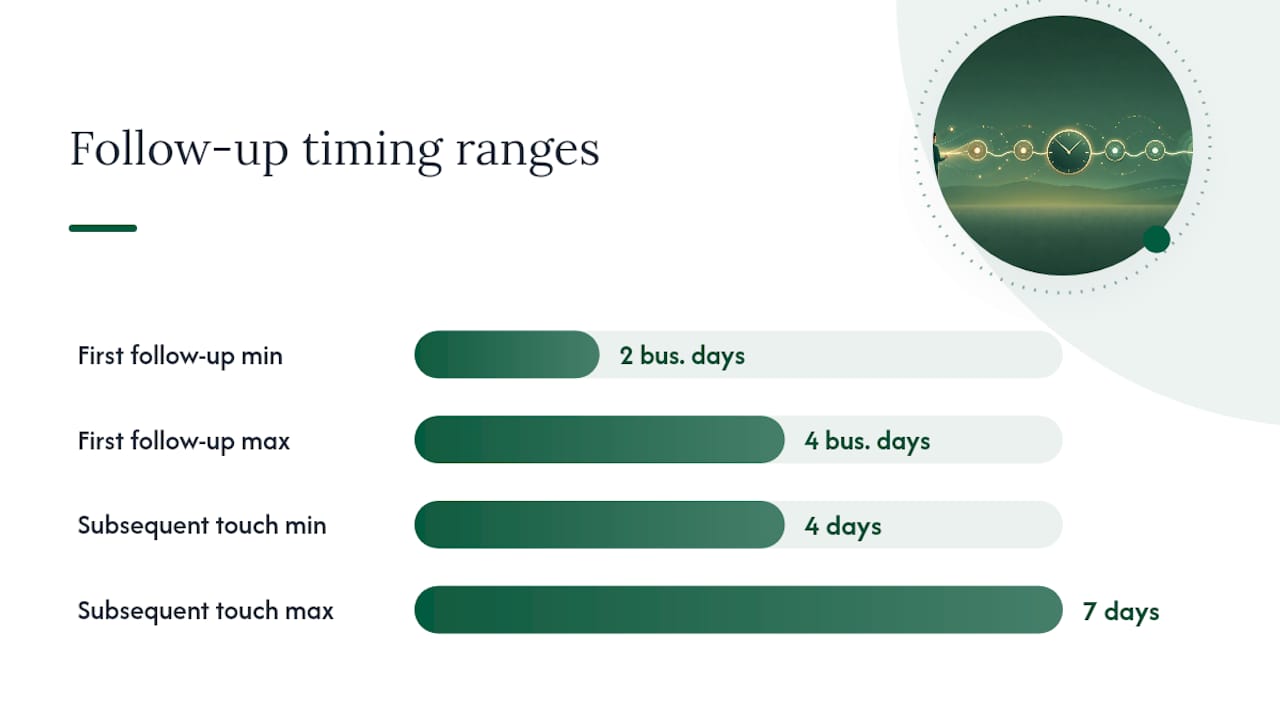
Your first follow-up should land 2 to 4 business days after the initial send. Wait too long and you lose the thread of relevance; too short and you look desperate or automated. From there, space subsequent touches 4 to 7 days apart, adjusting based on whether the prospect has opened or clicked anything.
The right cadence depends on what you’re actually optimizing for.
- Reply-focused sequences tend to work better with slightly longer gaps, since you’re giving the prospect room to actually respond rather than feel chased.
- Click or convert-focused follow-ups can move faster, especially if you’re nudging toward a specific action like a demo booking.
- Rising spam complaints are a signal to pause the sequence and reassess your list quality or sending domain, not just your timing.
- A low reply-to-open ratio over several sends usually means the day or window is wrong, not necessarily the message.
Managing this by hand across dozens of prospects gets messy fast, which is where a defined follow-up cadence framework pays off.
How Do You Test and Measure Your Own Optimal Send Time?
Generic benchmarks get you started. Your own data gets you results. Here’s the operational plan:
- Pick one variable at a time. Test day of week OR time of day, never both in the same run, or you won’t know which one moved the needle.
- Define two segments of equal size from the same list, matched as closely as possible on industry, title, and company size.
- Randomize recipients into each segment so you’re not accidentally testing “better prospects” against “worse prospects.”
- Run both variants simultaneously across the same calendar days to control for external noise like holidays or news events.
- Track opens, clicks, and replies separately rather than lumping them into one vague “engagement” number.
- Let it run for a fixed period, minimum one full week, ideally two, before calling a winner.
On metrics, reply rate should outrank open rate when your actual goal is a conversation, not a vanity number. InboxAlly’s research notes that reply spikes often cluster around mid-morning or early afternoon, sometimes at different hours than open spikes do. Open and click behavior genuinely diverge, according to Mailneo’s findings, so don’t assume a high-open window automatically means a high-reply window.
For sample size, small teams testing under 500 contacts per segment should treat results as directional, not definitive. Larger lists and agencies managing multiple clients can lean on sales prospecting and tracking tools to get statistically meaningful reads faster. The single most common pitfall: changing your subject line or list source mid-test, which contaminates the whole result and forces you to start over.
What Are Some Ready-to-Use Send Schedules?
You don’t need a complicated system to start. Two baseline schedules cover most situations.
Baseline midweek schedule: Tuesday 9 a.m. local, Thursday 10 a.m. local, with follow-up 1 on the following Tuesday and follow-up 2 the Thursday after that.
Distributed-week schedule (for higher volume or multiple inboxes): Monday 10 a.m., Tuesday 8 a.m., Wednesday 1 p.m., Thursday 9 a.m., spreading load to protect domain reputation while still weighting toward midweek.
For a morning send, keep the subject line short and specific. Something like “quick question about [specific process]” reads faster than a broad pitch when someone’s still working through overnight email. For afternoon follow-ups, put your call-to-action in the first two lines, not buried at the bottom, since attention is already thinner by 1 p.m. Timing and copy work together. Shopify’s research makes the point plainly: a perfectly timed email still can’t rescue a message that isn’t relevant to the person reading it.
Why Timing Alone Won’t Save a Bad List
Running timing tests at scale teaches you one thing fast: the send-time window matters, but it’s a multiplier on relevance, not a replacement for it. A well-targeted email sent at a mediocre hour will usually still beat a generic pitch sent at the “perfect” time.
Most teams treat Tuesday and Thursday mornings as gospel instead of a starting hypothesis. That’s backward. The data behind those windows is real, but it’s aggregated across thousands of accounts with different industries, roles, and habits. Your list is not the aggregate. LeadPilot’s outbound infrastructure runs timing experiments across hundreds of B2B campaigns, and the pattern that holds up is simple: teams that treat “best time to send” as a testable variable, not a fixed rule, consistently outperform teams that copy a chart and stop thinking about it.
How LeadPilot Helps You Find and Execute Your Best Send Times
Running the testing plan above by hand, across time zones, segments, and follow-up sequences, is exactly the kind of work that quietly eats a founder’s week. Runleadpilot handles the mechanics so you can focus on reading replies instead of managing spreadsheets of send times.
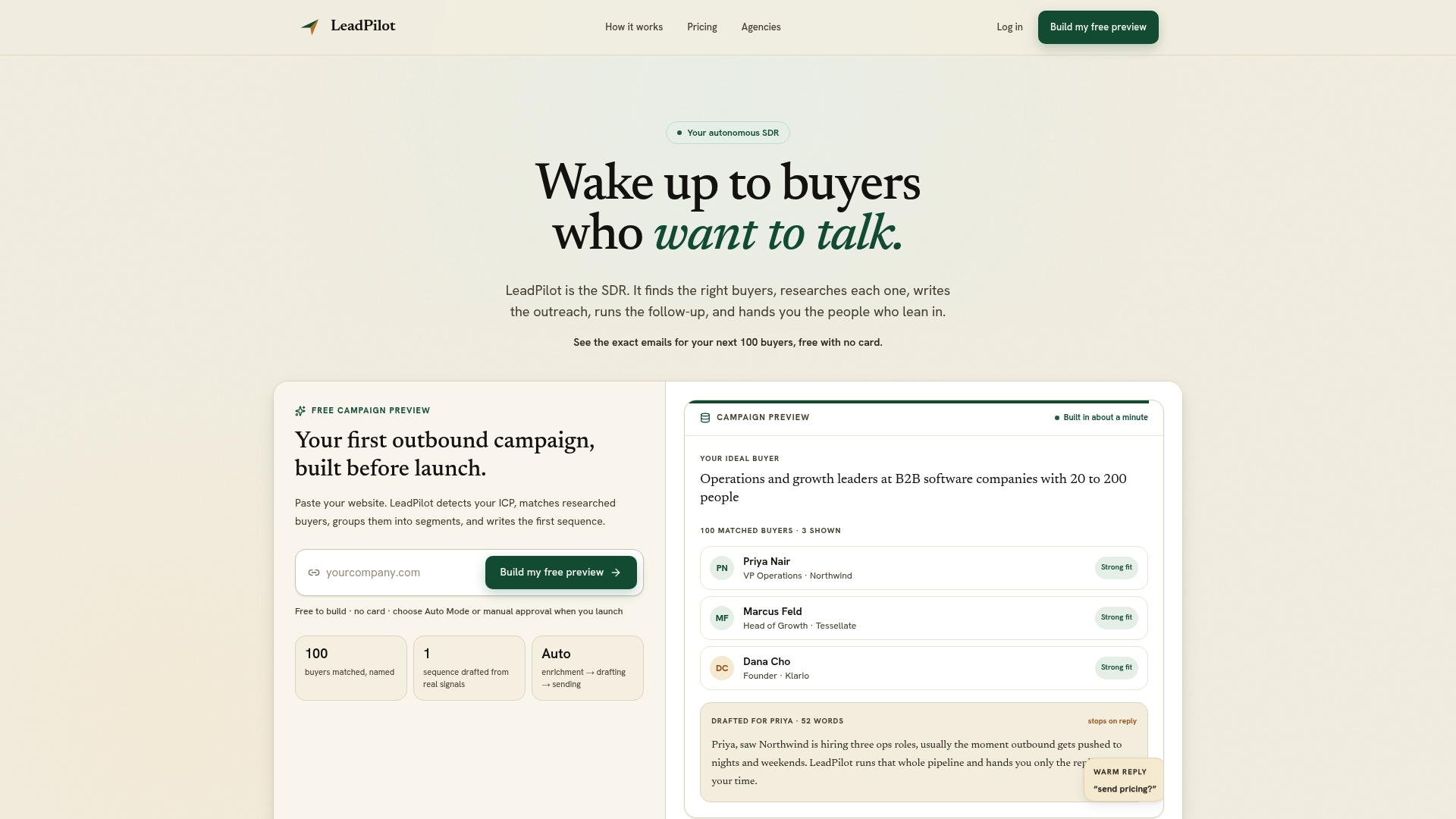
The platform schedules sends in each prospect’s local time automatically, staggers volume across your list to protect domain reputation, and manages follow-ups on a set cadence without you tracking dates manually. It also identifies your ideal customer profile from your own website and researches the specific decision-makers who match it, so the list you’re testing against is already relevant, not just big.
If you want to see how this maps to your own outbound before committing to anything, you can build a free campaign preview and see exactly how LeadPilot would target and time a real campaign for your business.
Sources
- What Is the Best Time To Send an Email? Factors + Tips (2026) - Shopify
- The Best Time to Send an Email (2026 Research) - Omnisend
- Best time to send email (2026 study) | Mailneo
- Best Time to Send Cold Emails | InboxAlly Guide 2025
- When to send cold email: timing, day-of-week, and time zone guidance | Quarvio