Stop Losing Replies: Ops First Warm Reply Handoff for SaaS Founders
Operations first plan for SaaS founders and B2B teams to catch replies, stop sequences, and send rep ready packets in a 30–90 day rollout.

Stop Losing Replies: Ops First Warm Reply Handoff for SaaS Founders
A warm reply handoff succeeds only when three things happen in order: the reply gets detected and every scheduled sequence touch stops immediately, the message gets triaged by account fit and intent, and a named human owns it within a defined SLA. Skip any one of those and you either burn a good lead with a robotic follow-up or bury it in a shared inbox until it goes cold.
TL;DR:
- Almost all reply detection relies on header analysis to filter out auto-responses before content analysis, reducing noise in routing.
- Routing decisions must consider both account fit and intent, with fit checked first to avoid misrouting hot leads or irrelevant replies.
- A reply packet for reps should include the full conversation thread, intent confidence, company context, suggested replies, and CRM integration.
- Tracking reply rate, conversion to meetings, SLA compliance, and time-to-response ensures the handoff process remains effective.
- The biggest mistake is continuing the sequence after a human reply, which damages credibility and wastes the lead.
Table of Contents
- What Every Warm Reply Handoff Needs to Work
- How Do You Detect a Real Reply Versus an Auto-Response?
- Who Should Get the Reply, and How Fast?
- What Belongs in the Rep-Ready Handoff Packet
- Which Metrics Actually Tell You the Handoff Is Working
- Rolling Out Warm Reply Handoff in 30, 60, and 90 Days
- The Mistake That Wrecks Otherwise Good Handoffs
- How LeadPilot Handles the Handoff for You
- Sources
What Every Warm Reply Handoff Needs to Work
Most teams don’t have a strategy problem with reply handoff; they have a plumbing problem. The classification logic and the SLA targets get plenty of attention, but the boring infrastructure underneath, the part that actually catches every reply and routes it, gets built halfway and then ignored.
Here’s the minimum operational stack that has to exist before anything else matters:
- Unified ingestion: every sending domain and inbox feeds one intake point, not five separate mailboxes nobody checks daily.
- Reply filtering: autoresponders, bounce notices, and out-of-office messages get identified and routed away from human review automatically.
- Sentiment lanes: replies sort into a small number of operational buckets, hot, warm, informational, not now, referral, and opt-out, each tied to its own SLA tier.
- Sequence stop and global suppression: the moment a real reply lands, every scheduled touch across every channel for that contact halts, permanently.
- Notification and ownership routing: a Slack channel, mobile push, or CRM task fires to a specific person, not a queue everyone assumes someone else is watching.
That last point is where most lean teams quietly fail. A centralized approach to inbox management prevents replies from getting buried across five domains that nobody’s actively monitoring.
Pro Tip: Test your suppression logic by replying to your own cold email from a personal account. If a follow-up touch still lands in your inbox two days later, your stop-everywhere plumbing is broken, and you won’t find out until a real prospect gets burned.
How Do You Detect a Real Reply Versus an Auto-Response?
Header analysis catches most of the easy cases. Auto-replies typically carry an Auto-Submitted header, a X-Autoreply flag, or subject lines with predictable patterns like “Out of Office” or “Delivery Status Notification.” Filtering on these signals alone eliminates a large share of the noise before any content analysis runs.
The harder problem is distinguishing a genuinely interested reply from a polite decline, a referral, or an objection dressed up as interest. A hybrid approach works better than either extreme:
- Keyword and pattern rules catch obvious signals (“not interested,” “please remove me,” “let’s talk”).
- A lightweight classifier scores intent and sentiment on the remaining ambiguous text.
- An account-fit check cross-references the sender against your ICP data before anything gets prioritized.
Structured outputs, intent, fit, urgency, and a confidence score, let deterministic workflow rules handle the routing, with human review reserved for exceptions below a confidence threshold. That review gate matters more than people assume. A classifier that’s 85% confident is still wrong one time in six or seven, and if that miss routes a hot lead into the “not now” lane, nobody ever finds it.
The other lesson worth stealing: don’t build ten reply categories. If “not interested,” “unsubscribe,” and “wrong contact” all trigger the same suppression action, collapse them into one lane. A lean classification schema is easier to audit and far less likely to misfire.
Who Should Get the Reply, and How Fast?
Intent alone doesn’t tell you who should answer. Fit does, and it has to be checked before the reply reaches a human at all. A CEO at a 400-person company replying “tell me more” is a different routing decision than a random newsletter subscriber saying the same thing, even though the classifier scores them identically on sentiment.
Once fit is confirmed, assignment usually runs on a short list of dimensions, applied in this order:
- Territory or account ownership — if the contact already belongs to a rep or an existing deal, it goes straight to them, no exceptions.
- Segment and deal value — enterprise-tier accounts route to senior reps; smaller accounts route to whoever’s next in rotation.
- Language and geography — a reply in Spanish or from a European time zone needs a rep who can respond appropriately, fast.
- Urgency signal — a reply requesting a call this week jumps ahead of a generic “interesting, tell me more.”
- Escalation fallback — anything the classifier flags below a confidence threshold, or anything unassigned after 10 minutes, escalates to a manager or a shared review queue.
Notification wiring should match urgency to channel. Hot, meeting-ready replies deserve a direct mobile push or a dedicated Slack ping, not a CRM task that sits unread until tomorrow’s stand-up. Intent-scored routing at this layer is what actually prevents replies from getting dropped as teams scale past a handful of reps.
What Belongs in the Rep-Ready Handoff Packet
A rep who opens a routed reply cold, with no context, wastes the first two exchanges just figuring out who they’re talking to. That delay alone can cost the meeting. Responding within the first hour converts to a booked meeting at more than double the rate of a reply answered a day later, and a rep scrambling for context burns exactly the minutes that speed advantage depends on.
The packet needs to include:
- The full thread excerpt plus the original outbound message that triggered the reply.
- The detected intent label and its confidence score, so the rep knows how much to trust the routing.
- A one-paragraph company summary with any recent trigger events (funding, hiring, product launches).
- A suggested continuation angle, ideally with two ready-to-send one-line replies and open calendar slots attached.
- Automatic CRM write-back, a task carrying the SLA deadline, and any suppression flags already applied.
This combination, thread context plus enrichment plus a suggested angle, is what separates a rep who replies in four minutes sounding informed from one who replies in four minutes sounding lost.
Which Metrics Actually Tell You the Handoff Is Working
Track four numbers, weekly, and nothing more elaborate until those are solid:
- Reply rate on outbound sequences, as your baseline volume signal.
- Reply→meeting conversion, where disciplined teams land at 20% or better, with top performers hitting 25 to 30%.
- SLA adherence, the percentage of replies answered inside their tier window.
- Time-to-first-human-response, tracked as a distribution, not just an average, since one 3-day outlier can hide behind a decent mean.
Log every handled reply in the CRM with its reply type, even the ones that led nowhere. That history is what lets you spot a classifier drifting or an SLA tier that’s consistently missed. When you change a threshold or a response window, treat it as a small experiment: adjust one variable, watch conversion and SLA adherence for a week, and roll back if the numbers slip. A simple dashboard that flags any reply older than its SLA deadline, colored red, catches aging leads before they’ve gone cold enough to lose.
Rolling Out Warm Reply Handoff in 30, 60, and 90 Days
You don’t need a mature RevOps stack to start. You need discipline and a sequence.
- Days 1 to 30: centralize and label. Merge every sending inbox into one intake point. Define your sentiment lanes and SLA tiers. Manually tag 100 to 200 sample replies by hand, this becomes your classifier’s training data and your baseline for what “good” looks like.
- Days 31 to 60: wire the routing. Build assignment rules by territory, segment, and urgency. Draft the rep-ready packet template so it auto-populates thread context and enrichment. Connect CRM sync and Slack or mobile notifications so nothing depends on someone remembering to check a folder.
- Days 61 to 90: tune and escalate. Review classifier misses weekly and adjust confidence thresholds. Measure reply→meeting lift against your day-30 baseline. Add an escalation path for enterprise accounts that need a senior rep regardless of what the routing rules say.
A shared inbox, a CRM field for reply type, and Slack alerts can replicate most of what a bigger platform does, provided the team actually enforces the SLA instead of treating it as aspirational.
Pro Tip: Give reps a one-line script for each lane before day 30, not after. A rep improvising a reply to a “referral” lead sounds different from one following a tested template, and the gap shows up in your conversion numbers within the first two weeks.
Build reps’ training checklist around the lanes, not the tool: how to answer a hot lead in under 15 minutes, how to acknowledge a referral, how to close out a “not now” without burning the relationship for next quarter.
The Mistake That Wrecks Otherwise Good Handoffs
The single biggest failure isn’t bad classification or a missed SLA. It’s letting the sequence keep running after a human already replied. Nothing damages credibility faster than a prospect who wrote “interested, let’s talk” getting a scheduled follow-up email three days later asking if they’re “still interested.” That one mistake tells the prospect, correctly, that a machine is running the show.

The second most common error is triaging purely on reply text. A one-line “sure, tell me more” from a perfect-fit account deserves a different response speed than the identical line from someone outside your ICP entirely. Fit has to gate intent, not the other way around.
— Harsh
How LeadPilot Handles the Handoff for You
LeadPilot is a managed, AI-powered platform that supports outbound sales by detecting replies, pausing scheduled touches, classifying intent and account fit, and routing a rep-ready packet to your team.
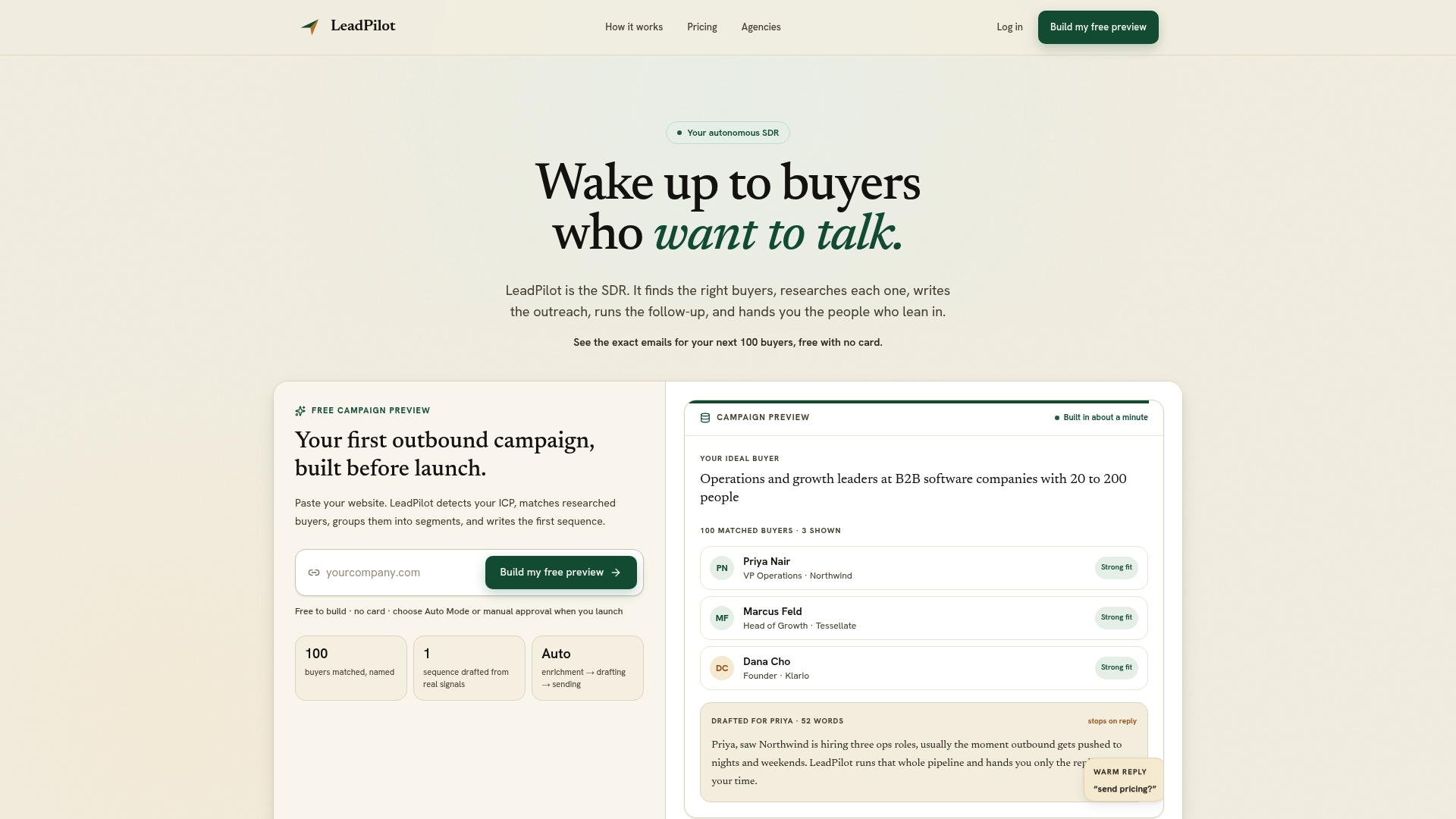
SaaS founders running managed campaigns through Runleadpilot have seen reply rates land in the 8 to 15% range, which only matters if those replies actually reach a human fast enough to convert. That’s the piece most stitched-together stacks get wrong, and it’s the piece this entire playbook is built around solving.
If you want to see how the full workflow looks before committing to anything, build a free campaign preview and watch how targeting, outreach, and reply routing connect end to end.
Sources
- How to Respond to Cold Email Replies (2026 Playbook)
- LinkedIn Reply Routing: AI to Human Sales Handoff Guide | ScaliQ
- AI SDR to AE Handoff: Process & Stack Guide (2026) | Scaling Tech