Should You Use Case Studies in Cold Email? The Short Answer
Discover how using case studies in cold emails can dramatically boost your reply rates. Learn effective strategies for impactful messaging!

Should You Use Case Studies in Cold Email? The Short Answer
Yes. When a case study is short, specific, and tied to something real happening in the prospect’s world, it lifts reply rates instead of tanking them. The mistake most sellers make isn’t including proof. It’s dumping a three-paragraph success story into an email that should take eight seconds to read.
Worth 15 minutes to see if the same setup fits [prospect company]?" That includes Background, Action, Results, and a low-commitment ask in one breath. Signal-personalized campaigns using this kind of specificity reach 15 to 25% reply rates, against roughly 2.1% for generic mass sends.
A few ground rules before the details:
- Use a case study only when it maps to a real signal (funding news, a new hire, a product launch), not just industry or company size.
- Cap it at one metric, one sentence, one ask.
- Tools like LeadPilot can match the right case study to the right trigger automatically, which matters once you’re sending past a few dozen emails a week.
Key Takeaways
Case studies improve cold email performance only when they’re short, tied to a real prospect signal, and paired with a single low-commitment call to action.
| Point | Details |
|---|---|
| Best placement | Touch 2 or 3 in the sequence, after initial relevance is established but before interest fades. |
| Format choice | Inline sentences for early touches, one-page PDFs or short video for higher-value accounts. |
| Compression method | Use BAR (Background, Action, Results) and cap the story at five sentences with one metric. |
| Measurement approach | Track positive reply rate and meetings booked, testing case-study inserts against a control group. |
| Scaling the workflow | Runleadpilot automates signal detection and case-study matching across sequences at volume. |
Table of Contents
- When to Use Case Studies in a Cold Email Sequence
- Which Case Study Format Works Best in Cold Outreach?
- How to Compress a Case Study Using the BAR Framework
- Subject Lines and Send Practices for Case Study Emails
- How to Measure Whether Your Case Study Emails Are Working
- How LeadPilot Puts Case-Study Personalization Into Practice
- Legal and Ethical Rules for Referencing Clients in Case Studies
- Common Mistakes That Sink Case Study Emails
- How to Add a Case Study Without Burying Your CTA
- What Actually Moves the Needle Here
- Try LeadPilot’s Signal-Based Approach to Case Study Outreach
- Sources
When to Use Case Studies in a Cold Email Sequence
Timing decides whether a case study reads as proof or as filler. Drop it into your very first email and you’re asking a stranger to trust a stat before they trust you. Save it too late, and by touch five the prospect has already mentally filed you as “another vendor pitch.”
The sweet spot is touch two or three. Your opener should earn attention with relevance and brevity, no proof required yet. By the second or third touch, the prospect has seen your name once or twice, and a concrete result gives them a reason to engage instead of archive. One well-placed follow-up alone can lift response rates by close to 49%, and a case study is one of the strongest reasons to write that follow-up in the first place.
Certain signals make a case study worth sending regardless of touch number:
- The prospect’s company just announced funding, a merger, or a leadership change.
- They posted a job opening tied to the problem your case study solves.
- They shipped a new product or feature that creates the exact friction your customer story addresses.
- They got press coverage mentioning a challenge you can point to directly.
Audience fit matters as much as timing. Director-level and VP-level buyers respond better to case studies with ROI or efficiency metrics, since they own budget accountability. Individual contributors and managers respond better to case studies about time saved or workload reduced, because that’s the pain they actually feel day to day. Larger deal sizes tolerate a slightly longer case study reference; smaller, faster-cycle deals need the one-sentence version every time.
Pro Tip: If you’re not sure whether touch 2 or touch 3 is right for a given sequence, default to touch 3. It gives your opener room to breathe and still lands the case study before prospect attention fades.
One more rule worth internalizing: don’t send a case study as a cold open to someone who has never heard of you, and don’t wait so long that the story feels disconnected from why you’re emailing at all.
Which Case Study Format Works Best in Cold Outreach?
Four formats dominate cold outreach: the inline sentence, the one-page PDF, the short video, and the landing page link. Each trades off differently against open rates, click friction, and deliverability, and picking the wrong one for the channel is a common way good copy gets ignored.
The inline sentence carries zero risk. No attachment, no extra click, nothing for a spam filter to flag. It’s your default for early touches and for any prospect you haven’t built trust with yet.
The one-page PDF works when the prospect needs a leave-behind they can forward internally. Short, scan-friendly PDFs that front-load the strongest metric outperform long attachments because readers scan a single result faster than they read three pages of narrative. Keep it under 3 pages, under 2MB, and lead with the number.
The short video takes more effort per prospect but pays it back. Personalized video in a cold email increases click-through rates by roughly 50% and reply rates by 2 to 3 times compared to text alone. Reserve this for high-value accounts where a 60 to 90 second Loom recap of a relevant customer win justifies the time.

The landing page link fits mid-to-late sequence touches when the prospect has shown some engagement (an open, a click) and you want to hand them more depth without stuffing it into the email body.
A quick checklist for any format you choose:
- One headline metric, stated as a number, not a range.
- The timeframe it took to hit that number.
- A one-line description of the customer’s profile (industry, size, or role).
- One sentence describing the outcome in the prospect’s language, not yours.
- A quote or visual only when it adds credibility. Skip it if it adds length.
On the file-hygiene side: avoid attaching anything over 2MB, compress images before they go into a PDF, and use a shortened or branded tracking link rather than a raw redirect chain, since long redirect strings can trip spam filters. If you’re sending video, always caption it. Plenty of prospects open email on mute during a commute or a meeting, and a silent video with no text is a wasted send.
How to Compress a Case Study Using the BAR Framework
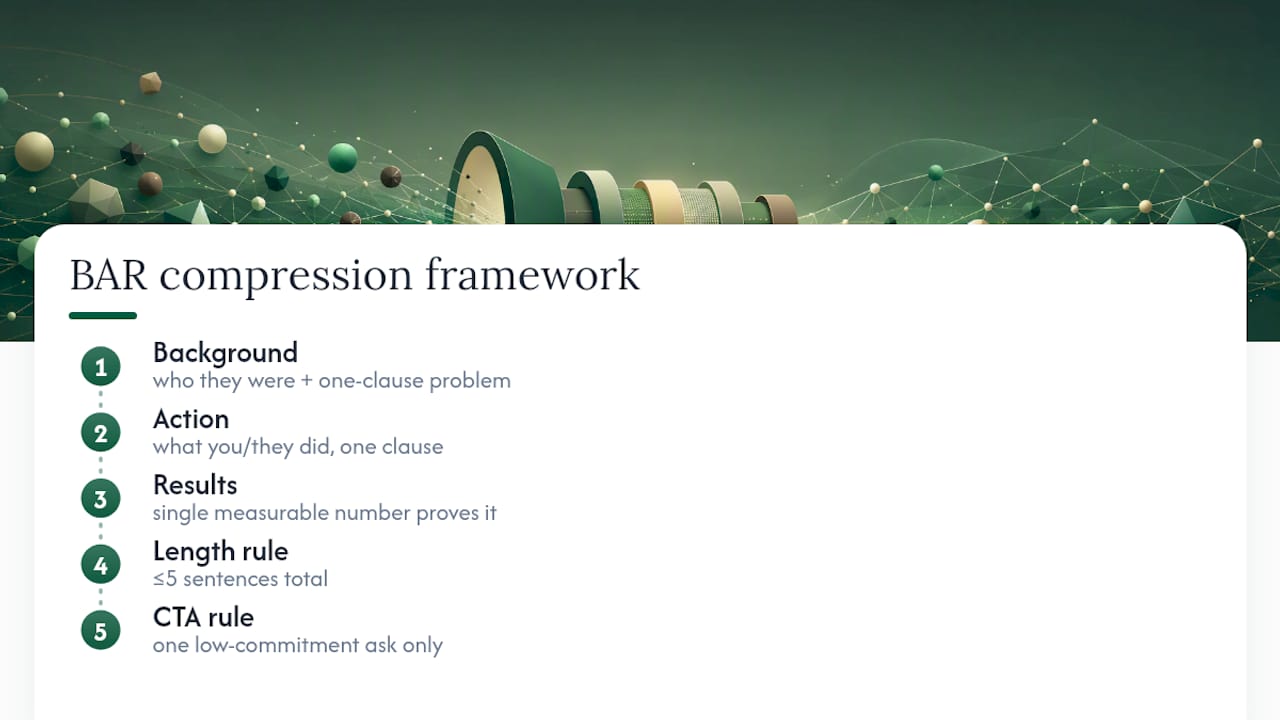
Most case studies fail in cold email because they’re written for a case study page, not for an inbox. The fix is a simple compression framework: Background, Action, Results, or BAR. Three parts, five sentences maximum, one measurable result.
Background states who the customer was and what problem they had, in one clause. Action states what they did or what you did for them, in one clause. Results states the single number that proves it worked. Everything else, the client’s org chart, the six-month timeline, the three stakeholders involved, gets cut. If it doesn’t help the prospect decide whether to reply, it doesn’t belong.
The other non-negotiable: one ask per email. Every additional request you tack onto an email reduces reply rate, so a case study should support a single, low-commitment call to action, not compete with three of them.
Here are five ready-to-use snippets built on that structure.
1. Inline outcome sentence (best for touch 2 or 3, no attachment):
Subject line: Cut 10 hours/week like [similar company]
Preview text: A quick example from a team similar to yours...
2. Follow-up with a one-page PDF attached:
Subject line: One page, one result: [metric]
Preview text: Attached: the exact number [similar company] hit
3. Short video intro script (60 to 90 seconds, high-value accounts):
Subject line: A 90-second video for [prospect company]
Preview text: Recorded this after seeing your [trigger event]
4. Landing-page CTA (mid-sequence, after an open or click):
Subject line: How [similar company] fixed [pain point]
Preview text: Real numbers, no fluff, 2-minute read
5. Trigger-based direct reference (works at any touch when a real signal exists):
Subject line: Re: [trigger event] at [prospect company]
Preview text: Saw the news, thought of a similar case
Personalization tokens matter more than the template itself. Place the trigger event as close to the first sentence as possible, since that’s what tells the prospect this isn’t a mass send. Signal-based personalization referencing real, recent trigger events consistently outperforms generic firmographic personalization, and it’s the difference between a case study that reads as relevant and one that reads as recycled. Tools like LeadPilot’s personalization approach are built specifically to detect those triggers and slot the matching case study in automatically, which scales this far better than a human manually checking LinkedIn for news before every send.
Subject Lines and Send Practices for Case Study Emails
A case study is only as good as the open it earns. The formulas that consistently work combine a specific value with brevity: name the metric, name a peer company or industry, keep it under 6 words when possible.
Preview text should raise curiosity without giving away the ending. “One number that changed their process” pulls better than restating the subject line, since it gives the reader a reason to open rather than just reread the same claim twice.
Before any of that copy matters, deliverability has to be solid. Fixing authentication and list quality has to happen before testing copy, since unauthenticated mail risks outright rejection regardless of how good the case study is.
- Use a dedicated sending domain, separate from your primary company domain.
- Confirm SPF, DKIM, and DMARC are all correctly configured, not just one or two of the three.
- Warm up new domains gradually over several weeks before full-volume sending.
- Avoid attaching large files directly; link to a hosted PDF or landing page instead.
- Use branded, shortened tracking links rather than long redirect chains.
When the case study is your main reason for reaching out, don’t front-load every touch with one. Space case-study-driven emails at least one full touch apart so each one feels like a distinct reason to engage, not a repeated pitch with new packaging.
How to Measure Whether Your Case Study Emails Are Working
Track three primary metrics: reply rate, positive reply rate (not just any reply, but ones expressing interest), and meetings booked. Open rate and click rate matter as secondary signals, mostly for diagnosing whether a subject line or a PDF link is the weak point.
Run the test properly. Split your list into a control group getting your standard sequence and a variant group getting the same sequence with a case-study insert at touch 2 or 3. Keep everything else identical: same list criteria, same sending domain, same time windows. A single feedback-guided variation moved one real campaign from roughly 9.8% to 18% reply rate, which shows how much one well-targeted change can move the needle, but it also means small sample sizes can mislead you if you stop the test too early.
- Run each variant to at least 100 to 200 sends per segment before drawing conclusions.
- Let the test run 10 to 14 days minimum to account for reply lag.
- Compare positive reply rate, not just raw replies, since “please remove me” counts as a reply but not as success.
- Scale the winning variant gradually, watching for reply-rate decay as volume increases.
| Metric | What it tells you |
|---|---|
| Reply rate | Overall engagement with the message and subject line |
| Positive reply rate | Whether the case study actually created interest, not just a response |
| Meetings booked | The real business outcome the test should optimize toward |
| Open rate | Diagnostic only, points to subject line or deliverability issues |
If reply rates crash across both control and variant, that’s a deliverability problem, not a messaging one. Check authentication and sending reputation first. If the control performs fine but the case-study variant underperforms, the case study itself is likely too long, too generic, or mismatched to the segment you sent it to.
How LeadPilot Puts Case-Study Personalization Into Practice
Running this playbook by hand across hundreds of prospects a week is where most teams stall out. Matching the right case study to the right trigger event, keeping sequences on schedule, and protecting a sending domain’s reputation is a full-time job layered on top of actual selling.
LeadPilot handles that workflow end to end. It learns what a company sells from its own website, identifies the buyers who match, researches the signals that matter (funding, hiring, product launches), and drafts sequences that slot the right proof point at the right touch, all while managing dedicated sending domains so authentication and warmup aren’t left to guesswork.
A few places to go deeper on the mechanics covered here:
- Cold email sequence structure for where case studies fit against your full touch cadence.
- Signal-based personalization for matching trigger events to the right proof point automatically.
- Subject line formulas that pair specifically with case-study-driven emails.
Readers who want to see how their own case studies would slot into a live sequence can build a free campaign preview before committing to anything.
Legal and Ethical Rules for Referencing Clients in Case Studies
Every case study you send to a stranger is a promise you made to a client, and breaking that promise costs more than the deal you’re chasing. Before any client story goes into a cold email, confirm you have explicit permission to use their name, logo, or specific metrics externally, not just internally.
The safest standard is written sign-off, even if it’s a two-line email confirming the client is fine with you referencing the engagement and the numbers involved. Verbal approval from a project call doesn’t hold up if a client later objects, and it puts you in an awkward position with a account you presumably still want to keep happy.
When permission is unclear or limited, anonymize. Reference “a mid-market SaaS company” or “a logistics firm with 200+ employees” instead of a name, and use rounded or ranged metrics instead of exact figures pulled from a contract the client might consider confidential. This still gives the prospect proof without exposing details the client didn’t agree to share.
Watch your contract language too. Many service agreements and NDAs include confidentiality clauses that cover case studies by default, meaning silence from a client isn’t consent, it’s often a contractual restriction. If you’re unsure, checking with whoever manages client relationships before including a story in an outbound sequence takes five minutes and avoids a much longer conversation later.
Common Mistakes That Sink Case Study Emails
The most frequent failure is length. A case study that reads like a one-pager crammed into an email body loses the prospect by sentence three. If your case study section runs longer than the actual pitch, cut it.
The second failure is irrelevance. Sending a manufacturing case study to a SaaS company, or a small-business result to an enterprise buyer, signals you didn’t do basic homework. Relevance beats impressiveness; a modest result from a similar company outperforms a huge result from a mismatched one.
Third: burying the metric. If the prospect has to read two paragraphs to find the number that matters, most won’t get there. Lead with it.
Fourth: stacking multiple case studies in one email. One story, one metric, one ask. Multiple examples read as a sales deck, not a personal note.
Fifth: using a case study as the entire email with no connection to why you’re reaching out to this specific prospect right now. A trigger event or a shared characteristic should bridge the story to the person reading it, otherwise it lands as generic proof that could’ve gone to anyone.
Sixth, and probably the most underrated: forgetting the CTA entirely. Teams get so focused on making the proof compelling that the actual ask disappears. Every case-study email needs one clear, low-commitment next step.
How to Add a Case Study Without Burying Your CTA
The case study supports the ask; it never replaces it. A useful mental model: your CTA is the headline, and the case study is the supporting subtitle. If someone skims only the first and last sentence of your email, they should still understand what you’re asking for.
Keep the case study to one sentence or one short paragraph, positioned in the middle of the email, sandwiched between your opening line (relevance) and your closing line (the ask). This structure keeps the proof from becoming the main event.
Use formatting to your advantage. A single line break before the case study sentence visually separates it from the ask, which makes both easier to scan on mobile, where most cold email actually gets read. Avoid bolding, bullet points, or excessive punctuation around the case study; it should read like a natural aside, not a highlighted advertisement.
If you’re including an attachment or link, mention it in the same sentence as the result, not as a separate afterthought. “Attached is a one-page breakdown of how they did it” keeps the reader’s attention moving toward the ask, rather than pausing to wonder what the attachment even is.
Finally, resist the urge to explain why the case study is relevant in more than one sentence. If it takes three sentences to justify the connection, the case study probably isn’t the right fit for this prospect, and no amount of explaining will fix that.
What Actually Moves the Needle Here
Most advice on this topic treats case studies as a credibility badge, something you attach because it feels thorough. That’s backward. A case study earns its place in a sequence only when it answers a question the prospect is already half asking themselves, which is why the trigger event matters more than the case study’s polish.
The conventional wisdom oversells format and undersells timing. Teams spend hours designing a beautiful PDF and five minutes deciding when to send it. Flip that ratio. A plain-text sentence sent at the right touch, matched to a real signal, beats a polished PDF sent generically at touch one, every time.
If you take one thing from this and test it this week, test placement before you test format. Move your existing case study reference from touch one to touch three, keep the copy identical, and watch what happens to positive reply rate. That single change tends to reveal more than any A/B test on wording ever will.
— Harsh
Try LeadPilot’s Signal-Based Approach to Case Study Outreach
Runleadpilot is the alternative to manually cross-referencing news alerts against your prospect list every morning. It reads a company’s own trigger events, funding news, hiring pushes, product launches, and automatically matches the right case study to the right prospect at the right touch, then handles the sending domain setup and authentication that makes any of this land in an inbox instead of a spam folder.
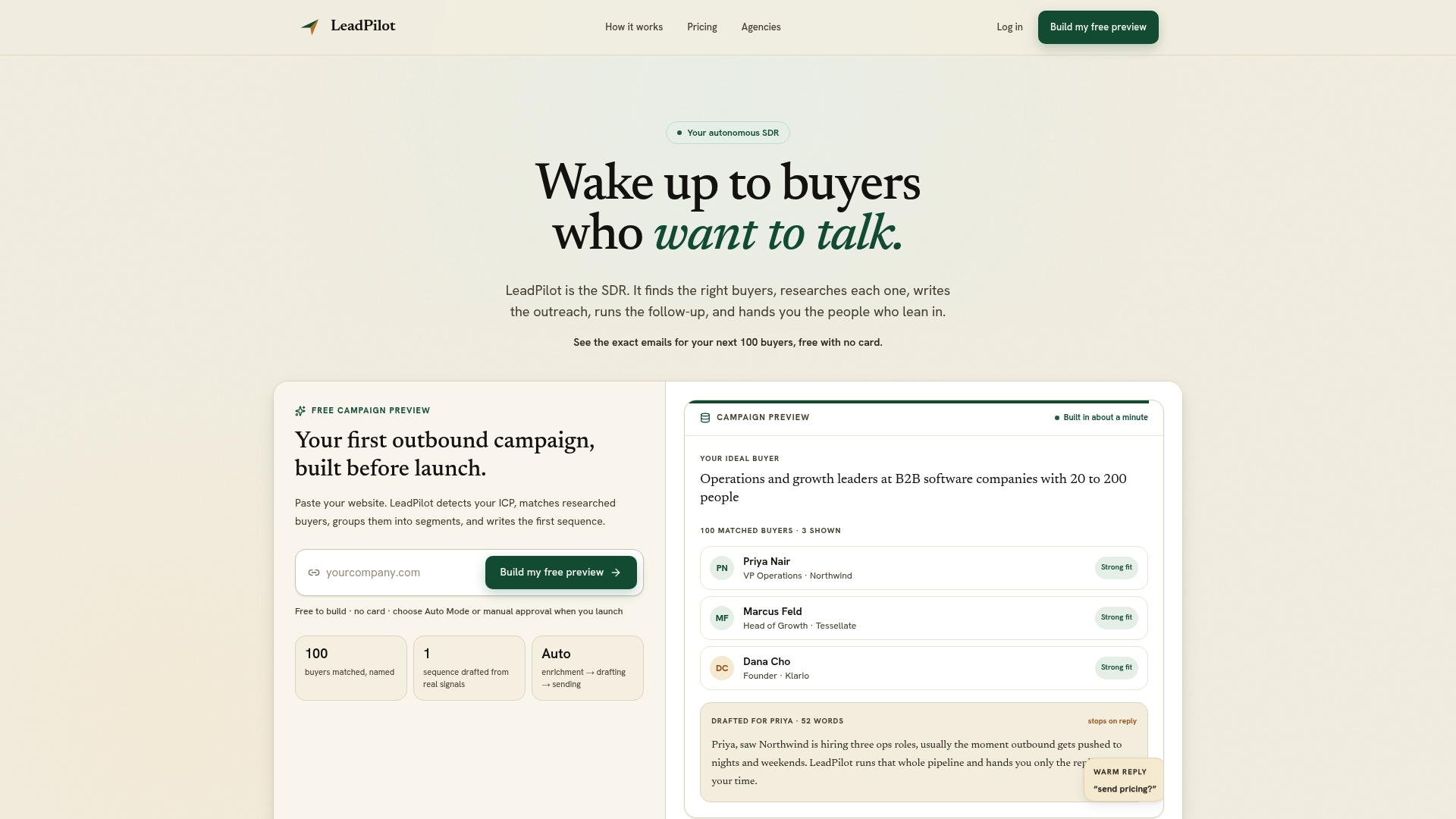
That matters because everything in this article works only if it reaches someone. LeadPilot manages dedicated sending domains, runs the warmup, and automates the follow-up cadence discussed above, so a founder or a two-person sales team can run signal-personalized sequences without hiring a dedicated SDR to babysit deliverability. For agencies, the same engine runs across multiple client workspaces with consolidated billing.
Build a free campaign preview to see how your own case studies would slot into a live sequence, or explore the B2B lead generation platform directly to start sending this week.
Sources
- Cold Email Best Practices That Get Replies | Sendspark
- Cold Email in 2026: A Full Operator-Grade Playbook
- Cold Email Case Study: 97% More Appointments After 1 A/B Test (w/ Templates)
- How to Use Case Study PDFs in Cold Outreach to CMOs