60–90 Day AI Managed Agency Cold Email Management Playbook
An implementation-first playbook for agencies and founders: how AI managed cold email platforms protect deliverability, onboard clients, and launch in...

60–90 Day AI Managed Agency Cold Email Management Playbook
An agency cold email management platform is a managed, AI-powered SaaS tool that finds your ideal buyers, researches decision-makers, writes personalized outreach, and runs the sending infrastructure behind it. It fits founders, lean B2B sales teams, and outbound agencies that want more qualified replies without hiring or babysitting an SDR. The tradeoff is real: you give up direct control over daily execution in exchange for managed deliverability and less manual grind.
TL;DR:
- Using multiple clean sending domains with proper authentication and a gradual warmup schedule is essential to maintain high deliverability rates.
- Automated safeguards like bounce rate monitoring and reply routing help protect inbox reputation and streamline team collaboration.
- Targeting signals such as funding, hiring activity, and product launches outperform static lists, emphasizing quality over volume.
- Effective onboarding involves detailed infrastructure setup, training on warmup and deliverability, and phased campaign scaling over 60 to 90 days.
- Focused, smaller outreach lists with personalized messaging and strict control over email volume deliver better results than mass blasting untargeted contacts.
Runleadpilotrunleadpilot.comManage More Outbound, With Less Manual WorkLeadPilot helps agencies find matching decision-makers, personalize outreach, manage sending infrastructure, and hand warm replies to your team.Explore LeadPilot
Table of Contents
- What Makes an Agency Cold Email Management Platform “AI-Managed”?
- What Technical Features Should You Check Before Signing Up?
- How Do You Evaluate a Managed AI Cold Email Platform?
- How Do You Launch a Cold Email Program Safely in 60 to 90 Days?
- Who Should Have Access, and How Do Teams Collaborate Inside the Platform?
- How Should Agency Teams Onboard onto a New Platform?
- What Results Should You Actually Expect from a Managed Platform?
- Why “Send Less, Target Harder” Is the Real 2026 Playbook
- How LeadPilot Handles Every Item on This Checklist
- Where to Read Deeper on Infrastructure and Agency Playbooks
- Sources
What Makes an Agency Cold Email Management Platform “AI-Managed”?
Most tools in this category do six things: pull an ideal customer profile from your website, research matching decision-makers, write personalized emails from real signals, manage dedicated sending domains and inboxes, run follow-up sequences, and route warm replies to a human. That last part matters. A platform that stops at “send emails” is a sequencer. One that hands you a qualified reply ready for a sales conversation is managing the whole workflow.
The “AI” label gets thrown around loosely, so here’s what it actually does in a competent platform:
- Extracts personalization signals (funding rounds, hiring surges, tech stack changes) instead of mail-merging a first name into a template
- Scores and prioritizes leads based on fit and buying signals, not just firmographic filters
- Adjusts sequence timing and messaging based on what’s generating replies versus what’s getting ignored
None of this guarantees a reply. What it does is remove the manual research and copywriting bottleneck that keeps most in-house teams stuck sending 50 generic emails a week instead of 500 targeted ones. This article covers that managed SaaS category specifically, not traditional outsourced agencies that run outreach on retainer without giving you platform access.
What Technical Features Should You Check Before Signing Up?
Deliverability is where most cold email programs quietly die. A platform can have brilliant AI personalization and still land every email in spam if the infrastructure underneath it is weak. Here’s what actually determines whether your messages get read.
- Inbox provisioning and send caps. Expect 2 to 3 inboxes per domain, each capped around 20 to 30 sends per day during warmup. Uncapped inboxes are a red flag, not a feature.
- Data and targeting quality. Look for an ICP builder tied to enrichment sources and intent triggers, not a static purchased list. List verification matters more than volume.
- Automated safeguards. The platform should auto-pause sending when bounce or spam complaint rates spike, and support OAuth so you’re not handing over raw email passwords.
- Monitoring and reporting. Ask whether the platform runs monthly seed tests and tracks inbox placement through Google Postmaster Tools, and whether reporting goes beyond opens and clicks into actual meeting conversion.
Pro Tip: *Ask any vendor for their bounce rate target before you sign anything.
How Do You Evaluate a Managed AI Cold Email Platform?
Comparing platforms gets easier once you stop looking at feature lists and start asking about control, transparency, and pricing logic. The best agency cold email management setups give you visibility into decisions, not just outputs.
Run every vendor through this filter:
- Deliverability controls: Do they own and manage sending domains, or do you have to source and configure your own?
- Data quality: Where does contact data come from, and how is it verified before a message goes out?
- Personalization depth: Is personalization based on real signals like funding or hiring activity, or a merge field bolted onto a static template?
- Automation fit: Does the platform handle follow-ups and reply routing automatically, or does someone need to manually trigger each step?
- Agency workspaces: If you’re running outreach for multiple clients, does the platform support separate workspaces with consolidated billing?
- Security: Does it use OAuth instead of storing raw credentials, and does it keep audit logs of sends and changes?
- Pricing logic: Is the cost tied to something concrete, like researched buyers or send volume, or is it a flat fee that scales unpredictably?
Ask vendors directly: Who controls the sending domains? What does the warmup process actually look like day by day? How does the AI personalize messages, and can you see an example? What happens to a reply, and how fast does it reach a human?
Red flags worth walking away from: a platform that won’t explain domain ownership, no mention of warmup at all, vague answers about where replies go, or a dashboard that only shows opens and clicks. Open-tracking metrics are notoriously unreliable and tell you almost nothing about actual interest.
How Do You Launch a Cold Email Program Safely in 60 to 90 Days?
Rushing a cold email launch is the single fastest way to burn a domain’s reputation before the campaign even gets going. A phased rollout protects deliverability while still giving you real data within the first month.
- Phase 0, before day one: Register dedicated sending domains separate from your main company domain. Configure SPF, DKIM, and DMARC on each one. Provision 2 to 3 inboxes per domain and enable OAuth. Run a baseline seed test so you know what “normal” inbox placement looks like before you send anything real.
- Phase 1, days 1 to 21: Begin warmup on every inbox, ramping gradually rather than jumping straight to volume. A common pattern is starting at 10 to 20 sends per day per inbox and adding roughly 2 sends daily, never mixing in real cold sends during this window. Once warmup is stable, verify your list and pilot a small live campaign at 20 to 50 sends a day. Watch spam complaint rate and seed test placement daily, and set automatic pause thresholds so a bad signal stops sending before it damages the domain.
- Phase 2, weeks 3 to 8: Scale gradually by rotating across your warmed inboxes rather than dumping volume onto one or two. Kill underperforming lists fast. Agencies working from large send volumes recommend a threshold of several hundred sends per list before deciding to cut or refresh with new messaging. Run a weekly optimization loop: check deliverability through seed tests and Postmaster data, review reply rate by segment and sequence, rewrite the weakest-performing touch, then audit reply quality to see whether replies are actually converting to meetings.
- Ongoing governance: Once the program is running, shift to monthly rhythm. Track cost per meeting, not just cost per reply. Review which trigger signals (funding news, hiring activity, tech stack changes) are actually correlating with replies, and cut the ones that aren’t earning their keep.
Untargeted cold outbound has been sliding toward reply rates of just 1 to 3% industry-wide, which is exactly why this phased, signal-first approach matters more now than it did five years ago. Sending less to better-matched prospects consistently beats sending more to everyone.
Who Should Have Access, and How Do Teams Collaborate Inside the Platform?
Cold email management stops being a one-person job the moment you’re running campaigns for more than one client or product line. Role structure determines whether that scales cleanly or turns into a mess of shared logins and untracked changes.
A platform built for agency use should support at least three tiers: an admin role that controls billing, domain provisioning, and workspace settings; a manager role that can build and launch campaigns within an assigned workspace; and a reviewer role limited to reading reports and approving reply handoffs without touching sending infrastructure. Separate workspaces per client matter just as much. An agency running outreach for five clients needs each client’s domains, data, and reporting walled off from the others, with billing that consolidates at the agency level instead of forcing five separate invoices.
Audit logs deserve more attention than they usually get. When a campaign underperforms or a domain gets flagged, you need to know who changed the sequence, who added a new list, and when a send cap got adjusted. Without that trail, troubleshooting turns into guesswork.
Reply handoff is the collaboration feature that actually affects revenue. The best setups route a warm reply to the right person within minutes, tagged with enough context (which sequence, which signal triggered the send) that the human picking it up doesn’t have to reconstruct the conversation from scratch.
How Should Agency Teams Onboard onto a New Platform?
Onboarding quality is often the difference between a platform that pays for itself in a month and one that sits half configured for a quarter. Agencies juggling multiple client accounts feel this gap the hardest, because every wasted setup day multiplies across clients.
A serious onboarding process starts before the first email goes out. That means connecting each client’s website so the platform can extract an ideal customer profile automatically, confirming domain and inbox provisioning is complete, and validating that authentication records are correctly propagated across DNS. Skipping this step is how teams end up debugging deliverability problems three weeks into a live campaign instead of before it starts.
Training should cover more than button clicking. Agency teams need to understand why warmup schedules exist, what a healthy bounce rate looks like, and how to read a seed test result, because those are the signals that tell you whether to scale a campaign or pull it back. Teams that only learn the interface and skip the underlying logic tend to panic at the first dip in reply rate instead of diagnosing it correctly.
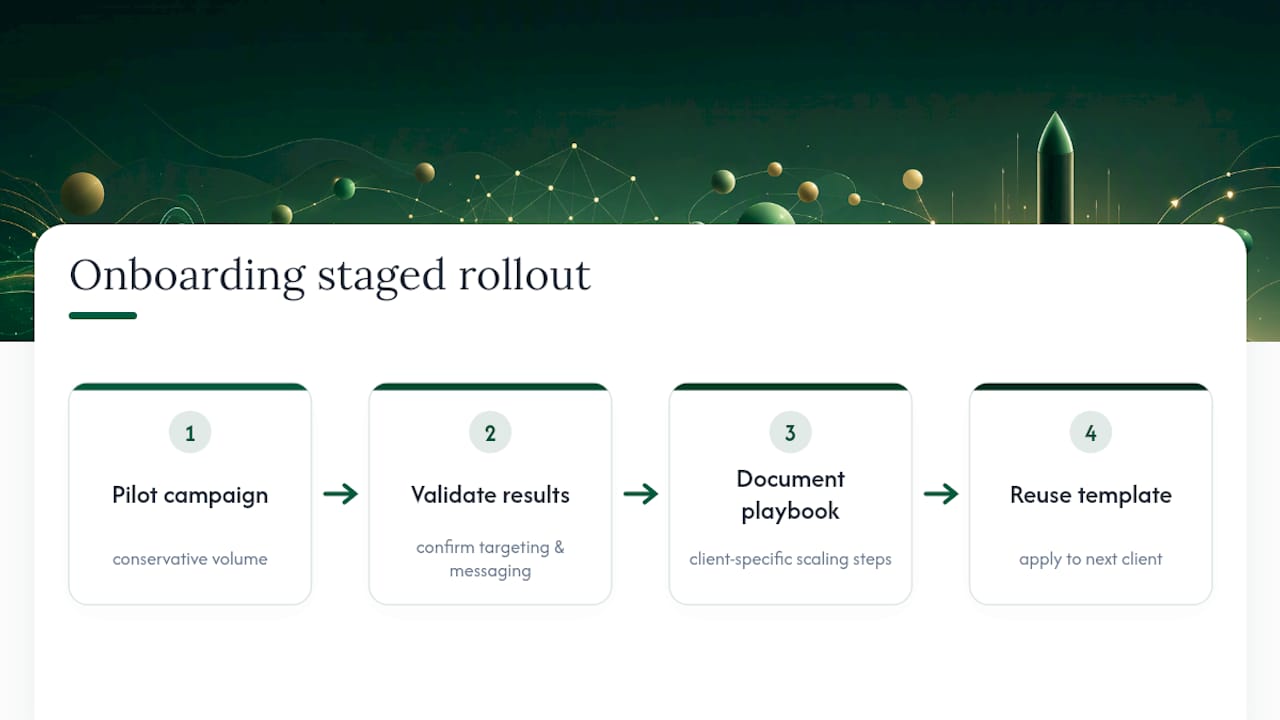
The fastest-moving agencies use a staged rollout for onboarding new clients: one pilot campaign at conservative volume to validate targeting and messaging, then a documented internal playbook for scaling that specific client once results confirm the approach works. That playbook becomes the template for the next client, which is where a managed platform starts saving real hours instead of just automating busywork.
What Results Should You Actually Expect from a Managed Platform?
Concrete public benchmarks in this space are hard to come by because most agencies treat their numbers as competitive advantage, not marketing material. What’s consistent across the agency playbooks that do publish figures is the priority order: infrastructure and targeting quality outrank clever copywriting almost every time.
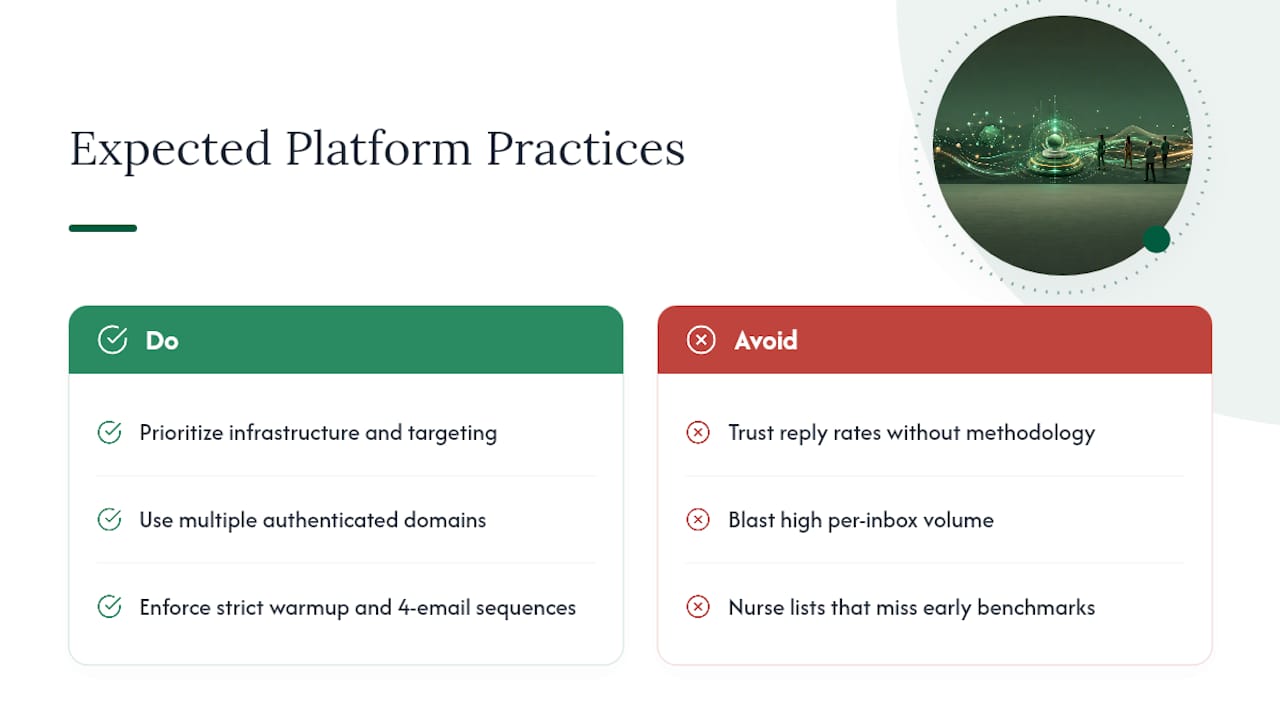
One documented framework built around 200-plus booked meetings a month leans on the same fundamentals covered above: multiple authenticated domains, strict warmup discipline, and a four-email sequence framework rather than long, meandering drip campaigns. Short sequences aren’t a stylistic choice. They reflect the reality that a prospect who hasn’t engaged after three or four well-targeted touches usually isn’t going to convert on touch seven either.
Agencies drawing lessons from two million sends report the same pattern from a different angle: verified data and low per-inbox volume outperform aggressive blasting, and lists that miss early benchmarks get killed fast rather than nursed along. That kill discipline protects domain reputation for every other campaign running on the same infrastructure.
The honest takeaway for anyone comparing platforms on promised reply rates: treat any number without a stated methodology as marketing, not evidence. Ask instead about deliverability practices and targeting logic. Those are the levers that actually move outcomes, and they’re the ones a legitimate platform will happily walk you through.
Why “Send Less, Target Harder” Is the Real 2026 Playbook
The instinct to fix a stalled cold email program by sending more is almost always wrong, and it’s getting more wrong every year. When reply rates for generic, untargeted outreach are sliding toward the low single digits industrywide, adding volume just accelerates the burn on your domain reputation while producing more noise, not more meetings.
What actually works is layering real signals, funding events, hiring activity, product launches, onto a smaller, better-matched list, and letting AI do the research grunt work that used to eat an SDR’s entire week. A free campaign preview is genuinely useful here because it lets you see the targeting logic and sample messaging before you commit budget, which removes most of the guesswork agencies usually eat on a client’s first month.
Set your expectations honestly: cold email in 2026 is a numbers game with a smaller denominator and a higher bar for relevance. Platforms that manage deliverability and personalization well will outperform anyone still mass-blasting a purchased list, but nothing here replaces the fundamentals of picking the right prospects in the first place.
— Harsh
How LeadPilot Handles Every Item on This Checklist
A cold email management platform is built around one idea: replace the manual grind of SDR research and infrastructure babysitting with a system that does it continuously. It reads your website to build an ideal customer profile, sources and researches matching decision-makers, and writes personalized outreach from real business signals rather than a merge field. Dedicated sending domains and inboxes, warmup, and follow-up sequencing are managed on your behalf, and warm replies get routed to your team the moment a prospect engages. Agencies running multiple clients get separate workspaces with consolidated billing instead of juggling five disconnected tools.
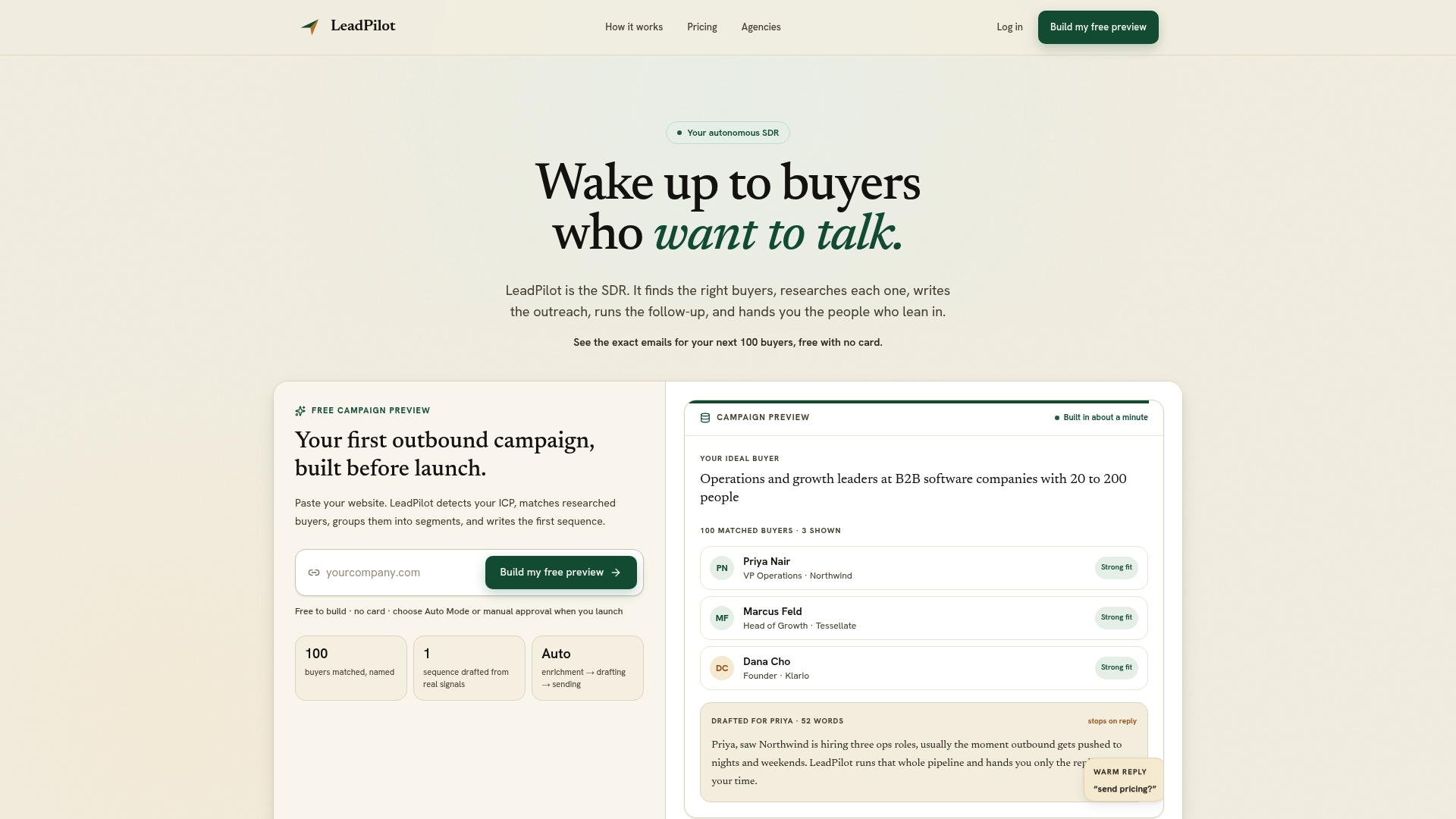
You don’t have to take any of that on faith before spending a dollar. Runleadpilot lets you build a free campaign preview that shows your actual targeting and sample messaging before you commit to managed outreach, which is the fastest way to validate fit without the onboarding risk of a multi-month contract. If the preview looks like the kind of outreach you’d want your name on, that’s your sign to move forward. Start with the preview, then decide.
Where to Read Deeper on Infrastructure and Agency Playbooks
For readers who want to go further into the mechanics covered here, a few resources are worth bookmarking. EmailSend.ai’s agency framework breaks down domain strategy and the four-email sequence model in more detail. Outreach Almanac’s 25-lesson playbook covers list hygiene and kill thresholds from real send volume. For sending limit specifics as you scale, Runleadpilot’s guide to cold email sending limits walks through ramping without tripping spam filters.
Sources
- Why Is Cold Outbound Broken in 2026? — Leadpipe
- 25 Cold Email Lessons From Sending 2 Million Emails (Agency Playbook) | Outreach Almanac