A/B Testing Cold Emails: The Reply-Rate Playbook
Master A/B testing for cold emails to boost reply rates. Learn to optimize subject lines and messaging with proven strategies.

A/B Testing Cold Emails: The Reply-Rate Playbook
Optimize for reply rate, not opens. That’s the entire premise behind effective a/b testing cold emails, and if you take one thing from this article, take that. Opens are contaminated by Apple’s Mail Privacy Protection and other prefetch systems that trigger false positives, so treat open rate as a diagnostic signal at best, never a success metric. Start your testing roadmap with subject lines, then move to opening lines, since that’s where reply-driving impact actually lives.
Four rules make the difference between a test that teaches you something and one that just wastes sends:
- Test one variable at a time. Change the subject line or the CTA, never both in the same run.
- Pre-calculate your sample size before you send a single email, based on your baseline reply rate and the lift you’re trying to detect.
- Randomize the split so each variant gets a truly comparable slice of your list, not whichever leads happened to load first in your sequencer.
- Run to completion. No checking results daily and calling it early once you like what you see.
Pro Tip: A test read at 95% confidence (p < 0.05) with too small a sample is not a “close call.” It’s a coin flip wearing a lab coat. Runleadpilot’s internal playbooks default to this threshold before declaring any subject-line or CTA winner.
Key Takeaways
Reply rate, not open rate, is the metric that should decide every cold email A/B test, and valid results require pre-calculated sample sizes with no early peeking.
| Point | Details |
|---|---|
| Optimize for replies | Treat open rate as a diagnostic only; positive reply rate is the KPI that reflects real pipeline impact. |
| Test one variable at a time | Isolate subject line, opening line, CTA, sequence length, or send time individually to know what actually drove the result. |
| Calculate sample size first | Smaller baselines and smaller detectable effects both require dramatically larger sample sizes, sometimes thousands of sends. |
| Never peek early | Wait the full measurement window, at least seven business days after the last send, before reading results. |
| Automate the operational load | Runleadpilot manages targeting, segmentation, sending, and reply classification so testing discipline scales past manual spreadsheet tracking. |
Table of Contents
- What Should You A/B Test First in Cold Email Campaigns?
- How Many Emails Do You Need Per Variant for a Valid Test?
- How Do You Set Up and Run a Cold Email A/B Test?
- What Are the Most Common Cold Email A/B Testing Mistakes?
- What Tools Do You Need to Measure Cold Email Tests Accurately?
- How Does Runleadpilot Apply These Testing Rules in Practice?
- Why Testing Discipline Compounds More Than Any Single Tactic
- Skip the Manual Setup and Let Runleadpilot Run the Test For You
- Where to Learn More About Cold Email Testing
- Sources
What Should You A/B Test First in Cold Email Campaigns?
Not every variable deserves equal attention. Some move the needle within a few hundred sends. Others need thousands before you can trust the result. Here’s the priority order that gives you the most signal for the least list burn.
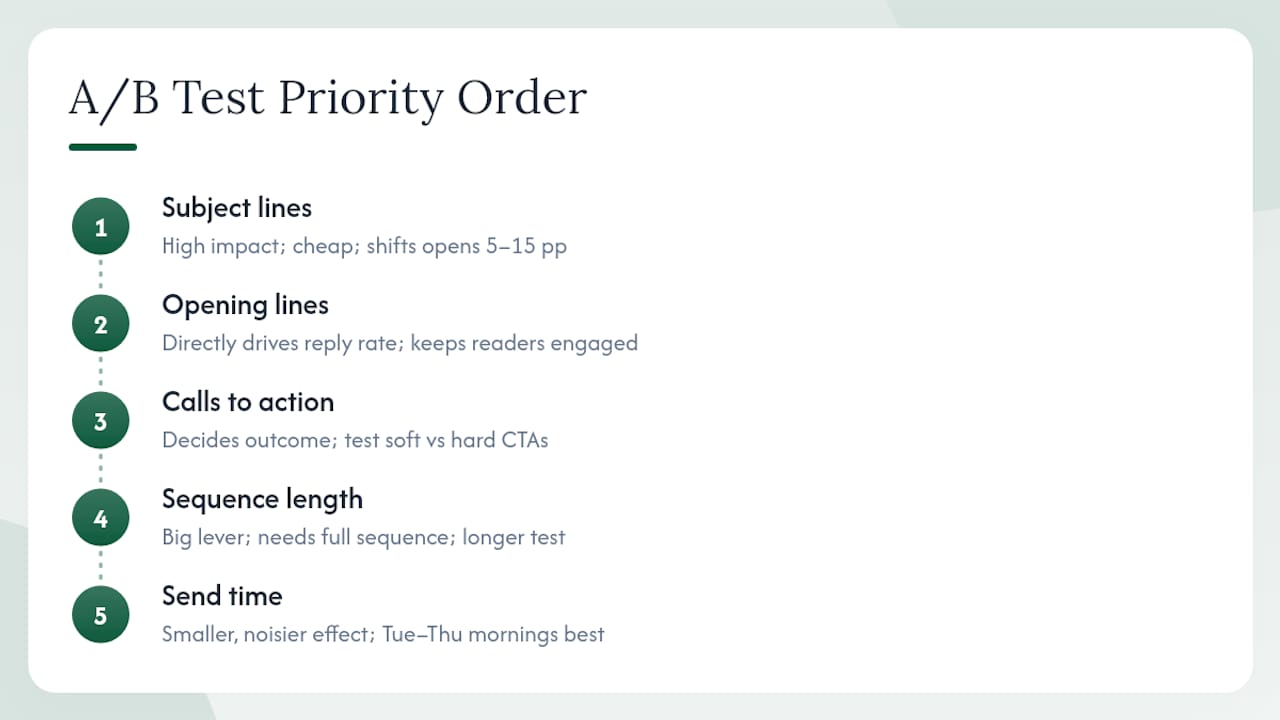
Subject lines come first because they’re cheap to test and they influence the metric most sensitive to small wording changes: whether the email gets opened at all. A subject line swap can shift open rates by 5 to 15 percentage points in either direction, and since subject lines are quick to write in bulk, you can run several rounds without exhausting your list. Try a direct, benefit-forward line against a curiosity-driven one, or a personalized line referencing a company event against a generic one. The catch: winning on opens doesn’t guarantee winning on replies, so don’t declare victory until you check the downstream number too.
Opening lines matter more than most sales teams assume. This is the line that decides whether a prospect keeps reading or archives the email in the first three seconds. Because opening lines drive reply behavior directly, reply rate is the metric that actually reflects outreach quality, and open rate simply can’t be trusted the same way given how many mail clients now prefetch messages regardless of whether a human ever looks at them. Test a pain-point observation against a compliment-based icebreaker, or a question against a statement. Runleadpilot’s personalization playbook breaks down which signal types (funding news, hiring surges, tech-stack changes) tend to produce the strongest opening-line hooks.
Calls to action decide what happens after someone reads the whole email. A soft CTA (“Worth a quick chat?”) often outperforms a hard ask (“Book 30 minutes here”) in early-stage cold outreach, but the reverse can be true once a prospect already knows your brand. Test one CTA style per campaign, and measure it against positive replies, not just any reply. A “not interested, remove me” is technically a reply. It’s not a win.
Sequence length is a bigger lever than most teams give it credit for. A three-email sequence and a six-email sequence targeting the same list can produce meaningfully different cumulative reply rates, largely because a chunk of your prospects simply need a fourth or fifth nudge before they respond. Runleadpilot’s sequence guide walks through spacing and follow-up angle variation in more detail. Testing this variable takes longer than a subject-line test, since you need the full sequence to play out before you can compare completion-level reply rates.
Send time produces smaller, noisier effects than the variables above, but it’s still worth testing once your copy is dialed in. Tuesday through Thursday mornings tend to outperform Monday and Friday sends in most B2B contexts, though this varies by industry and buyer role. Runleadpilot’s send-time analysis covers how role seniority shifts the ideal window. Treat send time as a fine-tuning variable, not a first-priority test.
Sender name and formatting round out the list. Testing “Jane at Acme” against “Jane Smith” or a plain-text email against a lightly formatted one rarely produces dramatic swings, but it’s low-cost to run once you’ve locked in the bigger variables. Save it for when you’ve already won on subject line, opening line, and CTA and are hunting for marginal gains.
How Many Emails Do You Need Per Variant for a Valid Test?
This is where most cold-email A/B tests fall apart before they even start. Teams run 50 emails per variant, see one version “winning” by three replies, and roll it out to the whole list. That’s not a test. That’s noise dressed up as insight.

Four numbers determine your required sample size: baseline reply rate (what you’re currently getting), minimum detectable effect or MDE (the smallest lift worth caring about), confidence level (almost always set at 95%, meaning p < 0.05), and statistical power (typically 80%, meaning you’ll correctly detect a real effect 4 times out of 5 if it exists). Move any one of these and your required sample size shifts, sometimes dramatically.
The relationship isn’t linear. Cutting your MDE in half doesn’t double your required sample size. It roughly quadruples it, because you’re asking the test to distinguish a smaller signal from the same amount of natural variance. This is the single biggest reason teams underestimate what a “real” test costs them in list volume.
Here’s how that plays out at common cold-email baselines:
These figures reflect the kind of worked examples practitioners use for cold-email sample-size planning, and they should reset expectations for anyone testing on a list of a few hundred contacts. If your total addressable list per variant is 300 people, you’re not equipped to detect small lifts at a low baseline. You need either a bigger list, a coarser MDE (only testing for large, obvious wins), or a longer timeline that accumulates sends across multiple weeks.
Statistical callout: at a 2% baseline reply rate, detecting a jump to 2.5% (a 0.5 point lift) can require more than 6,000 sends per variant, according to cold-email A/B testing benchmarks. That’s not a typo. Small baselines demand large samples, full stop.
Walk through one worked example. Say your current subject line gets a 5% reply rate and you want to know if a new opening line can push that to 7%, a 2-point absolute lift. If your list only supports 400 sends per variant, either widen your MDE target (test for a jump to 9% or 10% instead) or accept that you’ll need multiple weeks of sending to accumulate enough volume before you can read the result.
Teams running high email volume sometimes graduate to sequential testing or Bayesian methods, which let you monitor results continuously without the “no peeking” penalty that plagues fixed-sample designs. The trade-off is complexity. Sequential designs require different statistical tooling and a team member who understands the math well enough to set stopping boundaries correctly. For most cold-email programs, a properly pre-calculated fixed sample size is simpler to execute and just as reliable. Evan Miller’s widely cited breakdown of why optional stopping inflates false positives is worth reading in full if you want the statistical reasoning behind why “just check it and see” is such a costly habit.
How Do You Set Up and Run a Cold Email A/B Test?
A test is only as good as its setup. Here’s the sequence that keeps a cold-email experiment clean from hypothesis to rollout.
- Write a specific hypothesis. Not “test subject lines” but “a curiosity-driven subject line will lift open rate by at least 5 points over our current benchmark line, which should translate into a measurable reply-rate gain.”
- Calculate your sample size first. Use your baseline reply rate and target MDE to figure out exactly how many sends per variant you need before you build a single email.
- Segment and randomize your list. Split by a consistent method (alternating assignment or random number generation), not by whoever happens to be on the list first. Keep company size, industry, and seniority balanced across both groups so one variant isn’t accidentally testing against an easier audience.
- Define your control and your variant clearly. Document exactly what changed, ideally in a single line your whole team can read without opening the email itself.
- Send on a consistent cadence. Avoid splitting sends across different days of the week for different variants. If variant A goes out Tuesday and variant B goes out Friday, you’ve introduced a day-of-week confound that muddies your read.
- Let the sequence finish. If you’re testing a variable inside a multi-step sequence, don’t cut it short. Wait for the full sequence, including follow-ups, before you compare cumulative reply rates.
- Wait the full measurement window. A minimum of seven business days after your last send is the standard floor, since B2B reply patterns lag behind sends by several days as prospects catch up on inboxes.
- Run the significance check. Plug your reply counts into a two-proportion significance calculator to get your p-value. If p < 0.05, you have a statistically significant result. If not, the test is inconclusive, not a loss for either variant.
- Roll out the winner, then move to the next variable. Lock in the winning subject line or opening line as your new control, and start the next single-variable test from there. This compounding approach is what separates teams that get incrementally sharper from teams that run the same handful of A/B tests forever without ever building on them.
Pro Tip: Label every test in your CRM or sequencer with the hypothesis, sample size target, and start date before you launch it. Six weeks later, when three tests are running in parallel, you’ll thank yourself for not relying on memory.
Litmus’s guidance on test setup and result interpretation reinforces a point worth repeating: a clean setup at the start saves you from ambiguous, argument-inducing results at the end. Skipping steps 2 and 3 is the single most common shortcut that turns a promising test into a wasted round of sends.
What Are the Most Common Cold Email A/B Testing Mistakes?
Peeking at results early tops the list. Checking your dashboard on day three and declaring a winner because one variant is “pulling ahead” inflates your false-positive rate substantially, since random noise naturally produces streaks that look meaningful but aren’t. Evan Miller’s analysis is the standard reference here: pre-calculate your sample size, then don’t touch the result until you hit it.
Testing multiple variables simultaneously is the second-most common trap. Change the subject line and the CTA in the same test and you’ll have no idea which one drove the result you see. Build an isolation-first roadmap instead, one variable per test, in the priority order covered earlier.
Chasing open rate as the success metric misleads teams into declaring wins that never show up in the pipeline. A subject line can boost opens by 10 points while doing nothing for replies, because it attracted attention without changing the substance of the pitch. Reply rate, specifically positive reply rate, is the number that ties back to actual pipeline value.
Other traps worth flagging in short form:
- Running a test on a list under 200 contacts per variant and expecting a reliable read on anything but the largest possible effects.
- Comparing sends from different weeks without accounting for seasonal or list-quality shifts (a re-engaged dormant list behaves differently than a fresh one).
- Declaring “inconclusive” results a loss instead of useful information that rules out a hypothesis.
- Ignoring deliverability differences between variants (one subject line accidentally tripping spam filters skews the whole comparison).
If your list is genuinely too small to hit a valid sample size, don’t force an A/B test. Run sequential single-variable changes over time instead, tracking reply rate before and after each change, and treat the read as directional rather than statistically proven.
What Tools Do You Need to Measure Cold Email Tests Accurately?
You need four tool categories, not one all-in-one platform. A sequencer with built-in A/B split functionality handles the actual sending and variant assignment. A statistical significance calculator (a simple two-proportion z-test calculator works fine) turns your raw reply counts into a p-value you can trust. A deliverability monitor catches the scenario where one variant is landing in spam more than the other, which would otherwise masquerade as a content problem. And a CRM or labeling system that distinguishes positive replies from “unsubscribe” replies, since lumping them together corrupts your primary KPI.
Get your metric definitions straight before you launch anything:
- Raw reply rate: any response, including opt-outs and out-of-office autoresponders.
- Positive reply rate: responses expressing genuine interest, a question, or a meeting request. This is your real KPI.
- Open rate: unreliable in isolation due to prefetching and privacy protections; use only as a secondary diagnostic.
- Click rate: relevant if your email contains a link, but rare in early-stage cold outreach copy.
For subject-line ideation specifically, a scoring tool like SubjectLine.com can flag words or patterns that historically correlate with stronger open performance. Treat its score as a heuristic for generating variant ideas, never as proof a line will perform. Only a live test on your actual list settles that question. Startups and lean teams looking for a broader software checklist can find additional practical tips in BizDev Strategy’s cold-emailing software guide.
Before you report any result to your team, make sure your writeup includes the metric definition used, sample size per variant, the resulting p-value, your confidence interval, and the MDE you were testing for. A single reply-rate percentage with no context around sample size is a claim, not a finding.
How Does Runleadpilot Apply These Testing Rules in Practice?
Every rule in this article, single-variable isolation, pre-calculated samples, reply-rate-first measurement, gets harder to enforce manually as send volume grows. That’s the gap Runleadpilot’s automation platform is built to close.
The platform pulls a company’s ideal customer profile straight from its website, then sources and researches matching decision-makers before a single email gets written. From there, it drafts personalized sequences from real signals (funding news, hiring activity, tech-stack changes) rather than generic templates, manages dedicated sending domains to protect deliverability during test rounds, automates follow-up cadence, and routes warm replies to a human for the conversations that matter.
That combination matters for testing specifically because it removes the manual bottlenecks that make disciplined A/B testing hard to sustain: building segmented lists by hand, tracking which variant went to which contact, and manually classifying replies as positive or negative. Gartner reported that sellers who partner with AI are 3.7 times more likely to hit quota, a gap that widens further for teams running the kind of structured, iterative testing this article recommends.
The teams that compound their reply rates over a year aren’t the ones running smarter individual tests. They’re the ones who never skip a round, because the infrastructure for testing is built into how they send, not bolted on as a side project.
Runleadpilot’s own subject-line playbook reflects the same priority order covered in this article: subject line first, opening line second, CTA third. It’s a sequence built from watching what actually moves reply rate versus what just moves a vanity metric.
Why Testing Discipline Compounds More Than Any Single Tactic
Most sales teams treat A/B testing as a one-time project: run a test, pick a winner, move on. That framing wastes the entire value of testing. The compounding effect only shows up when a team locks in a winner, immediately starts the next single-variable test from that new baseline, and repeats the cycle for months without gaps. A team that runs four disciplined tests a year will outperform one that runs fifteen sloppy ones, because sloppy tests produce false winners that quietly erode performance instead of improving it.
The workflow that keeps this cumulative rather than chaotic is simple: one active test per list segment at a time, a shared log of every hypothesis and result (including the inconclusive ones), and a fixed rule that nobody looks at results before the pre-calculated sample size is hit. Teams that skip the shared log tend to repeat failed tests every few months because nobody remembers running them the first time.
— Harsh
Skip the Manual Setup and Let Runleadpilot Run the Test For You
If your outbound is small and steady, running these tests by hand with a spreadsheet and a significance calculator works fine. Once you’re sending to hundreds of prospects a week across multiple segments, the manual tracking (who got which variant, which replies count as positive, whether the sample size target was actually hit before anyone peeked) becomes its own part-time job. That’s where a managed platform earns its keep.
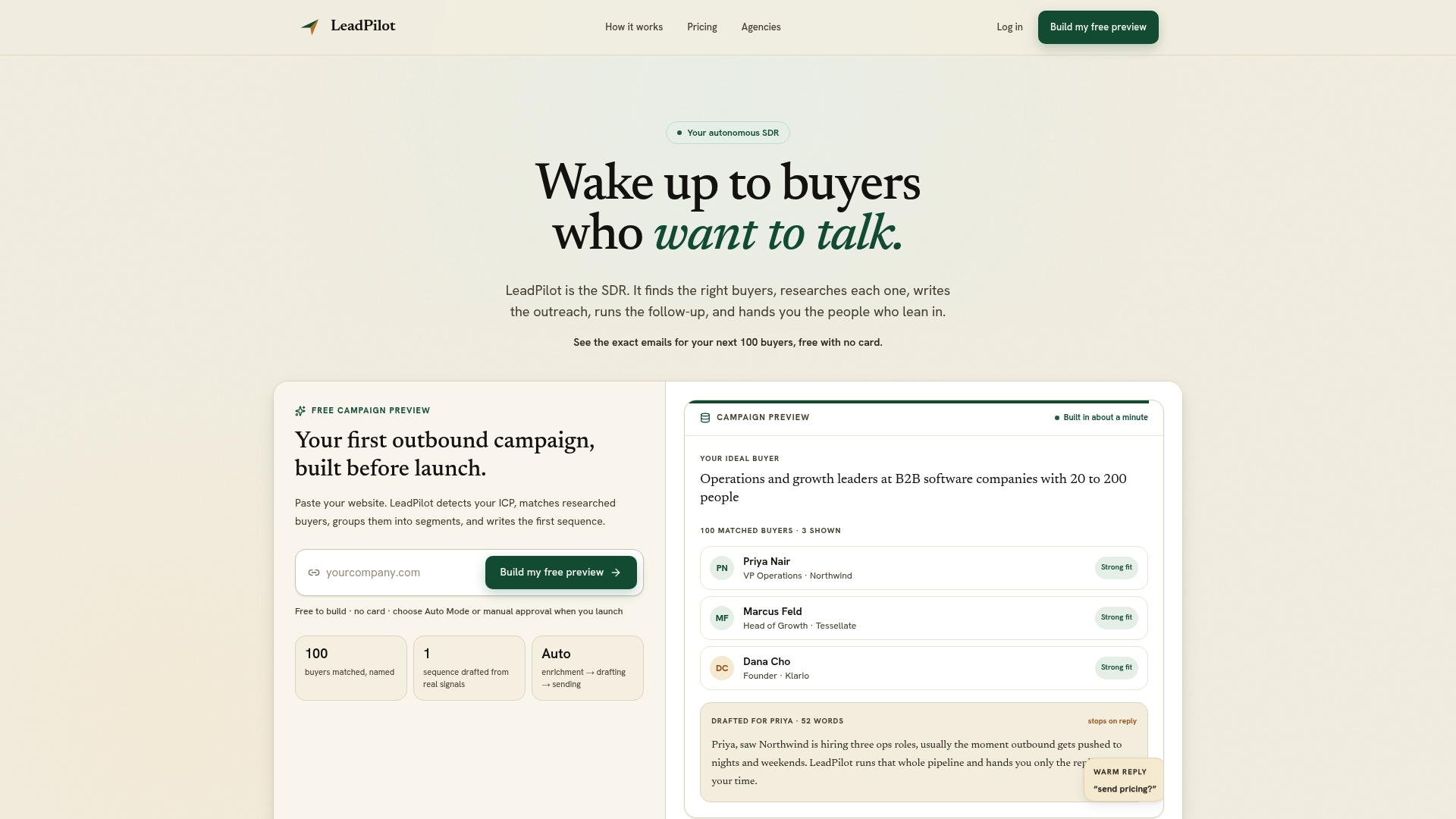
Runleadpilot handles the full loop: it identifies your ideal customer profile from your website, sources and researches matching decision-makers, writes and sends personalized sequences from real business signals, manages dedicated sending infrastructure so deliverability doesn’t quietly skew your results, and routes every warm reply to your team the moment it lands. The segmentation and reply classification that make cold-email testing valid happen automatically instead of living in someone’s side spreadsheet.
If you’re deciding between building this discipline in-house or handing off the operational load, start with a free campaign preview. You’ll see how Runleadpilot would target and message your specific audience before committing to anything. Explore the B2B lead generation platform or check out the AI SDR software to see the full workflow from targeting through reply handoff.
Where to Learn More About Cold Email Testing
For deeper reading on the statistics behind valid testing, Evan Miller’s analysis of common A/B testing errors remains the clearest explanation of why optional stopping breaks your results. Litmus’s email A/B testing guide covers broader test-setup practices worth adapting to cold outreach specifically.
For sample-size tables and worked examples tailored to cold email, WarmySender’s testing framework offers concrete numbers by baseline reply rate. Use SubjectLine.com to generate and score subject-line variants before you commit list volume to testing them live.