Founders Outbound Playbook: A 90-Day Founder-Led Plan
Accelerate your startup's growth with our concise, 90-day plan for a founder-led outbound strategy, ensuring efficient pipeline building.

Founders Outbound Playbook: A 90-Day Founder-Led Plan
The fastest way for an early-stage founder to build repeatable pipeline is a focused, founder-led outbound playbook you can validate in 90 days. Founder-led outbound works because you already have the domain credibility and product knowledge a hired rep would take months to develop, and every reply becomes market research you can act on immediately.
Your first move this week: write a 3 to 5 attribute ICP that fits on an index card, then assemble 50 Tier-1 accounts that match it exactly.
That’s the whole engine, in miniature. The rest of this founders outbound playbook fills in the mechanics.
- ICP definition: 3 to 5 attributes plus one clear disqualifier
- Target list: 50 Tier-1 accounts, researched at roughly 10 minutes each
- Founder sequence: three touches over ten days
- Daily time budget: blocked hours for sourcing, sending, and follow-up
- Deliverability basics: a dedicated sending domain, verified emails, and a two-week warmup
A tight ICP and finite list, run through a short founder sequence, can produce material qualified pipeline within roughly 90 days starting from zero outbound activity.
Key Takeaways
Founder-led outbound works because a validated ICP, a finite list, and a short founder sequence turn every reply into pipeline and product feedback simultaneously.
| Point | Details |
|---|---|
| Start with an index-card ICP | Define 3 to 5 attributes plus one disqualifier before building any list. |
| Keep the list and sequence finite | 50 Tier-1 accounts and a 3-touch sequence beat massive lists and long drips. |
| Protect deliverability from day one | Use a separate domain, verify emails, and warm up two weeks before sending. |
| Track four metrics only | Reply rate, meeting rate, opportunity conversion, and time-to-engage matter most early. |
| Consider a managed option once validated | LeadPilot automates sourcing, sequencing, and domain management once your playbook and volume outgrow founder capacity. |
Table of Contents
- Why Founder-Led Outbound Beats Early Hires and DIY Guessing
- The 6-Step Founder Outbound Playbook You Can Run Solo
- What Metrics Actually Matter in Your First Sprint
- What to Buy (and Skip) for a Founder-Led Sales Stack
- Founder Outbound Mistakes That Quietly Kill Reply Rates
- When to Stop Doing This Yourself
- Templates You Can Send Today
- Legal and Compliance Rules for Founder Outbound
- A Founder’s Honest Take on Time Allocation
- If You Want a Managed Route: How LeadPilot Fits This Playbook
- Sources
Why Founder-Led Outbound Beats Early Hires and DIY Guessing
You bring three things a first sales hire cannot fake: domain expertise, founder credibility on a cold call, and a direct line from a prospect’s objection to a product fix. A rep repeats what you tell them to say. You already know why the product exists.
Hiring too early usually backfires because it transfers your opinion about what should work to someone who has no evidence it does. Founder-led sales is the most productive go-to-market approach in the first 12 to 24 months, specifically because founders learn market signals firsthand instead of secondhand through a report.
- Founders close faster on trust alone; prospects want to talk to the person who built the thing.
- A rep without a validated script burns leads learning what you could have already tested.
- The right horizon for founder-led selling runs through your first 20 to 30 deals, not your first 3.
Pro Tip: Block founder selling time on your calendar as a recurring meeting, not a “when I have time” task. Outbound dies first on the founder’s own schedule.
The 6-Step Founder Outbound Playbook You Can Run Solo
This is the operational core of the founders outbound playbook: six steps, in order, with time budgets attached so you stop guessing how long each phase should take.
Step 1: Define a one-sentence ICP. Write 3 to 5 attributes (industry, company size, tech stack, role, trigger event) plus one clear disqualifier. A precise ICP that fits on an index card consistently outperforms a broad list on reply quality, even at lower volume.
Step 2: Build the list in tiers. Pull your top 50 accounts as Tier 1 and reserve them for manual research, roughly 10 minutes per account on triggers, recent news, and a genuine reason to reach out. Everything below Tier 1 gets lighter-touch treatment later.
Step 3: Design a 3-touch sequence. Keep it short. A cold list respects three touches over about ten days better than a long automated drip: Day 1 opens with a specific observation about the account, Day 4 delivers a proof point, Day 10 is an honest, no-pressure close.
Step 4: Set up deliverability before you send anything. Use a separate sending domain from your primary company domain, configure SPF, DKIM, and DMARC, and run a two-week warmup before real sending. Cap volume at 20 to 50 sends per day per inbox.
Step 5: Add multi-channel touches for Tier 1 only. Email plus LinkedIn plus a phone call, layered on your highest-value accounts, tends to lift meeting rates two to five times over email-only outreach. Save the extra effort for accounts that matter most.
Step 6: Run a post-meeting routine. After every call, spend five minutes capturing discovery notes, the exact objection raised, and what would have changed the outcome. Feed that straight back into your sequence copy.
| Touch | Channel | Timing | Purpose |
|---|---|---|---|
| Touch 1 | Day 1 | Specific observation, no pitch | |
| Touch 2 | Day 4 | Proof point or relevant result | |
| Touch 3 | Day 10 | Honest close, permission to disengage | |
| Day 2–3 | Warm the name before Touch 2 | ||
| Call | Phone | Day 5–7 | Tier 1 accounts only, after engagement |
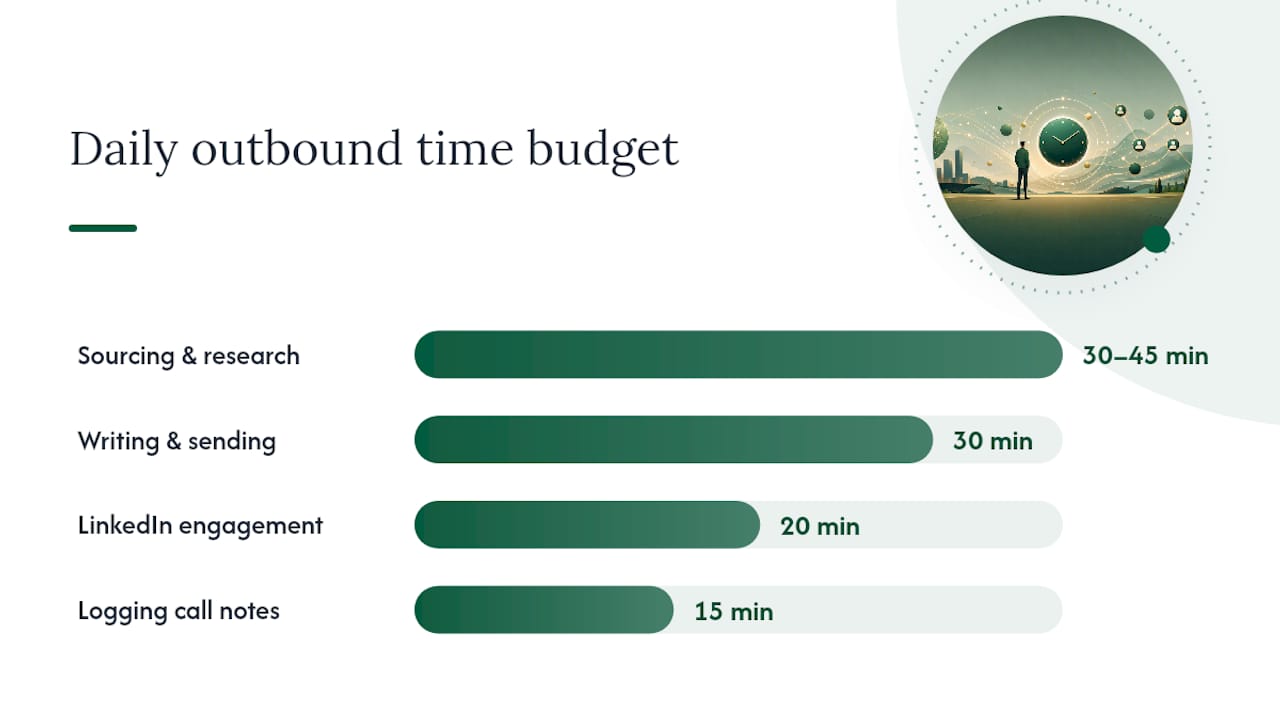
A realistic daily time budget for a solo founder running this:
- 30 to 45 minutes sourcing and researching new Tier 1 accounts
- 30 minutes writing and sending that day’s touches
- 20 minutes on LinkedIn engagement for warm prospects
- 15 minutes logging notes from any calls that happened
Pro Tip: Batch your sourcing on Monday for the whole week. Context-switching between research mode and writing mode is what actually kills founder outbound time, not the sending itself.
What Metrics Actually Matter in Your First Sprint
Four numbers tell you whether the motion works: reply rate, positive-reply-to-meeting rate, meeting-to-proposal conversion, and time-to-engage. Everything else is noise for a founder running this solo.

Cold outreach converts at roughly 1% to 2% overall, which is exactly why a tight ICP and personalized signal hooks matter more than raw send volume. Signal-based targeting, where you act on a trigger like a hire, a funding round, or a tool change, raises reply and meeting rates over static list-blasting.
| Metric | 90-day sprint benchmark |
|---|---|
| Reply rate | 8% to 15% on Tier 1, cold list |
| Positive reply → meeting | 40 to 50 percent |
| Meeting → qualified opportunity | 25 to 35 percent |
| Time-to-engage | Under 24 hours from reply |
Prioritize signal-to-meeting over volume in your first sprint. A spreadsheet tracking replies against the account’s ICP fit tells you more in week three than a CRM dashboard would.
What to Buy (and Skip) for a Founder-Led Sales Stack
You need five categories, not fifteen tools: prospect sourcing and verification, a cold-email sequencer, a sending domain with warmup, a lightweight CRM or spreadsheet, and a calendar booking link. That’s it until volume forces an upgrade.
Favor speed-to-first-send and built-in deliverability features over feature-rich platforms you’ll spend a week configuring. A founder launch pattern of one domain, 50 contacts, and 20 to 40 sends per day keeps sender reputation intact while you’re still testing message fit.
- Prospect sourcing and email verification tool, so you’re not guessing at deliverability from day one
- A sequencer with a built-in warmup feature rather than a bolt-on service
- A spreadsheet or Notion board for tracking replies before you need a full CRM
- A free or low-cost booking link so replies convert to calendar time without back-and-forth
Pro Tip: Resist buying a CRM before you have 20 real opportunities in the pipeline. A spreadsheet with reply status, notes, and next action does the same job for less money and less setup time.
Founder Outbound Mistakes That Quietly Kill Reply Rates
Three mistakes account for most stalled founder outbound motions, and all three are fixable in an afternoon.
Oversized lists and long automated cadences. A 2,000-contact list with a 7-touch drip feels productive but tanks reply quality and burns domain reputation. Fix it with a finite 50-account list and a 3-touch sequence.
Pitching before discovery. Leading with your product instead of a curiosity-first question kills trust on the first call. Ask what’s actually broken before you explain what you built, and take notes immediately after every call while the language is still fresh.
Ignoring deliverability until replies stop coming. By the time your open rates crater, the domain is often already flagged. Set up a single dedicated sending domain, verify every email, and warm up for two weeks before your first real campaign.
When to Stop Doing This Yourself
Three conditions signal it’s time to hire or outsource: your playbook is validated (you know what messaging converts), your close signals are repeatable across more than a handful of deals, and your outbound volume has outgrown what you can personally sustain without your product work suffering.
Before handing anything off, whoever takes over needs your ICP documented, your highest-converting messaging, your meeting-to-opportunity rates, and a clean CRM history, not a folder of half-finished spreadsheets. If you’re evaluating a managed outbound provider instead of a hire, ask direct questions before signing anything.
- How do you preserve the founder’s existing playbook and learnings instead of starting from a generic template?
- How are warm replies routed back to a human, and how fast?
- What deliverability controls are in place: dedicated domains, verification, warmup?
- Can we see a campaign preview before committing to a paid plan?
| Decision factor | What it tells you |
|---|---|
| Validated playbook | Documented ICP and messaging that already converts |
| Repeatable close signals | Same objections and triggers recurring across deals |
| Volume vs. founder time | Outbound now competes directly with product work |
| Vendor transparency | Willingness to show reply routing and deliverability setup upfront |
Templates You Can Send Today
Adapt these, don’t copy them verbatim. Swap in the specific trigger or detail you found during account research; generic versions of these same templates get ignored.
- Day 1 email, specific observation. Open with one real detail about their business (a recent hire, a product launch, a technology switch). Two sentences. No pitch. End with a genuine question.
- Day 4 email, proof point. Reference a result relevant to their situation, one sentence, then connect it back to the observation from Day 1.
- Day 10 email, honest close. Acknowledge the silence directly, offer a clean way to say no, and leave the door open without another follow-up scheduled.
For LinkedIn, send a connection request with a one-line reason tied to their business, not a pitch. If they engage with a post or accept the connection, follow up with a short value note referencing something specific, never a copy-pasted message.
The phone script should run under 30 seconds before you ask a question: name, company, one sentence on why you’re calling, then a discovery question. Let them talk. Your only job on that first call is to learn, not to close.
Legal and Compliance Rules for Founder Outbound
Cold email in the United States falls under the CAN-SPAM Act, which requires accurate sender information, a clear subject line that isn’t deceptive, a working physical mailing address, and an easy opt-out mechanism honored within 10 business days. It does not require prior opt-in consent for B2B outreach, which is why cold email remains legal for founders targeting business contacts.
If you have prospects or customers in the European Union or UK, GDPR applies differently. B2B outreach based on “legitimate interest” is permitted in many cases, but you need a documented legitimate interest assessment, a clear way to object, and you cannot process personal data indefinitely without a retention policy. Rules vary by country within the EU, so treat any EU-facing campaign as higher-risk and consult counsel familiar with that specific market before scaling volume there.
Practical compliance steps that protect you regardless of jurisdiction: always include a real unsubscribe link, honor opt-outs immediately, never buy scraped lists with no consent trail, and keep a record of where each contact’s information came from. Deliverability providers increasingly flag lists that generate spam complaints, so compliance and inbox placement are now the same problem in practice.
A Founder’s Honest Take on Time Allocation
If I were running this, I’d put outbound first on the calendar, not last. Ten focused hours a week beats thirty distracted ones. Every call is product research whether or not it closes, and that compounds faster than most founders expect. Stop doing it yourself once your messaging stops changing between calls. That’s your signal to document and hand off.
If You Want a Managed Route: How LeadPilot Fits This Playbook
Once your ICP and messaging are validated, the bottleneck usually shifts from “what do we say” to “how many accounts can we actually touch.” LeadPilot picks up exactly where the manual version of this playbook gets time-constrained: it reads your website to detect your ICP, sources and verifies matching decision-makers, drafts personalized sequences from real business signals, and manages dedicated sending domains and warmup so deliverability stays intact as volume grows.
You keep control of the parts that matter most, meaning the message strategy and every warm reply, while LeadPilot handles the research and sending mechanics that eat a founder’s week. That’s a meaningful trade once your outbound volume has outgrown what you can personally sustain without your product roadmap slipping. Founders considering cold email automation at this stage should look for exactly the deliverability controls and reply routing covered earlier in this guide.
You can build a free campaign preview before committing to anything, which shows you the ICP detection and sample messaging LeadPilot would run for your specific business. Start there, review the first two weeks of output against your own benchmarks, and decide from evidence instead of a sales call.
Sources
- What is founder-led sales? The most powerful GTM strategy for early-stage B2B | GTM AI Blog
- Founder-led outbound without an SDR team: pipeline and qual…
- Founder-Led Outbound Playbook: Best Tools & Workflow
- Founder-led sales — HubSpot