How to Outsource Outbound Sales: A B2B Founder's Guide
Discover how to outsource outbound sales effectively. Learn strategies, costs, and benefits to enhance your B2B sales efforts today!

How to Outsource Outbound Sales: A B2B Founder’s Guide
Outbound sales outsourcing is the practice of delegating prospecting, lead qualification, and meeting booking to a specialized external team. For B2B founders and small business owners, the decision to outsource outbound sales often comes down to one hard truth: building an in-house sales development team takes months and costs far more than most early-stage budgets allow. External providers handle recruitment, training, compliance, scripting, and reporting, so you focus on closing deals rather than managing reps. Pricing starts near $1,100 per month for entry-level managed pods and climbs past $7,500 monthly for AI-enabled outbound campaigns, making the model accessible at multiple budget levels.
How does outsourcing outbound sales work in practice?
Outbound sales outsourcing operates through two distinct models: fully managed teams and staff augmentation. Understanding the difference shapes every decision that follows.
Fully managed teams hand the entire sales development function to an external provider. The provider recruits, trains, and supervises reps, writes call scripts, monitors quality, and delivers reporting. Fully managed outsourced teams handle recruitment, training, compliance, scripts, supervision, and reporting, so clients define campaign goals and review outcomes rather than managing daily operations. This model suits founders who want pipeline results without operational overhead.

Staff augmentation places external reps under your direct management. You set the schedule, approve scripts, and run quality checks. This model works when you have an existing sales process but need more capacity quickly.
Typical outsourced outbound campaigns focus on three goals:
- Lead generation. Reps identify and contact prospects who match your ideal customer profile, then pass qualified names to your team.
- Appointment setting. Outsourced SDRs own the top-of-funnel motion end to end, from list building through booking meetings directly on closers’ calendars.
- Lead qualification. Reps score inbound or cold prospects against defined criteria before handing them off with full context.
Ramp-up timelines matter. Most providers need 3–5 weeks to reach the first live call, compared to 8–16 weeks for an in-house hire to become productive. Three-month minimum engagements are standard because campaigns need time to generate reliable data before optimization.
Compliance is non-negotiable. Outbound calling to US prospects falls under the Telephone Consumer Protection Act (TCPA) and CAN-SPAM regulations. TCPA compliance requires strict consent management and framework alignment. Reputable providers execute within your compliance framework and stay current on regulatory changes.
Pro Tip: Before signing any outsourcing contract, ask the provider to walk you through their consent ledger and TCPA documentation process. A provider that cannot answer this question clearly is a liability.
What are the cost considerations and pricing structures?
Cost is the most common reason founders explore third-party sales management, and the numbers are genuinely compelling when compared to in-house alternatives.
Hourly and retainer pricing
Outsourced SDR services are priced from $12 to $18 per hour nearshore, with entry-level managed outbound pods starting near $1,100 per month and AI-enabled pods exceeding $7,500 monthly. The wide range reflects team size, channel mix, and the level of management included.
Caribbean nearshore providers offer native-English outbound teams at $12–$18 per hour in 2026. That rate is 40–60% lower than fully loaded US SDR wages, while delivering native communication quality and full US time zone coverage year-round.
Cost comparison: outsourced vs. in-house
| Cost factor | Outsourced SDR | In-house SDR (US) |
|---|---|---|
| Monthly cost per agent | $1,092–$1,764 | $3,500–$5,600 |
| Time to first live call | 3–5 weeks | 8–16 weeks |
| Management overhead | Bundled in service | Requires dedicated manager |
| Compliance infrastructure | Provider managed | Built and maintained internally |
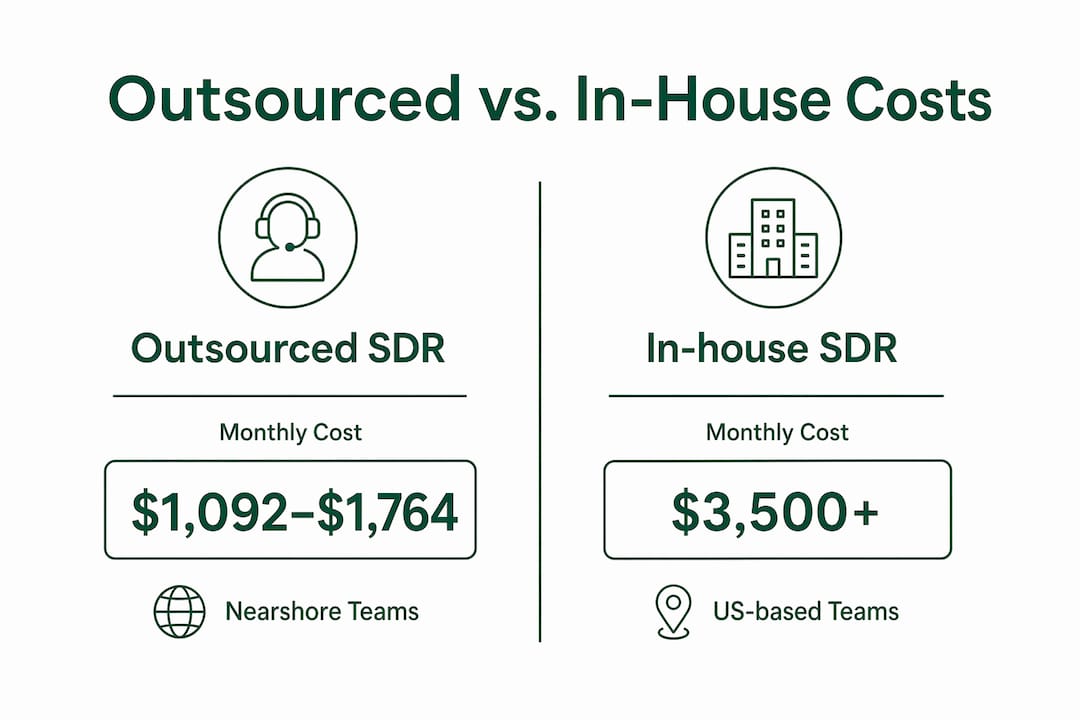
The cost difference per agent between outsourced and in-house is significant. At $1,092–$1,764 per month outsourced versus $3,500–$5,600 fully loaded in-house, a founder running two reps saves roughly $40,000 to $90,000 annually before accounting for benefits, equipment, and manager time.
Minimum commitments are common. Most providers require a three-month engagement to allow enough campaign data to surface before making adjustments. Treat that period as a structured test, not a locked-in obligation.
What are the benefits and potential challenges of outsourcing outbound sales?
The benefits of outsourcing sales are real, but so are the risks. Founders who go in with clear expectations get better results than those who treat outsourcing as a hands-off fix.
Key benefits
- Faster pipeline impact. Outsourced teams reach the first live call in 3–5 weeks. An in-house hire takes 8–16 weeks to reach the same point, meaning you lose months of pipeline activity during onboarding.
- Lower management overhead. Outsourcing bundles management into the service. Team leaders and project managers come with the engagement, which eliminates a layer of internal hiring.
- Multi-channel reach. Effective outsourced outbound programs integrate voice, email, and SMS within a unified workspace. Multi-channel outreach with a shared consent ledger improves cadence consistency and lead engagement across every touchpoint.
- Native-English, time-zone-aligned teams. Caribbean nearshore providers deliver US-accented reps available during Eastern, Central, Mountain, and Pacific business hours without the cost of US-based hiring.
Potential challenges
- Brand messaging alignment. External reps learn your product from scripts and briefs, not from daily exposure to your team. Weak onboarding produces generic pitches that damage your brand with prospects.
- Loss of direct control. Fully managed models give you outcomes, not visibility into daily rep behavior. Without defined reporting cadences, you lose the ability to course-correct quickly.
- Compliance risk. Providers execute within your framework, but you remain legally responsible for how your prospects are contacted. Vet every provider’s TCPA and CAN-SPAM practices before signing.
Pro Tip: Request weekly call recordings and a monthly pipeline report as contract deliverables, not optional extras. Providers who resist this level of transparency are not worth the risk.
How to choose and integrate outsourced outbound sales teams effectively
Selecting the right provider is where most founders make their biggest mistake. They evaluate price first and fit second. The sequence should be reversed.
Evaluating providers
Start with specialization. A provider that has run outbound campaigns in your industry already knows the objections, the buying cycle, and the right job titles to target. Ask for case studies from companies with a similar average contract value and sales cycle length.
Assess communication quality directly. Run a test call with a sample rep before committing. Listen for clarity, pacing, and the ability to handle an unexpected objection. A rep who stumbles on a basic pushback will struggle with your real prospects.
Confirm multi-channel capabilities. The best outsourced programs combine voice, cold email outreach, and SMS in a single coordinated cadence. Providers who only dial are leaving conversion opportunities on the table.
Onboarding and integration best practices
- Define KPIs before the engagement starts. Qualified meetings booked, connect rate, and pipeline value created are the three metrics that matter most at the top of funnel.
- Give the provider CRM access from day one. Reps who log activity directly into your system create a clean audit trail and reduce the risk of data loss at contract end.
- Provide a detailed ideal customer profile, a competitor objection guide, and at least three recorded calls from your best closers. This context shortens the ramp period and produces better scripts.
- Schedule a weekly sync for the first 90 days. Use that time to review call recordings, adjust messaging, and flag compliance concerns before they become patterns.
Protecting brand reputation requires ongoing attention. Treat the outsourced team as an extension of your company, not a vendor operating independently. The prospects they contact will form their first impression of your brand from that interaction.
Key Takeaways
Outsourced outbound sales delivers faster pipeline results and lower costs than in-house hiring, but only when founders select the right provider and manage the relationship with clear KPIs and reporting.
| Point | Details |
|---|---|
| Cost advantage is substantial | Outsourced SDRs cost $1,092–$1,764 per month versus $3,500–$5,600 for a fully loaded US hire. |
| Speed to pipeline is faster | Outsourced teams reach the first live call in 3–5 weeks, compared to 8–16 weeks for in-house hiring. |
| Compliance is your responsibility | Providers execute within your TCPA and CAN-SPAM framework, but legal accountability stays with you. |
| Onboarding quality drives results | Strong scripts, CRM access, and weekly reviews in the first 90 days determine campaign success. |
| Multi-channel outreach outperforms single-channel | Combining voice, email, and SMS in one coordinated cadence improves lead engagement and conversion. |
What I’ve learned from watching founders outsource outbound sales
Most founders approach outsourcing outbound sales with one of two wrong assumptions. The first is that handing it off means they are done thinking about it. The second is that outsourcing is only a stopgap until they can afford to hire in-house. Both assumptions produce bad outcomes.
The founders I have seen get real results treat the outsourced team the way they would treat a new internal hire: with structured onboarding, regular feedback, and clear accountability. The ones who send over a one-page brief and wait for meetings to appear on the calendar are usually disappointed by month two.
The technology question also gets underestimated. Providers who run voice-only campaigns are operating with one hand tied behind their back. The data is clear that multi-channel SDR workflows produce better engagement rates than cold calling alone. When evaluating a provider, ask specifically how they coordinate email and SMS alongside voice, and what platform manages the consent ledger across all three channels.
My honest view on fully managed versus partial outsourcing: fully managed works best when you have no existing sales infrastructure and need to build pipeline fast. Partial outsourcing, where you manage the reps but outsource recruiting and training, works better when you already have a process and just need capacity. Mixing the two without a clear decision about who owns what creates confusion that kills campaigns.
The relationship management piece is where most outsourcing arrangements quietly fail. Providers respond to attention. Weekly reviews, prompt feedback on call recordings, and clear signals about what is working keep the team calibrated. Founders who go quiet for six weeks and then complain about results have contributed to the problem.
— Harsh
Runleadpilot: AI-powered outbound without the overhead
Founders who want the output of a full SDR team without the cost or complexity of managing one now have a third option beyond traditional outsourcing.
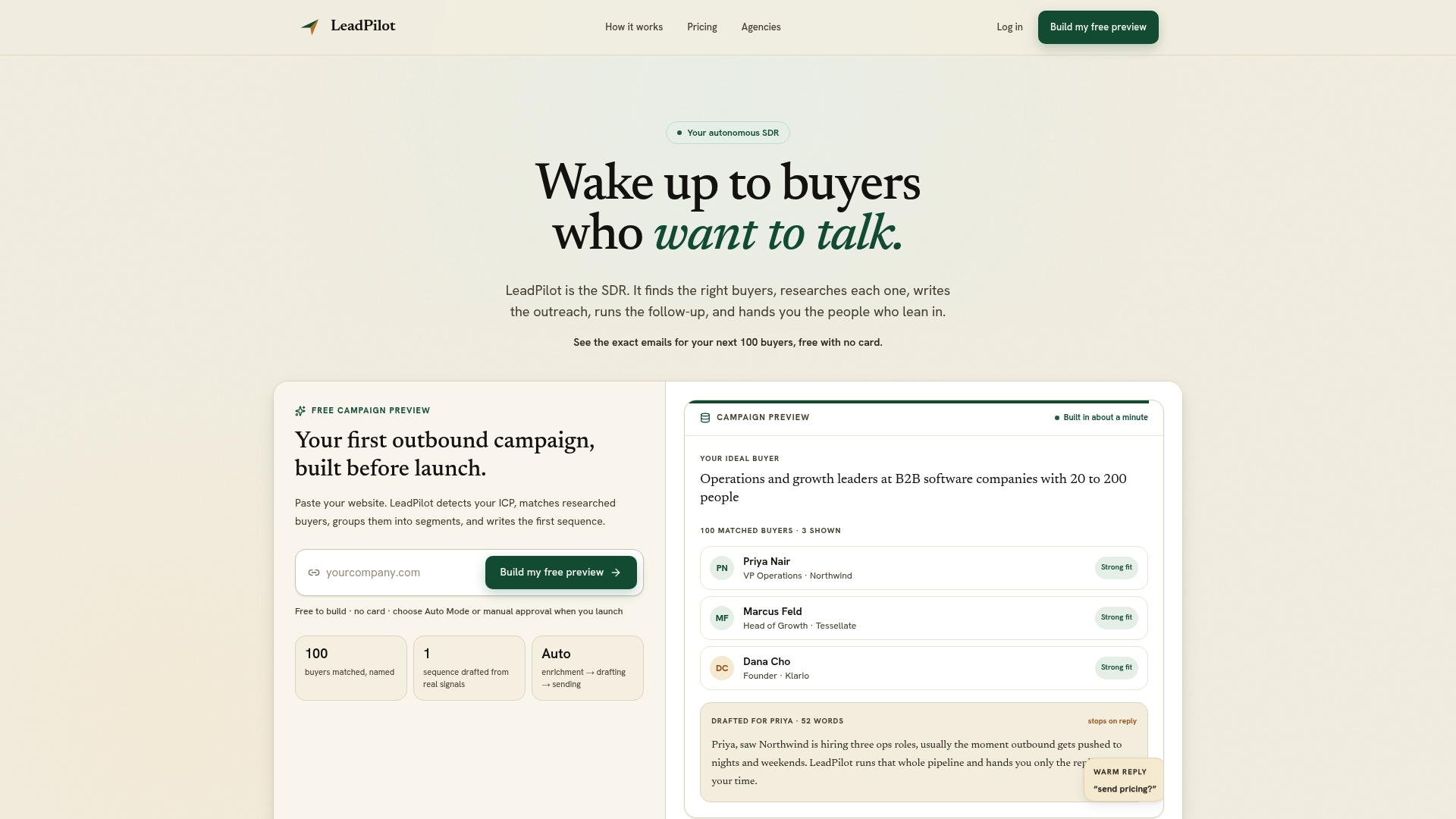
Runleadpilot is a managed, AI-powered B2B outbound platform that reads your website, builds your ideal customer profile, finds matching decision-makers, and writes personalized cold emails from real business signals. It manages dedicated sending domains, runs follow-up sequences, and hands warm replies directly to your team. There is no database subscription to manage, no sequencer to configure, and no SDR to onboard. You can build a free campaign preview before committing to managed outreach, and transparent pricing plans are available for teams at every stage of growth.
FAQ
What does it mean to outsource outbound sales?
Outsourcing outbound sales means hiring an external provider to handle prospecting, lead qualification, and meeting booking on your behalf. The provider manages reps, scripts, compliance, and reporting while you focus on closing qualified opportunities.
How much does outsourced outbound sales cost?
Entry-level managed outbound pods start near $1,100 per month, while AI-enabled multi-channel pods exceed $7,500 monthly. Nearshore SDRs in the Caribbean cost $12–$18 per hour, which is 40–60% less than fully loaded US rates.
How long does it take to see results from outsourced outbound?
Most outsourced teams reach the first live call within 3–5 weeks of engagement start. Three-month minimum commitments are standard because campaigns need sufficient data before meaningful optimization is possible.
What compliance rules apply to outsourced outbound calling in the US?
US outbound calling is regulated by the TCPA, which requires strict consent management. Your outsourced provider executes within your compliance framework, but legal responsibility for how prospects are contacted remains with your company.
Is outsourcing outbound sales better than hiring in-house?
For most early-stage B2B founders, outsourcing is faster and cheaper than in-house hiring. The cost difference is roughly $2,000–$4,000 per month per rep, and outsourced teams reach the first live call in a fraction of the time it takes to recruit, hire, and train an internal SDR.