Buyer Intent Signals: A B2B Prioritization Playbook
Unlock sales success with buyer intent signals. Prioritize leads effectively and streamline your outreach for better conversion rates.

Buyer Intent Signals: A B2B Prioritization Playbook
Buyer intent signals are behavioral and contextual clues that reveal which accounts are actively evaluating a solution right now. They do not guarantee a purchase, but they let revenue teams stop guessing and start prioritizing. Used correctly, they shift outbound from spray-and-pray to probability-weighted targeting. The immediate next step: pick one high-impact, verifiable signal, wire a single workflow around it, and run a pilot before adding anything else.
Three-step quick start:
- Choose a Tier-1 signal. Pricing page visits, demo requests, or a new executive hire at an ICP account are all strong starting points.
- Set a threshold. Define what “enough” looks like: three pricing page visits in seven days, or a VP-level hire at a company that fits your ICP on firmographics.
- Create one routing rule. Send qualifying accounts to an SDR within 24 hours, or trigger a personalized email sequence automatically. Measure reply rate and meeting conversion over four weeks before scaling.
Privacy note: if you are sourcing third-party behavioral data, confirm your vendor’s CCPA compliance and data-subject opt-out handling before activating any U.S.-based contact.
Table of Contents
- What buyer intent signals actually are (and how they differ from lead attributes)
- Concrete signal examples and how to read each one
- Where intent signals come from: sources and trade-offs
- How to use buying signals across marketing and sales workflows
- Martech stack setup for signal activation
- How to score and prioritize signals: a worked example
- Common pitfalls and how to avoid them
- How to measure the impact of intent-driven workflows
- Implementation timeline, pricing shapes, and pilot checklist
- US privacy and vendor due diligence for intent data
- Key Takeaways
- The part most teams get wrong about signal-based prospecting
- Runleadpilot turns intent signals into booked meetings, not just alerts
- Useful sources and further reading
What buyer intent signals actually are (and how they differ from lead attributes)
A buyer intent signal is an observable behavior or event that indicates movement toward a purchase decision. That is the operative definition, and it matters because teams routinely confuse signals with lead attributes.

Lead attributes are static facts: company size, industry, job title, technology stack. They tell you whether an account could buy. Signals tell you whether an account is actively evaluating. A 500-person SaaS company in your ICP is an attribute. That same company visiting your pricing page four times in a week while their new VP of Sales posts on LinkedIn about evaluating outbound tools is a signal cluster.
Enrichment data sits in between: it adds context (funding round, headcount growth, tech installs) but is not itself behavioral. Treat enrichment as a fit multiplier, not a standalone trigger.
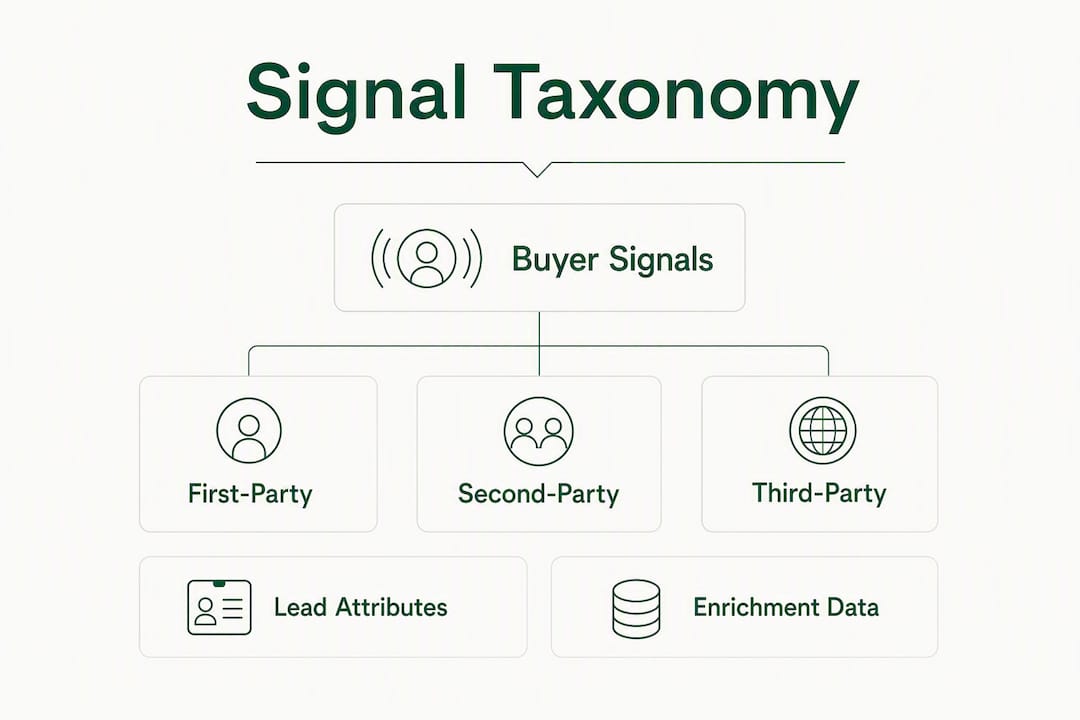
The four signal dimensions that determine strength
Every signal can be assessed on four axes:
- Frequency: — One visit is curiosity. Five visits in ten days is research.
- Seniority and ICP fit: — A VP of Revenue at a 200-person SaaS company reading your competitive comparison carries more weight than an intern at a non-ICP account doing the same.
Signal taxonomy for revenue teams
| Signal type | Definition | Best queue |
|---|---|---|
| First-party behavioral | Actions on your own properties (web, product, email) | Marketing automation + SDR |
| Third-party behavioral | Topic surges and review-site activity from publisher networks | SDR + demand gen |
| Contextual / event-based | Funding, hires, job posts, tech-stack changes | AE + SDR |
| Second-party / ecosystem | Partner referrals, co-marketing engagement | AE |
| Active discrete | Demo request, form fill, trial activation | Immediate SDR or AE |
| Passive topic surge | Broad research behavior across publisher networks | Marketing nurture first |
Active signals (demo requests, form fills) belong in an SDR or AE queue immediately. Passive topic surges from third-party feeds are weaker on their own and work better as a trigger for marketing nurture until corroborated by a discrete event.

Concrete signal examples and how to read each one
Not all signals are equal. The table below maps common buying signals to their typical strength, action window, and the interpretation rule that separates a real trigger from noise.
| Signal | Strength | Action window | Interpretation rule |
|---|---|---|---|
| Demo request / form fill | Very high | Hours | Immediate SDR routing; no corroboration needed |
| Pricing page: multiple visits over several days | High | 24–48 hours | Confirm seniority of visitor; route if ICP fit |
| Repeated docs / comparison reads | High | 1–3 days | Depth matters; one read is curiosity, three is evaluation |
| Trial or product activation | Very high | Hours | PQL trigger; route to AE if account fits ICP |
| Search-query surge (third-party) | Medium | 2–3 weeks | Requires corroboration; pair with a discrete event |
| Review-site activity (e.g., G2) | High | 1–5 days | Category-specific research; strong purchase-stage signal |
| Competitor mention in public thread | Medium | 3 days | Validate seniority; useful for personalization angle |
| New VP/C-suite hire at ICP account | High | 30–60 days | New exec = new budget authority; strong timing signal |
| Funding announcement | Medium | 30–60 days | Signals budget availability, not active evaluation |
| Job post for a role your product replaces | Medium | 2–4 weeks | Indicates pain; pair with web activity to confirm |
| LinkedIn post about a relevant problem | High | 24 hours | Verified identity makes personalization precise |
| Tech-stack install / uninstall | Medium | 2–3 weeks | Uninstalling a competitor is a strong trigger |
Signal freshness varies sharply by type: pricing and demo visits have a half-life measured in hours to days, while funding and hire signals stay relevant for 30–60 days. Build per-signal time-to-live (TTL) rules into your CRM so stale alerts do not clog the queue.
The single most common mistake is treating a topic surge in isolation. A broad search spike for “outbound sales software” across a publisher network is weak on its own. Add a VP of Sales hire at the same account, and the signal cluster becomes a strong trigger.
Pro Tip: Before wiring a signal to a live workflow, test it on a sample of 20–30 historical accounts. Check whether accounts that showed the signal actually converted at a higher rate than your baseline. If the lift is not there, the signal is noise for your specific ICP.
Where intent signals come from: sources and trade-offs
First-party sources: your ground truth
First-party signals come from properties you own: website analytics (Google Analytics 4, Segment), product telemetry, email engagement data, demo funnels, and CRM activity. They are the most accurate and carry the lowest privacy risk, because you collected them directly from known or identifiable contacts.
Instrument these before buying anything external:
- Pricing page and ROI calculator visits (tag with UTM parameters and session depth)
- Product activation events (trial starts, feature adoption milestones)
- Email click-throughs on high-intent content (case studies, comparison guides)
- Demo request and form fill completions
- Repeat visits from the same IP or known contact
Second-party and ecosystem signals
Second-party signals come from partners, co-marketing events, or referral networks where you have a direct relationship with the data source. A partner flagging a shared prospect who attended a joint webinar is second-party. These are reliable but limited in volume.
Third-party providers: reach vs. noise
Third-party intent providers (including Demandbase and Clearbit) aggregate behavioral data from publisher networks, review sites like G2, and data co-ops. They give you reach across accounts that have never visited your site, but the signal-to-noise ratio is lower.
| Source type | Accuracy | Volume | Freshness | Cost | Compliance risk |
|---|---|---|---|---|---|
| First-party (owned) | Very high | Low to medium | Real-time | Low (infrastructure) | Very low |
| Second-party (partner) | High | Low | Variable | Low to medium | Low |
| Third-party (provider) | Medium | High | Days to weeks | Medium to high | Higher (CCPA checks required) |
| Review-site signals (G2) | High | Medium | Near real-time | Varies by tier | Low (public behavior) |
The recommended sequencing: instrument your own pricing page, product, and email stack first. Once you have a baseline conversion rate from first-party signals, layer in third-party feeds to extend reach to accounts you have not yet touched. Buying third-party data before your first-party instrumentation is clean is a common and expensive mistake.
How to use buying signals across marketing and sales workflows
The activation checklist
Before a signal triggers any outreach, run it through this sequence:
- Enrich — Resolve the company to a canonical record (name, domain, firmographics) and verify the contact’s current role and email.
SDR playbook: signal-first outreach
The signal is the opening, not the pitch. A strong first-touch email for a pricing-page signal looks like this:
- Line 1: — Reference the signal without being creepy: “Saw [Company] has been looking at options in the [category] space.”
For LinkedIn, verified professional identity means you can personalize precisely. Comment on their post with a genuine observation before sending a connection request. The first message should not mention your product.
Workflow routing rules
- Immediate human follow-up: Demo requests, trial activations, pricing page (3+ visits, senior contact, ICP fit). SLA: under 24 hours.
- Marketing nurture: Topic surges without corroboration, single-visit web activity, non-ICP accounts. Trigger a three-email sequence and re-evaluate after engagement.
- AE direct outreach: Funding announcements or executive hires at existing pipeline accounts or high-value targets.
Pro Tip: Start with one signal and one workflow. A new executive hire at an ICP account, wired to a five-touch SDR sequence, is a complete pilot. Measure reply rate and meeting conversion over four weeks before adding a second signal.
Martech stack setup for signal activation
Getting signals into the right hands requires a clean data pipeline. Here is the integration sequence:
- Enrichment — Connect an enrichment tool (Clearbit, for example, resolves anonymous web visitors to company records) between your analytics layer and CRM. Set up a canonical company-record schema.
Data hygiene non-negotiables
- Deduplication: — Run a merge-and-dedupe job on company records before activating any signal feed. Duplicate records split signal history and break scoring.
Testing and rollback
Before going live, run a QA pass on a sample signal end-to-end: trigger the event manually, confirm it enriches correctly, verify the CRM record updates, and check that the routing rule fires. Set an alert-volume cap so a misconfigured rule does not flood the SDR queue. Keep a rollback plan: the ability to pause a signal feed or routing rule without disrupting other workflows.
How to score and prioritize signals: a worked example
The most practical scoring model combines three dimensions: Fit (does this account match your ICP?), Intent (what behaviors have they shown?), and Timing (how recent and how discrete?).
Sample scoring table
| Dimension | Factor | Points |
|---|---|---|
| Fit | ICP industry match | 20 |
| Fit | Company size in range | 15 |
| Fit | Decision-maker seniority (VP+) | 15 |
| Intent | Pricing page visit (1–2x) | — |
| Intent | Pricing page visit (3+) | 25 |
| Intent | Demo request or form fill | — |
| Intent | G2 category research | 20 |
| Intent | Competitor comparison read | 20 |
| Timing | Signal within last 48 hours | +15 boost |
| Timing | New exec hire (last 30 days) | +20 boost |
| Timing | Funding announcement (last 30 days) | +— boost |
Handoff thresholds:
- 80+ points: Route to SDR immediately. SLA: first touch within 24 hours.
- 50–79 points: Enter a marketing nurture sequence; re-score after engagement.
- Below 50: Log and monitor. No active outreach until score improves.
Why combinations beat single signals
A single broad topic search spike is often a weak predictor unless corroborated by a discrete event. An account scoring 25 points on a topic surge alone sits in nurture. Add a VP of Sales hire (+20 timing boost) and a G2 category research event (+20 intent), and the same account crosses 65 points and enters the SDR queue. That is the lift-over-baseline principle in practice.
LinkedIn signal handling
LinkedIn signals carry high verification value because posts are attached to real professional identities. When a VP of Revenue at an ICP account posts about evaluating outbound tools, you know their role, tenure, and company without any enrichment step. Score a relevant LinkedIn post at 20–25 intent points, verify the account fits your ICP, and reach out within 48 hours with a comment or connection request that references the post specifically, not your product.
Pro Tip: Wire a single workflow around new executive hires at ICP accounts. Pull the hire from LinkedIn or a news feed, enrich the contact, and trigger a five-touch SDR sequence. Run it for four weeks and compare reply and meeting rates against your cold-list baseline. That single comparison tells you whether signal-based prospecting is working before you invest in anything else.
Common pitfalls and how to avoid them
Signal-based prospecting fails in predictable ways. Most failures trace back to one of these:
- Reacting to a single signal without corroboration. One pricing page visit from an unknown visitor is not a lead. Require at least two corroborating signals or a discrete event before routing to an SDR.
- Skipping ICP gating. A high-intent signal from a non-ICP account is a distraction. Gate every signal by fit criteria before it enters any queue.
- Duplicate alerts. The same account triggering multiple signals across different tools creates duplicate tasks. Deduplicate at the CRM level before routing.
- Stale data. Acting on a signal that is two weeks old for a high-perishability event (pricing page visit) wastes SDR time and damages sender reputation. Enforce TTL rules.
- Volume-driven KPIs. Measuring success by the number of signals processed or emails sent rewards noise over quality. Shift to lift-based metrics: reply rate, meeting conversion, and pipeline sourced.
- No ownership. Signals that route to a shared queue without a named owner go cold. Assign every signal type to a specific role: SDR, AE, or marketing.
- Over-automation without personalization. A generic sequence triggered by a signal is only marginally better than cold outreach. The signal must inform the message.
Operational failure signals to watch:
- SDR queue growing faster than it is being worked (alert volume exceeds capacity)
- Reply rates below your cold-outreach baseline (signals are not predictive for your ICP)
- High bounce rates on signal-triggered sequences (contact data is stale)
- Duplicate opportunities created for the same account (deduplication is broken)
When reply rates drop below baseline, the first question is not “which signal is wrong?” It is “are we gating by ICP fit before routing?” Most false-positive problems disappear when fit criteria are enforced upstream.
How to measure the impact of intent-driven workflows
Priority KPIs
- Signal-to-contact time: How long from signal detection to first outreach? Under 24 hours for high-priority signals consistently outperforms slower processes.
- First-touch reply rate: The percentage of signal-triggered outreach that gets a response. Compare against your cold-outreach baseline.
- Meeting conversion rate: Replies that convert to a scheduled meeting. This is the clearest measure of signal quality.
- MQL-to-SQL conversion lift: Are signal-sourced MQLs converting to sales-qualified leads at a higher rate than non-signal MQLs?
- Pipeline sourced from signals: Total pipeline value attributed to signal-triggered outreach in a given period.
- Deal velocity: Are signal-sourced deals closing faster than deals from cold lists?
- False-positive rate: Percentage of routed accounts that SDRs mark as “not a fit” after review. A high rate means your gating criteria need tightening.
A/B experiment template
- Split: Randomly assign ICP-fit accounts to two groups. Group A receives signal-triggered outreach. Group B receives standard cold outreach with no signal filter.
- Duration: Run for four weeks minimum. Shorter windows produce unreliable conversion data.
- Sample size: Aim for at least 50 accounts per group to get directional signal.
- Measurement: Compare first-touch reply rate, meeting conversion, and pipeline created per account touched.
- Attribution: Tag all signal-origin contacts in your CRM with a custom field (“Signal Source” + signal type). Track through to closed-won.
Reporting cadence
- Weekly: Alert volume, SDR queue depth, reply rate by signal type.
- Monthly: Meeting conversion, pipeline sourced, false-positive rate.
- Quarterly: Win rate lift, deal velocity, ROI on third-party data spend.
Implementation timeline, pricing shapes, and pilot checklist
Phase timeline
| Phase | Duration | Key milestones |
|---|---|---|
| Pilot (single signal) | Weeks 1–4 | Instrument one signal, wire one workflow, measure reply and meeting rates |
| Small rollout | Weeks 5–— | Add 2–3 signals, expand routing rules, validate scoring model |
| Full activation | Months 3–6 | Full signal stack, CRM integration complete, reporting dashboards live |
| Scale | Month 6+ | Third-party feeds layered in, scoring model tuned, team KPIs updated |
Vendor pricing models
Third-party intent providers typically price in one of three ways:
- Subscription tiers: A flat monthly fee for access to a defined set of topic clusters and account-level alerts. Common for mid-market teams.
- Per-account signal fees: You pay for each account that triggers a signal above your threshold. Scales with volume; can get expensive quickly without ICP gating.
- API call rates: Pay-per-query pricing for enrichment and signal lookups. Flexible but requires engineering resources to manage.
First-party instrumentation (analytics tagging, CRM configuration) carries no incremental vendor cost beyond your existing stack. That is another reason to start there.
Pilot checklist
- [ ] One signal defined with a clear threshold (e.g., pricing page: multiple visits over several days, VP+ contact, ICP fit)
- [ ] Enrichment connected and canonical company records clean
- [ ] Routing rule configured with a named SDR owner
- [ ] Personalized email template written referencing the signal
- [ ] Baseline reply rate documented from cold outreach
- [ ] Four-week measurement window set with go/no-go criteria
- [ ] Go/no-go decision: if reply rate exceeds baseline by a meaningful margin, proceed to small rollout
Internal cost allocation: Pilot setup typically sits in RevOps or marketing operations. SDR time is the primary variable cost. Full launch requires buy-in from sales leadership to shift KPIs from volume to lift.
US privacy and vendor due diligence for intent data
Intent signals are behavioral data. Before activating any third-party feed in the U.S., run through these checks:
- CCPA compliance: Confirm your vendor has a current privacy policy covering California Consumer Privacy Act obligations, including consumer opt-out mechanisms and data deletion request handling.
- Data provenance: Ask the vendor exactly where the behavioral data originates. Publisher networks, co-registration, and data co-ops each carry different risk profiles.
- Sampling methodology: Understand how the vendor extrapolates from panel data to account-level signals. A small panel with broad extrapolation produces noisy signals.
- Enrichment sources: If the vendor appends contact data, confirm those sources are licensed and compliant.
- Security certifications: SOC 2 Type II is the baseline for B2B data vendors. Ask for the most recent report.
- Data-subject request handling: Confirm the vendor can process deletion and opt-out requests within the timeframes your contracts require.
- Data retention and TTL: Confirm how long the vendor retains behavioral data and whether you can set your own TTLs on alerts.
- Contractual protections: Include a data processing addendum (DPA) in every vendor contract. Specify permitted use cases, prohibited re-use, and breach notification timelines.
Prefer first-party signals wherever possible. They carry the lowest compliance risk and the highest accuracy. When you do buy third-party data, document the source for every feed in your signal playbook so any future audit has a clear chain of custody.
This article provides general information about data practices and is not legal advice. Confirm your specific obligations under CCPA and any applicable state privacy laws with qualified legal counsel.
Key Takeaways
Buyer intent signals only produce pipeline when paired with clean data, ICP gating, and fast routing — the signal itself is just the starting point.
| Point | Details |
|---|---|
| Signals are probability inputs | Treat every signal as a trigger to investigate, not proof of purchase; always require corroboration. |
| First-party before third-party | Instrument your pricing page, product, and email stack before buying external intent feeds. |
| Score on Fit + Intent + Timing | Route accounts scoring 80+ to an SDR within 24 hours; nurture accounts scoring 50–79. |
| Measure lift, not volume | Compare reply rate and meeting conversion against your cold-outreach baseline to prove signal value. |
| Runleadpilot automates the workflow | Runleadpilot detects ICP fit from your website, wires signals to personalized sequences, and routes warm replies to your team. |
The part most teams get wrong about signal-based prospecting
The conventional wisdom says: buy intent data, load it into your CRM, and watch reply rates climb. Teams spend months evaluating third-party providers, negotiate contracts, and then discover that the signals are noisy, the SDR queue is flooded, and reply rates are no better than cold outreach. The data was not the problem. The workflow was.
What actually moves the needle is deceptively simple: one signal, one workflow, one measurement window. Not because simplicity is virtuous, but because complexity before validation is how signal programs die. When you wire a new executive hire to a five-touch SDR sequence and measure reply rate against your baseline, you get a clean answer in four weeks. That answer tells you whether signal-based prospecting works for your ICP before you have committed budget to a third-party feed or restructured your team’s KPIs.
The second thing teams consistently underestimate is the KPI shift. Signal-based prospecting produces fewer outreach touches than cold-list dialing. Volume drops. If your SDR team is measured on dials and emails sent, that looks like underperformance. The fix is not to explain the strategy better. It is to change the metric before the pilot starts. Agree on reply rate and meeting conversion as the success criteria, document the baseline, and hold the line when someone asks why the team sent fewer emails this month.
Ownership is the third failure point. Signals that route to a shared queue without a named owner go cold within hours. The half-life of a pricing-page signal is measured in days. Assign every signal type to a specific person or role, set an SLA, and enforce it. The technology is the easy part.
Runleadpilot turns intent signals into booked meetings, not just alerts
Most teams that invest in intent data end up with a longer alert queue and the same conversion rate. The gap is execution: someone still has to enrich the contact, write a personalized email, manage deliverability, and follow up. Runleadpilot closes that gap by handling the full SDR workflow from signal to warm reply, improving efficiency.
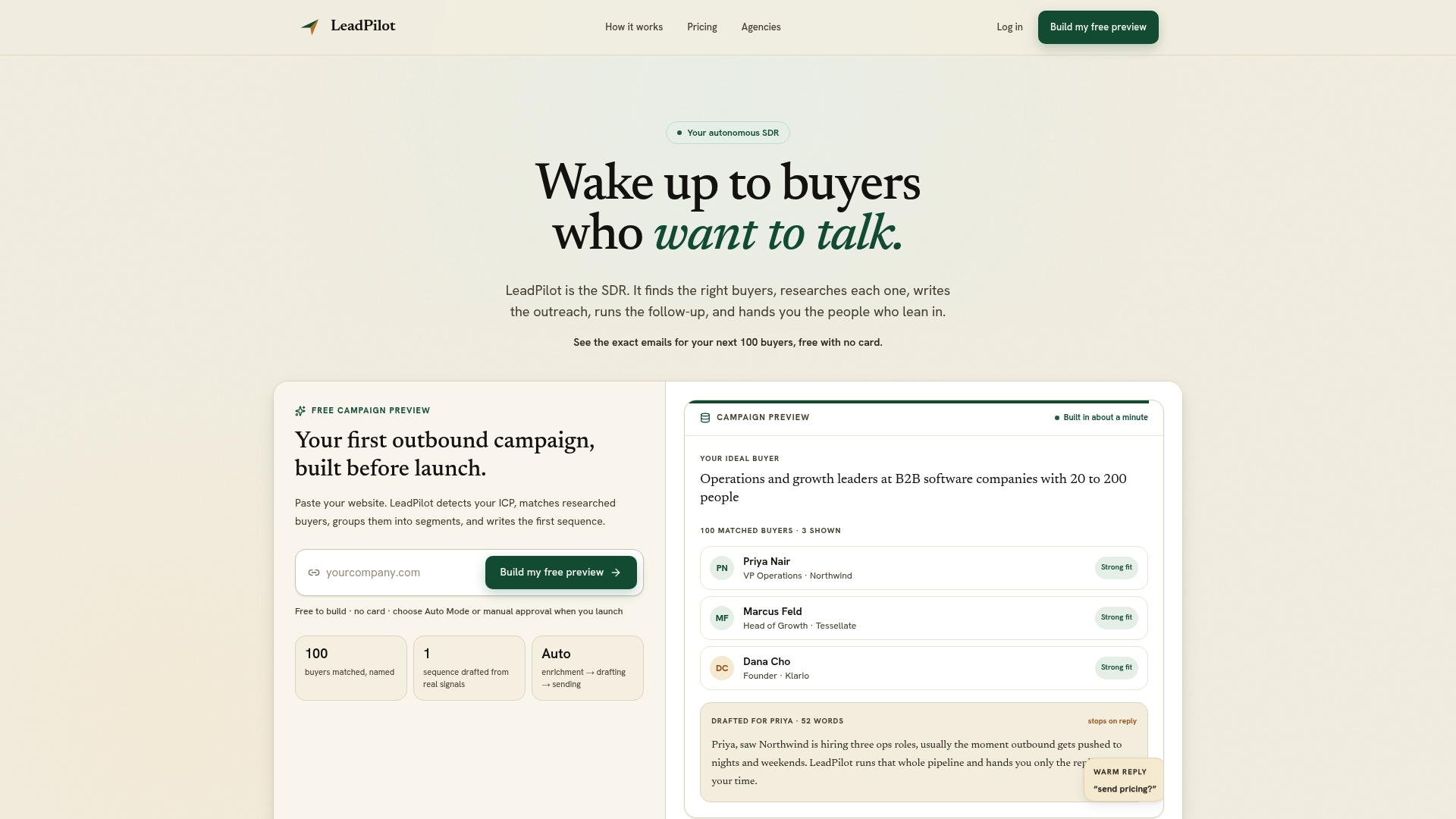
Runleadpilot reads your website to identify your ICP, finds and researches matching decision-makers, and writes personalized cold email sequences built from real business signals, including the exact triggers your scoring model flags. Dedicated sending domains and automated follow-ups run in the background. When a prospect replies, the conversation lands in your inbox, ready for a human. No SDR headcount required to get from signal to meeting.
For lean teams and agencies running outbound sales automation across multiple clients, Runleadpilot’s managed approach means the pilot checklist above is already built in. You define the ICP and the signal threshold; the platform handles research, sequencing, and deliverability.
Start with a free campaign preview at runleadpilot.com/b2b-lead-generation to see exactly which accounts and contacts your first signal-based campaign would target before committing to a subscription.
Useful sources and further reading
The sources below informed this playbook and are worth bookmarking for teams building out a signal-based prospecting program.
| Source | What it covers | Best for |
|---|---|---|
| Buyer Intent Signals: A Practical Guide for Modern Revenue Teams | Probabilistic framing of intent signals and workflow requirements | BLUF and scoring model foundations |
| B2B Intent Signals: Types, Strength & Freshness | Signal taxonomy, freshness windows, and lift-over-baseline methodology | TTL rules and scoring calibration |
| Signal-Based Prospecting: The B2B Playbook | LinkedIn signal handling, verified identity, and KPI shift guidance | SDR playbooks and LinkedIn outreach |
| Signal-Based Prospecting — The End of the Cold List | Single-signal pilot approach and first-party sequencing | Pilot design and data-source prioritization |
| B2B Buying Signals: How to Spot, Score, and Convert Them | Fit + Intent + Timing scoring model with letter-grade and numeric components | Scoring table construction |
| G2 Buyer Intent Data | Review-site behavioral signals and category-research triggers | Third-party signal sourcing and vendor evaluation |
| Gartner: B2B buyers often prefer a rep-free buying experience | Buyer behavior research and self-serve evaluation trends | Framing signal strategy around buyer-led journeys |
Vendor due-diligence checklist (quick reference):
- Confirm CCPA compliance and data-subject request handling
- Request SOC 2 Type II certification
- Ask for data provenance documentation and sampling methodology
- Include a DPA in every contract
- Set TTLs on all third-party alert feeds before activation
For product telemetry and first-party signals, your analytics and CRM documentation (GA4, HubSpot, Salesforce) are the primary references. For sales prospecting tools that integrate with signal feeds, the Runleadpilot blog covers current stack options and integration patterns.