Best Sales Prospecting Tools for B2B Teams in 2026
Discover the best sales prospecting tools for B2B teams in 2026. Unlock high-ROI solutions like HubSpot and Apollo to boost your outreach!

Best Sales Prospecting Tools for B2B Teams in 2026
The strongest sales prospecting tools available to US-based B2B teams right now are Apollo.io, ZoomInfo, LinkedIn Sales Navigator, Cognism, and HubSpot Sales, each winning a distinct use case. The right pick depends on whether your team needs raw data volume, compliance-safe contacts, CRM-native workflows, or full outreach automation. AI-native lead finders querying live sources now achieve very high email accuracy, which raises the bar for any static database tool still on your shortlist.
The four criteria that consistently separate high-ROI tools from shelfware are clean data, CRM integration, ease of use, and measurable ROI. Free tiers from Apollo, HubSpot Sales Hub, Lusha, Seamless.AI, and LeadIQ let teams pressure-test data coverage before signing anything.
| Tool | Best For | Key Strength | Free Tier | G2 Rating |
|---|---|---|---|---|
| Apollo.io | SMB/mid-market all-in-one | Verified data + sequencing | Yes | — |
| ZoomInfo | Enterprise outbound | Intent data + GTM AI agents | Yes | 3.3★ (42) |
| LinkedIn Sales Navigator | Relationship-based selling | Social selling + CRM sync | 30-day trial | — |
| Cognism | EMEA/cross-border teams | GDPR-compliant verified mobiles | No | 4.1★ (30) |
| HubSpot Sales | HubSpot CRM users | Native CRM prospecting | Yes | 3.8★ (166) |
| Lusha | Individual sellers | Browser extension lookup | Yes | 1★ (11) |
| LeadIQ | SDR/BDR teams | One-click LinkedIn capture | Yes | 1.7★ (6) |
| Seamless.AI | High-volume list building | Real-time AI contact discovery | Yes | 4.2/5 |
| Snovio | All-in-one prospecting | Lead gen + email verification | Yes | 4.7★ (164) |
| Salesgenie | Business contact lists | Established marketing database | — | 4.2★ (35) |
| Hunter.io | Budget email discovery | Domain-based email finding | Yes | — |
| Clay | Data aggregation workflows | Multi-source contact enrichment | — | — |
| Mailshake | Cold email sequences | Multichannel campaign management | — | — |
| Overloop | Multichannel outreach | Data enrichment + cadences | — | — |
| RocketReach | Broad contact discovery | Social + professional data | — | — |
| G2 Buyer Intent Data | ABM/intent-driven teams | Real-time buying signals | — | — |
| Storylane | Demo-led prospecting | Interactive guided demos | — | — |
| Cleanlist | List quality focus | Real-time list verification | — | — |
| Pipedrive and LeadBooster | SMBs building from scratch | CRM + lead gen in one system | — | — |
Key points at a glance:
- Apollo and ZoomInfo lead for outbound volume; Cognism leads for EMEA compliance.
- HubSpot Sales Hub eliminates integration overhead for teams already on HubSpot.
- Intent data tools like G2 Buyer Intent Data and ZoomInfo help teams time outreach to active buyers.
- Free tiers exist across most major platforms, making trials low-risk.
Detailed profiles of the leading prospecting tools
Salesforce experts recommend tools that let reps call, email, and pull data from a single dashboard rather than toggling between screens. That principle cuts through most of the noise in this category.
Apollo.io is the strongest all-in-one pick for SMB and mid-market teams. It combines a verified contact database with built-in email sequencing, call dialing, and analytics. The free plan includes limited credits, and paid tiers start at $49/user/month. Teams that previously ran separate tools for data and outreach often consolidate onto Apollo and cut their stack.

ZoomInfo is built for enterprise go-to-market teams. It unites marketing, sales, and customer data into one AI-driven platform trusted by over 35,000 companies, with proprietary intent signals that surface accounts actively researching solutions like yours. The pricing reflects that scale: expect an annual contract.
LinkedIn Sales Navigator earns its place for teams where relationships drive deals. Advanced search filters, account alerts, and CRM sync make it the default for enterprise AEs and anyone running account-based programs. At roughly $99/seat/month, it is not cheap, but there is no substitute for the LinkedIn graph.

Cognism covers GDPR and CCPA compliance with verified mobile numbers across EMEA, NAM, and APAC. For US teams with European prospects, it is the safest choice. Pricing is quote-based across two tiers.
HubSpot Sales Hub removes the integration problem entirely for teams already on HubSpot. Email tracking, pipeline management, and automated workflows live inside the CRM you already use. The free CRM tier is a genuine starting point; paid plans begin at $15/seat/month.
Snovio serves over 400,000 users and combines lead generation, email verification, and outreach automation in one platform. It is particularly strong for teams that want a full prospecting workflow without enterprise pricing.
Lusha is a lightweight browser extension for quick LinkedIn and CRM contact lookup. Five free credits per month make it easy to evaluate. Individual sellers and small teams use it to fill gaps without a full data subscription.
LeadIQ focuses on one-click contact capture from LinkedIn with automated CRM sync, cutting the manual steps between finding a prospect and getting them into a sequence. Free plan includes 20 verified emails per week.
Seamless.AI runs real-time AI contact discovery with a Chrome extension for prospecting directly on LinkedIn and company websites. It suits SDR teams that prioritize list-building speed over database depth.
Clay aggregates data from multiple sources into a unified contact view, making it the tool of choice for teams running waterfall enrichment strategies. It pairs well with LinkedIn outreach automation workflows.
Hunter.io remains the go-to for domain-based email discovery on a budget. It does one thing well: find and verify professional email addresses fast.
Mailshake and Overloop both handle multichannel cold outreach, with Mailshake leaning toward simplicity and Overloop adding data enrichment to the mix. RocketReach covers broad contact discovery across social and professional sources. G2 Buyer Intent Data surfaces real-time buying signals for ABM teams. Storylane adds interactive demo experiences to the qualification process. Cleanlist focuses on list accuracy and deliverability. Salesgenie offers an established business contact database suited to teams needing large marketing lists. Pipedrive with LeadBooster remains the recommended starting point for SMBs building a sales process from scratch, combining pipeline management with lead generation in one system.
How to select the right prospecting tool for your B2B team
Start with your ideal customer profile, not the feature list. The tool that finds your buyers accurately matters more than the one with the longest spec sheet.
Factors that actually drive the decision:
- Data quality and coverage: Does the database cover your ICP’s industries, geographies, and seniority levels? Static databases decay; AI-driven live-source tools tend to maintain higher accuracy.
- CRM integration depth: A tool that syncs cleanly with your CRM eliminates duplicate data and keeps pipeline reporting honest.
- Automation features: Email sequencing, follow-up triggers, and intent alerts save hours per rep per week.
- Budget and team size: Enterprise platforms like ZoomInfo carry enterprise price tags. Apollo and Snovio offer comparable functionality at SMB-friendly pricing.
- Compliance requirements: Cross-border teams targeting EU contacts need GDPR-compliant tools. Cognism is the clearest choice there.
Common red flags when evaluating vendors:
- No transparent pricing on the website usually means a high-pressure sales process.
- Demo data that looks cleaner than production data is a warning sign for real-world accuracy.
- Vendors who cannot show CRM integration documentation before you sign.
Pro Tip: Run a parallel trial: load 50 target accounts into two competing tools and compare verified email counts and bounce rates after one send. Real-world bounce data tells you more than any vendor benchmark.
Assess free tiers against your actual ICP before committing. A free plan that covers your target segment well is a strong signal; one that caps the exact filters you need is not.
How these tools were evaluated
The evaluation behind this comparison prioritized four pillars identified by ZoomInfo CEO insights: integration quality, data cleanliness, ease of use, and measurable ROI. Tools were assessed through hands-on trials, volume messaging tests, and bounce rate monitoring across real prospect lists.
| Evaluation criterion | What was measured |
|---|---|
| Data accuracy | Verified email deliverability and bounce rates on live sends |
| CRM integration | Native connectors, sync speed, and field-mapping flexibility |
| Ease of use | Time from signup to first prospect list exported |
| Automation depth | Sequence builder, follow-up triggers, and multichannel support |
| Scalability | Performance at high contact volumes and multi-seat deployments |
| Pricing transparency | Free tier availability and published plan pricing |
| User ratings | G2 scores from verified buyers |
Evaluation steps:
- Tested each tool against a consistent ICP (US-based SaaS companies, 50–500 employees, VP-level contacts).
- Measured bounce rates after sending to tool-sourced lists.
- Checked CRM sync with HubSpot and Salesforce.
- Reviewed G2 ratings from verified users.
- Assessed onboarding time and documentation quality.
Runleadpilot: a managed AI alternative for lean sales teams
Most tools on this list require a rep to operate them. Runleadpilot takes a different approach: it handles the full SDR workflow so your team only touches warm replies.
Runleadpilot reads your website to identify your ICP, sources and researches matching decision-makers, writes personalized cold emails from real business signals, manages dedicated sending domains for deliverability, and routes warm replies to your team. It is built for founders, lean sales teams, and outbound agencies that need pipeline without hiring an SDR.
Core capabilities:
- AI-driven ICP detection from your website
- Automated decision-maker research and contact sourcing
- Personalized cold email drafting from live business signals
- Dedicated sending domain and inbox management
- Automated follow-up sequences
- Warm reply routing to your human team
- Free campaign preview before purchase
Pro Tip: Combining AI-managed outreach with a human follow-up process consistently outperforms fully automated sequences. Let the AI handle research and first contact; let your team close the conversation once intent is confirmed.
Runleadpilot fits teams that have validated their ICP but lack the headcount to run outbound at scale. Agencies managing multiple clients benefit from consolidated billing and multi-client workspaces. Learn more at runleadpilot.com/how-leadpilot-works.
What prospecting tools actually cost beyond the sticker price
The subscription fee is rarely the largest cost. Onboarding, training, and integration work add up fast, especially for enterprise platforms.
ZoomInfo and Cognism typically require dedicated onboarding sessions and CRM configuration work before a team is fully productive. Apollo and HubSpot Sales Hub have lighter onboarding curves, but teams still spend time mapping fields and building sequences. Budget two to four weeks for a mid-market tool deployment and six to twelve weeks for an enterprise platform with deep CRM integration.
Training costs depend on team size and tool complexity. A solo rep using Lusha or Hunter.io is productive within a day. A 10-person SDR team adopting ZoomInfo with custom intent workflows may need formal training sessions and an internal admin. Factor in the cost of that person’s time.
Data quality maintenance is an ongoing cost. Static databases decay as contacts change roles. Teams using tools without auto-refresh features spend rep time cleaning lists manually, which erodes the ROI of the tool itself.
How long does tool selection and implementation actually take?
Most teams underestimate the timeline. A realistic breakdown:
- Weeks 1–2: Define requirements, shortlist tools, request demos.
- Weeks 3–4: Run parallel free trials against your actual ICP.
- Week 5: Evaluate trial results, check integration documentation, negotiate pricing.
- Weeks 6–8: Onboard the chosen tool, configure CRM sync, train the team.
- Weeks 9–12: Run first live campaigns, measure bounce rates and reply rates, adjust sequences.
Full adoption, meaning reps using the tool consistently without workarounds, typically takes two to three months. Enterprise deployments with custom intent workflows or multi-team rollouts can extend to six months. Build that timeline into your planning before you sign.
Key Takeaways
The best sales prospecting tools win on data accuracy and CRM integration, not feature count. Teams that match the tool to their ICP and sales motion before buying consistently outperform those that chase the most popular platform.
| Point | Details |
|---|---|
| Data accuracy drives ROI | AI-native tools querying live sources achieve very high email accuracy, reducing bounce rates and protecting domain reputation. |
| CRM integration is non-optional | Tools that sync natively with your CRM eliminate data silos and keep pipeline reporting accurate. |
| Free tiers enable real evaluation | Apollo, HubSpot Sales Hub, Lusha, Seamless.AI, and LeadIQ all offer free plans to test data coverage before committing. |
| Total cost exceeds subscription price | Onboarding and training add weeks and real labor cost; enterprise tools typically require 6–12 weeks for full deployment. |
| Runleadpilot for managed outbound | For lean teams that need pipeline without an SDR hire, Runleadpilot automates the full outbound workflow from ICP detection to warm reply handoff. |
The prospecting tool market is more fragmented than vendors admit
The conventional wisdom says “pick the tool with the best database.” That framing misses the actual problem most SMB sales teams face.
The real issue is not data access. Apollo, ZoomInfo, and Cognism collectively cover most of the US B2B market. The problem is that teams add tools before they have a working prospecting process, and then blame the tool when pipeline does not grow. A verified email list sent to the wrong ICP with a generic sequence produces the same result as no list at all.
The shift worth watching in 2026 is toward data intelligence layers rather than standalone contact databases. High-performing teams treat their prospecting tool as infrastructure that feeds a defined qualification process, not as a substitute for one. ZoomInfo’s intent signals and G2 Buyer Intent Data are useful precisely because they tell you when to reach out, not just who to reach out to. That timing layer is what separates efficient pipeline generation from high-volume, low-conversion outreach.
Tool fatigue is a real operational cost. Every additional platform a rep must check is a platform they will eventually stop checking. The teams with the cleanest pipelines tend to run fewer tools, not more, and they integrate them deeply rather than using them in parallel silos.
Runleadpilot replaces your SDR stack with one managed workflow
Hiring an SDR, buying a data subscription, and managing a sequencing tool separately costs more than most SMB teams realize, and it still requires someone to coordinate all three. Runleadpilot collapses that into a single managed service.
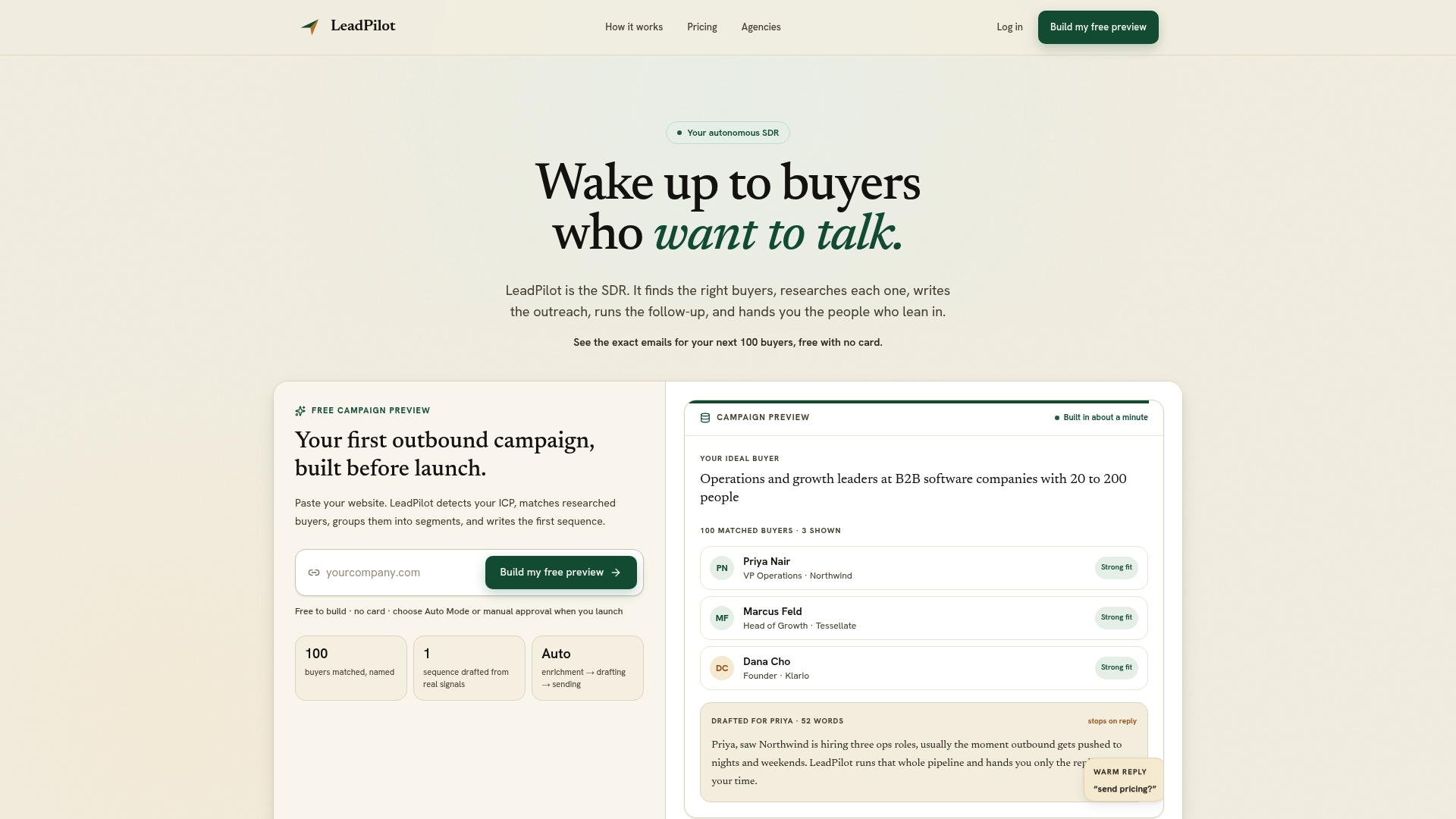
The platform reads your website, identifies your ICP, sources decision-makers, writes personalized cold emails from real business signals, and manages sending infrastructure so your domain stays healthy. Follow-ups run automatically. Warm replies land in your inbox, ready for a human conversation. Agencies get multi-client workspaces with consolidated billing.
You can build a free campaign preview before spending anything. For founders and lean teams ready to run outbound sales automation without the overhead, that is the lowest-risk starting point available. See the full platform at runleadpilot.com/ai-sdr.