Best Clearbit Alternatives for B2B Teams in 2026
Discover the best Clearbit alternatives for B2B teams in 2026. Explore top options for CRM integration, compliance, and pricing.

Best Clearbit Alternatives for B2B Teams in 2026
What are the best Clearbit alternatives right now?
Clearbit is no longer the independent enrichment tool it once was. HubSpot acquired Clearbit and folded it into its own product suite as Breeze Intelligence, with standalone free tools ending in 2025 and the Logo API also sunsetting. If your team runs on Salesforce, Outreach, or any stack outside HubSpot, you are effectively locked out of the full feature set unless you migrate your CRM. That reality is pushing a lot of B2B sales and marketing teams to find a replacement fast.
The good news: the market for B2B enrichment and sales intelligence has never been more competitive. Whether you need phone-verified mobile data, GDPR-compliant email generation, a full outreach platform, or a managed AI-driven SDR workflow, there is a purpose-built option at nearly every price point.
Here is a direct comparison of the top alternatives to Clearbit in 2026:
| Tool | Pricing model | Key features | Compliance | CRM integrations | Best for | Limitations |
|---|---|---|---|---|---|---|
| ZoomInfo | ~$15,000+/year | a very large contact database, intent data, conversation intelligence | SOC 2 | Salesforce, HubSpot, Outreach, Salesloft | Enterprise GTM teams | High cost, complex contracts |
| Apollo.io | Free to $49/seat/month | large contact database, email sequences, dialer | SOC 2 | Salesforce, HubSpot | SMB and mid-market | Data freshness varies |
| Cognism | Custom, seat-based | Diamond Data mobile numbers, phone verification | GDPR, ISO 27001, SOC 2 | Salesforce, HubSpot | EMEA-focused teams | Pricing not public |
| Lusha | Free to $79/seat/month | Contact and company data, browser extension | GDPR, CCPA | Salesforce, HubSpot, Pipedrive | Individual reps and small teams | Limited firmographic depth |
| Salesmotion | Custom | Signal-based account intelligence, CRM sync | SOC 2 | Salesforce, HubSpot | Revenue teams tracking buying signals | Newer, smaller data network |
| ListKit | Usage-based | Triple-verified contacts, Clay integration | CCPA | Salesforce, HubSpot | Cold email agencies | No outreach sequencing built in |
| LeadIQ | Free to $75/seat/month | Prospecting, Salesforce sync, email tracking | GDPR, SOC 2 | Salesforce, HubSpot, Outreach | SDR teams prospecting at scale | Smaller database than ZoomInfo |
| Dropcontact | Per-enrichment | GDPR-native email generation, no stored database | GDPR | Salesforce, HubSpot, Pipedrive | Compliance-first European buyers | Email only, no phone or firmographics |
| LeadPilot | Monthly subscription | Managed SDR workflow, AI personalization, inbox management | SOC 2 | Flexible API | Founders and lean outbound teams | Done-for-you model, not a self-serve database |
Who should stay with Breeze Intelligence? Teams already running on HubSpot CRM with moderate enrichment needs and no plans to change their stack. For everyone else, the alternatives below offer more flexibility, better pricing transparency, and in several cases, richer data.
Table of Contents
- Detailed profiles of the top Clearbit competitors
- How to choose the right Clearbit alternative for your team
- How to migrate from Clearbit to a new platform
- Where B2B enrichment tools are heading beyond Clearbit
- Runleadpilot handles the workflow that enrichment tools leave unfinished
- Key takeaways
Detailed profiles of the top Clearbit competitors
ZoomInfo
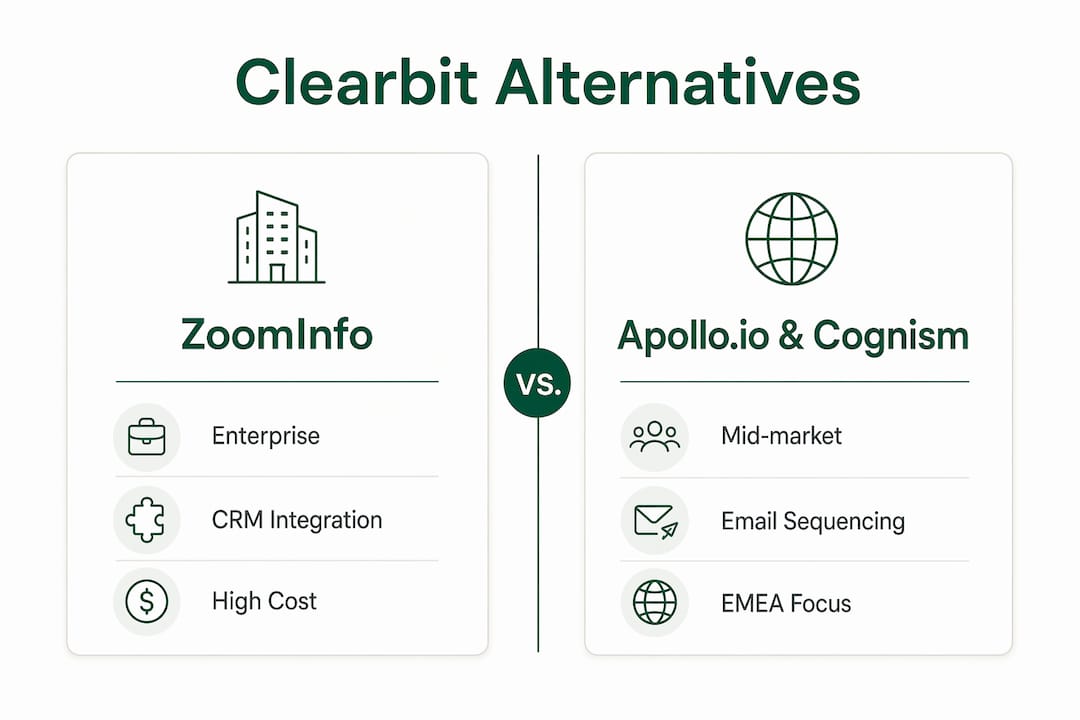
ZoomInfo is the enterprise standard for GTM intelligence. Its database covers a very large contact database with native integrations into Salesforce, HubSpot, Outreach, and Salesloft, plus advanced intent data and conversation intelligence that Clearbit never offered at scale. The platform is genuinely comprehensive, but the entry price at an enterprise level puts it out of reach for most startups and mid-market teams. Contracts tend to be annual and negotiated, with limited flexibility for smaller buyers.
Best for: Enterprise revenue teams that need intent signals, conversation intelligence, and deep CRM automation in one platform.
Limitations: Cost is the primary barrier. Smaller teams often pay for features they will never use, and the onboarding curve is steep without a dedicated RevOps resource.
Apollo.io
Apollo.io packs prospecting, email sequencing, and a built-in dialer into a single platform, with a large contact database and plans starting from free to a mid-range per seat monthly fee. For SMB and mid-market teams that want to replace both an enrichment tool and a sequencer, Apollo is one of the most cost-effective options on the market. G2 reviewers consistently praise its breadth of features relative to price. The main caveat is data freshness: phone numbers and emails can lag behind faster-moving databases, so verification before outreach is worth building into your workflow.

Best for: SMB and mid-market teams that want prospecting and engagement in one tool without paying enterprise prices.
Limitations: Data accuracy on mobile numbers trails behind phone-verification-focused providers. The free tier has meaningful restrictions on export volume.
Cognism
Cognism is the strongest option for teams with significant EMEA pipeline. Its Diamond Data mobile numbers are phone-verified before delivery, and the platform holds ISO 27001 and SOC 2 certifications alongside full GDPR compliance. For US-based teams calling into Europe, that verification layer alone can meaningfully lift connect rates. Pricing is custom and seat-based, so you will need to go through a demo to get a number, which is a friction point for teams that want to compare costs quickly.

Best for: Revenue teams with active EMEA outbound programs or strict compliance requirements.
Limitations: No public pricing. US-only teams may find the data coverage thinner than ZoomInfo or Apollo for domestic prospecting.
Lusha
Lusha sits in a practical middle ground: a browser extension that surfaces contact and company data directly in LinkedIn or a CRM, with plans from free up to $79 per seat per month. It covers GDPR and CCPA requirements and integrates with Salesforce, HubSpot, and Pipedrive. Individual reps and small teams tend to get the most value here, particularly for quick lookups during active prospecting sessions. The firmographic data depth is lighter than enterprise platforms, so teams building large account-based marketing lists may hit its ceiling quickly.
Best for: Individual SDRs and small teams doing targeted, rep-driven prospecting.
Limitations: Not built for bulk enrichment or large-scale list building. Firmographic coverage is limited compared to ZoomInfo.
Salesmotion
Salesmotion focuses on signal-based account intelligence rather than raw contact volume. It monitors buying signals across accounts, syncs that intelligence into Salesforce and HubSpot, and helps revenue teams prioritize outreach based on real-time activity rather than static data. It is a newer entrant with a smaller data network than the established players, but for teams that already have contact data and need a smarter prioritization layer, it fills a specific gap. Pricing is custom.
Best for: Revenue teams that want to layer buying-signal intelligence on top of an existing contact database.
Limitations: Smaller data network. Works best as a complement to a primary enrichment tool rather than a standalone replacement.
ListKit
ListKit takes a different approach: it focuses on delivering triple-verified contact lists optimized for cold email agencies and high-volume outreach teams. It integrates with Clay and connects to Salesforce and HubSpot, and its pricing is usage-based, which keeps costs predictable for teams with variable monthly list needs. G2 reviewers note strong data accuracy and responsive customer support. There is no built-in sequencing, so ListKit works best when paired with a dedicated sending platform.
Best for: Cold email agencies and outbound teams that need verified lists at volume without paying for a full outreach suite.
Limitations: No native sequencing or engagement tools. Teams need a separate sending platform to run campaigns.
LeadIQ
LeadIQ is built specifically for SDR workflows: it captures prospect data from LinkedIn, syncs directly to Salesforce, and tracks email engagement. Plans run from a free tier to $75 per seat per month, and the platform holds GDPR and SOC 2 certifications. The database is smaller than ZoomInfo’s, but the Salesforce sync is tight and the prospecting experience is clean. Teams at Outreach-heavy organizations will find the integration particularly smooth.
Best for: SDR teams that live in Salesforce and LinkedIn and need a clean, fast prospecting workflow.
Limitations: Database size limits its usefulness for broad market coverage. Less suited for account-based enrichment at scale.
Dropcontact
Dropcontact takes a fundamentally different approach to compliance. Rather than storing a database of contacts, it generates email addresses at the moment of request using algorithmic logic, which means it carries no stored personal data and sidesteps most GDPR storage obligations. The trade-off is scope: Dropcontact provides email addresses only, with no phone numbers, firmographic data, or intent signals. It integrates with Salesforce, HubSpot, and Pipedrive, and pricing is per enrichment. For European teams with strict legal requirements around data storage, it is a genuinely useful option. For teams that need full contact profiles, it is not a standalone solution.
Best for: Compliance-driven buyers in Europe who need email enrichment without data storage liability.
Limitations: Email only. No phone numbers, company data, or intent signals.
LeadPilot
LeadPilot operates differently from every other tool on this list. Rather than providing a database to search or an API to query, it runs the entire outbound SDR workflow as a managed service. It reads your website to identify your ideal customer profile, sources and researches matching decision-makers, writes personalized cold emails from real business signals, manages dedicated sending domains and inboxes for deliverability, and routes warm replies to your team. The full SDR workflow from targeting through reply handoff is handled for you. For founders and lean sales teams that do not want to hire an SDR or stitch together five separate tools, that is a meaningful difference.
Best for: Founders, lean sales teams, and outbound agencies that want managed outreach without building an internal SDR function.
Limitations: Not a self-serve contact database. Teams that need raw data exports or API access to enrich their own CRM records will need a different tool.
How to choose the right Clearbit alternative for your team
The right choice depends on four variables: your budget, your CRM stack, your compliance requirements, and whether you need raw data or a managed workflow.
Start with your CRM. If your team runs on Salesforce, ZoomInfo, Apollo, LeadIQ, and Cognism all offer tight native integrations. HubSpot users have the widest range of options. Teams on Pipedrive or less common CRMs should verify integration depth before committing, since some platforms offer only Zapier-based connections that break under volume.
Match the tool category to your workflow:
- All-in-one outreach platforms (Apollo, LeadIQ): best when you want prospecting and sequencing in one place, without managing multiple vendor relationships.
- Compliance-focused providers (Cognism, Dropcontact): best when GDPR or CCPA exposure is a real legal concern, not just a checkbox.
- API-first enrichment infrastructure (ZoomInfo, ListKit): best when your RevOps team wants to build custom data pipelines or enrich records programmatically.
- Managed outbound services (LeadPilot): best when you want results without managing the tooling yourself.
Consider data geography. US-focused teams generally get the best coverage from ZoomInfo and Apollo. EMEA-heavy pipelines benefit from Cognism’s phone-verified mobile data. Teams with global coverage needs may need to layer providers.
Budget realistically. Enterprise platforms like ZoomInfo require annual contracts starting around $15,000. Mid-market tools like Apollo and LeadIQ offer monthly plans under $100 per seat. Usage-based tools like ListKit and Dropcontact scale with actual consumption, which works well for variable-volume teams.
Pro Tip: Before signing any annual contract, run a parallel trial of your top two candidates against the same target account list. Measure email deliverability, phone connect rates, and CRM sync accuracy over two weeks. The results will tell you more than any vendor demo.
Evaluate customer support quality during the trial, not after. Response time, onboarding quality, and documentation depth vary significantly across these platforms. Teams that underestimate support needs during migration often pay for it in lost productivity.
The shift toward CRM-agnostic platforms is worth factoring into your decision as well. Tools that integrate into your existing workflow without forcing a new data silo tend to deliver faster time-to-value than platforms that require you to adopt their native CRM or sequencer.
How to migrate from Clearbit to a new platform
Switching enrichment tools is less painful than most teams expect, provided you plan the transition before canceling your current subscription.
-
Audit your current Clearbit usage. List every workflow that touches Clearbit data: form enrichment, CRM record updates, lead scoring triggers, and any API calls. This audit prevents you from discovering broken integrations two weeks after you switch.
-
Export your existing enriched data. Before your Clearbit or Breeze Intelligence access ends, export all enriched contact and company records from your CRM. Most CRMs allow bulk CSV export. Store this data in a shared drive with a clear date stamp so your team knows what is current.
-
Engage your shortlisted vendors before you cancel. Run overlapping trials with your top two or three candidates while Clearbit is still active. This gives you a real comparison without a gap in data coverage.
-
Map your integration points in the new tool. Every platform handles CRM sync differently. In Salesforce, confirm field mapping for company name, industry, employee count, and contact title before you go live. In HubSpot, check that enrichment triggers fire on the correct lifecycle stages.
-
Handle credits and subscription timing carefully. If you are on a Breeze Intelligence credit model, time your cancellation to avoid paying for a partial month you will not use. Most vendors will prorate on request if you ask during the offboarding call.
-
Run a parallel enrichment test. For one to two weeks, run both the old and new tool against the same incoming leads. Compare fill rates, data accuracy, and field coverage. This surfaces gaps before they affect live pipeline.
-
Train your team on the new workflow. Even a tool with a cleaner interface requires a brief onboarding session. A 30-minute walkthrough covering prospecting, CRM sync, and export workflows prevents the support tickets that slow adoption.
-
Decommission the old integration. Once the new tool is stable, remove Clearbit API keys from your CRM, marketing automation platform, and any custom scripts. Leaving stale integrations active creates data conflicts that are hard to diagnose later.
The most common migration pitfall is underestimating field mapping complexity. Clearbit used specific field names that your CRM workflows may reference directly. Document every field name before you switch and confirm the new tool’s field names match or update your automation rules accordingly.
Where B2B enrichment tools are heading beyond Clearbit
The enrichment category is changing faster than most teams realize. Static contact databases are losing ground to platforms that combine data with workflow automation and buying-signal detection.
Signal-driven GTM intelligence is replacing passive enrichment. B2B RevOps teams are shifting toward agentic workflows that detect buying intent and trigger automated research and outreach sequences. Rather than pulling a list and working it manually, the next generation of tools surfaces accounts showing active purchase signals and initiates the first touch automatically.
Sheet-native and CRM-agnostic tools are gaining ground. Teams are increasingly choosing enrichment tools that live inside Google Sheets or connect to any CRM without forcing a new platform adoption. The appeal is straightforward: lower friction, lower cost, and no new data silo to manage. Platforms like Derrick App, which starts at a low monthly flat fee with no per-seat fees and unlimited rows, represent this shift toward budget-friendly, flexible data workflows.
Three platform categories are emerging as the dominant models:
- All-in-one outreach platforms that combine contact data, sequencing, and analytics in a single product. Apollo is the clearest current example.
- Compliance-focused providers that prioritize GDPR and CCPA adherence, often through real-time generation rather than stored databases. Dropcontact and Cognism sit in this category.
- API-first enrichment infrastructure designed for technical teams that want to build custom data pipelines. These tools treat enrichment as a programmable layer rather than a UI-driven workflow.
AI-native platforms are redefining what “enrichment” means. The next wave of tools does not just fill in a contact’s job title. It researches the account, identifies the right decision-maker, drafts a personalized message based on real business signals, and manages the sending infrastructure. That is a fundamentally different product category from what Clearbit offered, and it is where the most interesting development is happening. Real-time signals for sales intelligence, as explored by technology partners like MACCE Industries, point toward a future where enrichment and engagement collapse into a single automated workflow.
The customer engagement platform space is evolving in parallel, with CRM-agnostic tools increasingly absorbing functions that used to require separate enrichment vendors. Teams evaluating Clearbit alternatives in 2026 are really making a decision about which model of sales intelligence fits their next two to three years, not just their current quarter.
Runleadpilot handles the workflow that enrichment tools leave unfinished
Most Clearbit alternatives give you data. Runleadpilot gives you pipeline. While enrichment tools hand you a contact record and expect your team to do the rest, Runleadpilot reads your website, identifies your ideal customer profile, sources matching decision-makers, writes personalized cold emails from real business signals, and manages the sending infrastructure end to end. Warm replies land in your inbox, ready for a human conversation.
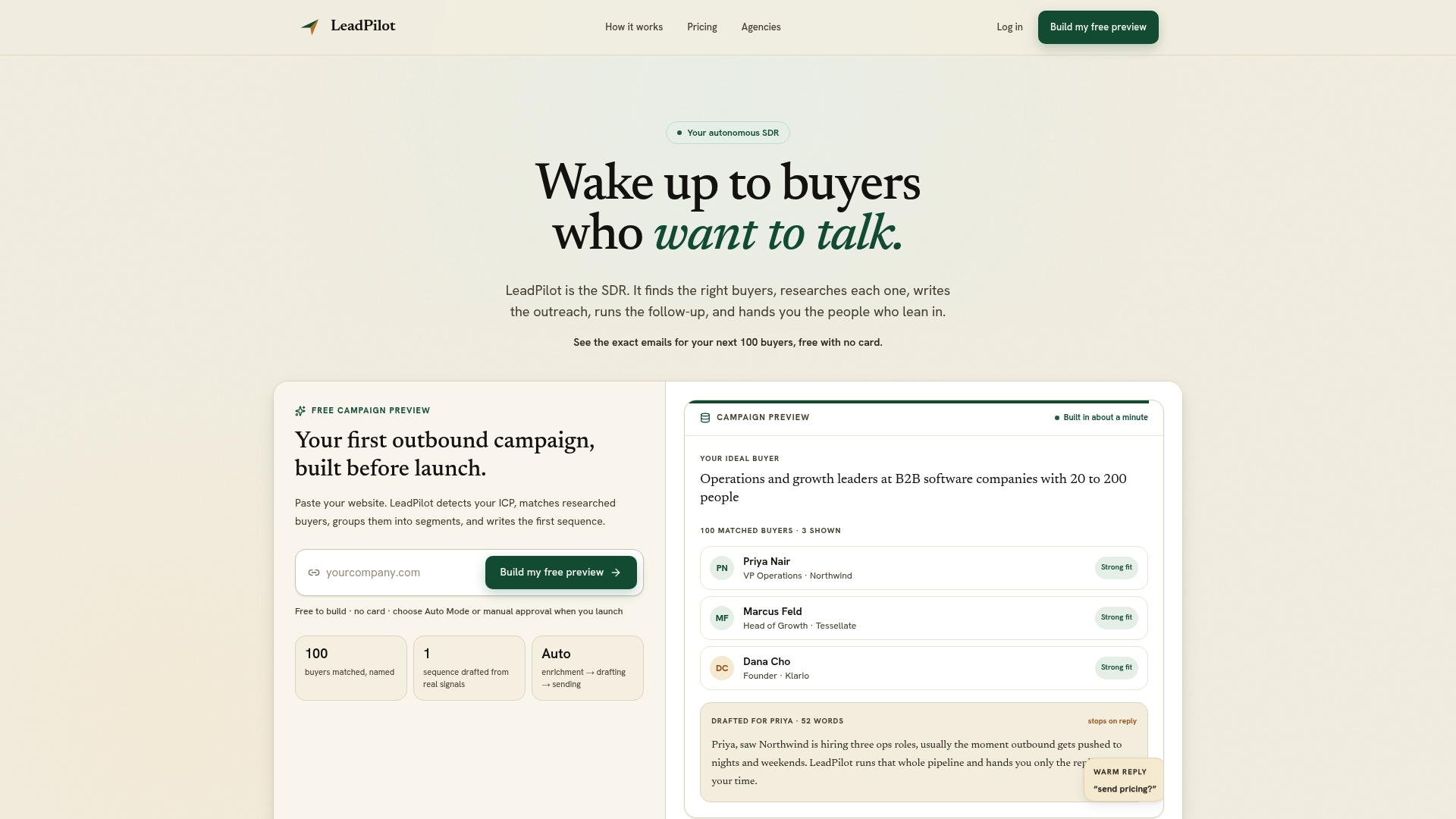
For founders and lean sales teams that do not have the headcount to run a full SDR function, that distinction matters in practice. No list to build, no sequences to configure, no domains to warm. Runleadpilot’s managed outbound platform handles the full workflow from targeting through reply handoff, with monthly subscription plans based on the number of researched buyers and sending capacity. Agencies can run multi-client workspaces under consolidated billing. Before committing, you can build a free campaign preview to see exactly who Runleadpilot would target and what the outreach would look like. Start your free campaign preview at runleadpilot.com.
Key takeaways
The strongest Clearbit alternatives in 2026 are purpose-built for specific workflows: enterprise GTM teams need ZoomInfo’s intent data, compliance-driven buyers need Cognism or Dropcontact, and founders who want pipeline without the SDR overhead need a managed platform like Runleadpilot.
| Point | Details |
|---|---|
| HubSpot acquisition changed everything | Standalone Clearbit tools ended in April 2025; non-HubSpot teams need a replacement now. |
| Match tool category to workflow | All-in-one, compliance-focused, and API-first platforms serve distinct needs; pick the category before the vendor. |
| Enterprise vs. budget options | ZoomInfo starts around $15,000/year; Apollo runs $49/seat/month; usage-based tools like ListKit scale with consumption. |
| Migration requires field mapping | Audit every Clearbit field name and CRM workflow before switching to avoid broken automations post-migration. |
| Runleadpilot as a managed alternative | Runleadpilot handles the full SDR workflow, from ICP detection to warm reply handoff, without requiring a self-serve database. |