Follow Up Cadence: Essential Guide for Sales Professionals
Master your follow up cadence with our essential guide! Learn structured outreach to boost engagement and prevent dropped leads.

Follow Up Cadence: Essential Guide for Sales Professionals
What is a follow-up cadence and why does it matter?
A follow-up cadence is a structured sequence that defines exactly how many times you reach out to a prospect, through which channels, at what intervals, and with what type of message at each step. It turns persistence from a personality trait into a repeatable system.
Most sales professionals already know they should follow up. The problem is that without a defined cadence, follow-up becomes reactive and inconsistent. Leads fall through the cracks after one ignored email. Reps make judgment calls on timing that vary wildly from week to week. The result is a pipeline that depends on memory rather than method.
A well-designed cadence solves all of that:
- No dropped leads. Every prospect receives the full planned sequence, not just whatever a rep remembers to send.
- Multi-channel reach. Mixing email, phone, and social raises the odds of connecting, since buyers respond to different mediums.
- Measurable outreach. The same pattern runs for every lead, which means you can track what works and improve it.
- Disciplined persistence. You stay present without crossing into pestering territory, because the spacing is built in.
The gap between reps who hit quota and those who don’t often comes down to this one habit. A cadence closes that gap by making consistent follow-up the default, not the exception.
Why most prospects don’t respond to your first email
Follow-up emails generate a substantial portion of all replies in cold outreach campaigns. The first email alone rarely does the work. Yet nearly half of senders never follow up at all.
Silence from a prospect almost never means outright rejection. It usually means they’re busy, their inbox is competing with dozens of other priorities, or the timing of your first message was simply off. Prospect silence most often signals busyness, not disinterest. Treating it as a “no” is the most expensive mistake in outbound.
Here’s what actually drives non-response:
- Inbox overload. Decision-makers receive dozens of cold emails daily. Your message gets buried, not deleted.
- Timing misalignment. The prospect may be mid-quarter, traveling, or focused on a different priority when your email lands.
- Lack of immediate relevance. The first email didn’t connect the offer to a problem they’re actively feeling right now.
- No urgency. Without a reason to act today, even interested prospects defer.
The follow-up sequence is where you fix all of this. Each additional touch gives the prospect another opportunity to engage at a different moment, with a different frame. 70% of replies in cold email campaigns come from follow-up emails beyond the first contact, and the first follow-up alone can yield 26% of positive responses. Stopping after one email doesn’t just lose a deal. It donates your pipeline to whoever follows up next.
Pro Tip: Never reference the silence. Don’t write “I haven’t heard back from you.” Come in with a new angle, a fresh data point, or a direct question. Each follow-up should read like it could stand alone.
What is a sales cadence and what makes it effective?
A sales cadence is a repeatable outreach plan defined by four variables: the number of touches, the channels used, the spacing between touches, and the total duration before you stop or move the prospect to a lighter nurture. The cadence defines these four things and runs the same disciplined pattern for every lead, whether executed by a rep or through automation.
“Cadence” and “sequence” are used interchangeably in most platforms. When people distinguish them, “sequence” usually refers to the automated workflow inside a sales engagement tool, while “cadence” refers to the underlying rhythm and strategy. For practical purposes, they mean the same thing.
The advantages of running a defined cadence:
- Reliable pipeline development. Consistent outreach produces predictable results you can forecast and improve.
- Persistence without pestering. Built-in spacing prevents back-to-back messages that read as spam.
- Multi-channel lift. Email plus phone plus a LinkedIn touch outperforms any single channel alone. Senior buyers, in particular, often respond well to a phone call even when they don’t pick up.
- Lead prioritization. Cadences pay off most when reserved for well-scored leads. Applying your highest-effort sequence to every contact wastes resources. Personalization at the opener, tied to the prospect’s role or a trigger event, lifts reply rates far more than volume does.
- Measurable and improvable. Because the same pattern runs every time, you can isolate which touches, channels, and message types drive replies and refine from there.
The goal isn’t to contact a prospect as many times as possible. It’s to give the conversation a real chance through a disciplined, value-driven sequence, then exit gracefully when the signal says “not now.”
Core elements and templates of an effective cadence
The anatomy of a strong follow-up sequence comes down to four decisions: how many touches, which channels, what spacing, and what each message actually says.
How many touches?
Between four and six follow-ups after the initial email is the research-backed range for maximizing replies without burning contacts, resulting in roughly five to seven total touchpoints. Beyond six follow-ups, incremental reply rates tend to drop below the effort cost of sending, and spam complaints can increase, negatively impacting deliverability.
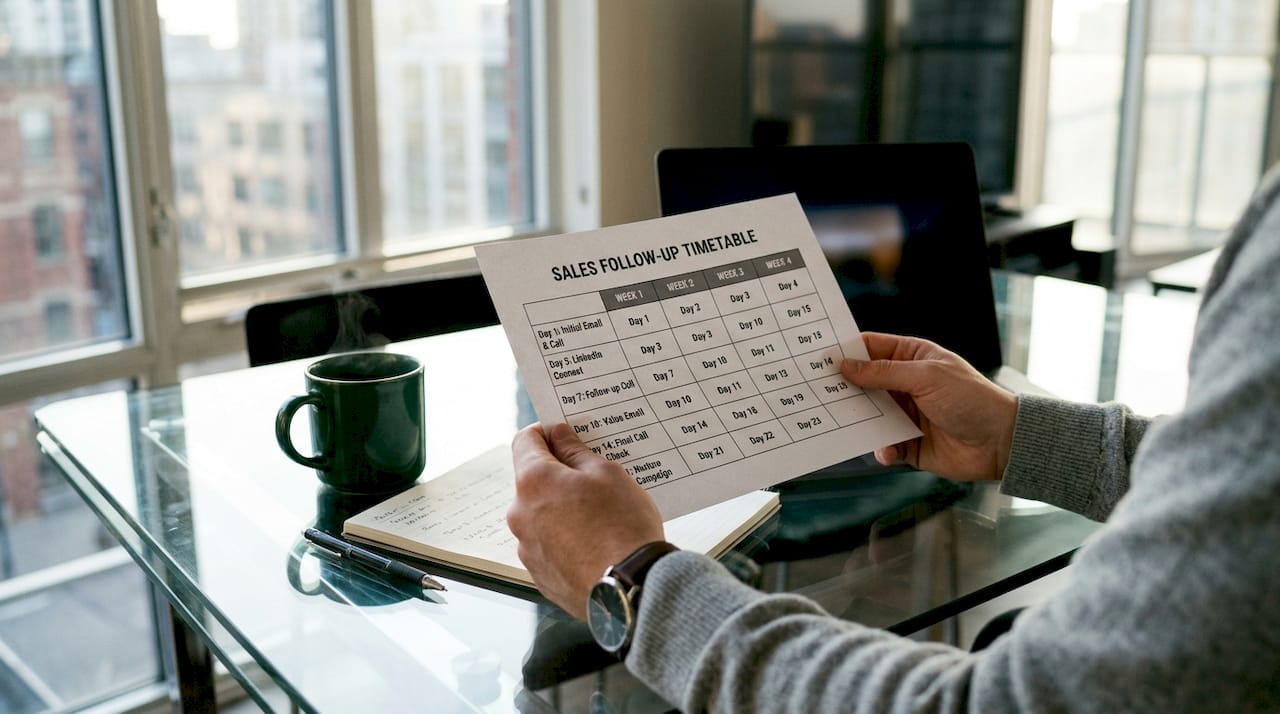
For enterprise deals with longer buying cycles, a higher number of touches over several weeks is a reasonable approach. For inbound leads, a moderate number of touches over about one to two weeks is typically sufficient. The principle stays the same: early touches are tight, later touches spread out.
Timing and spacing
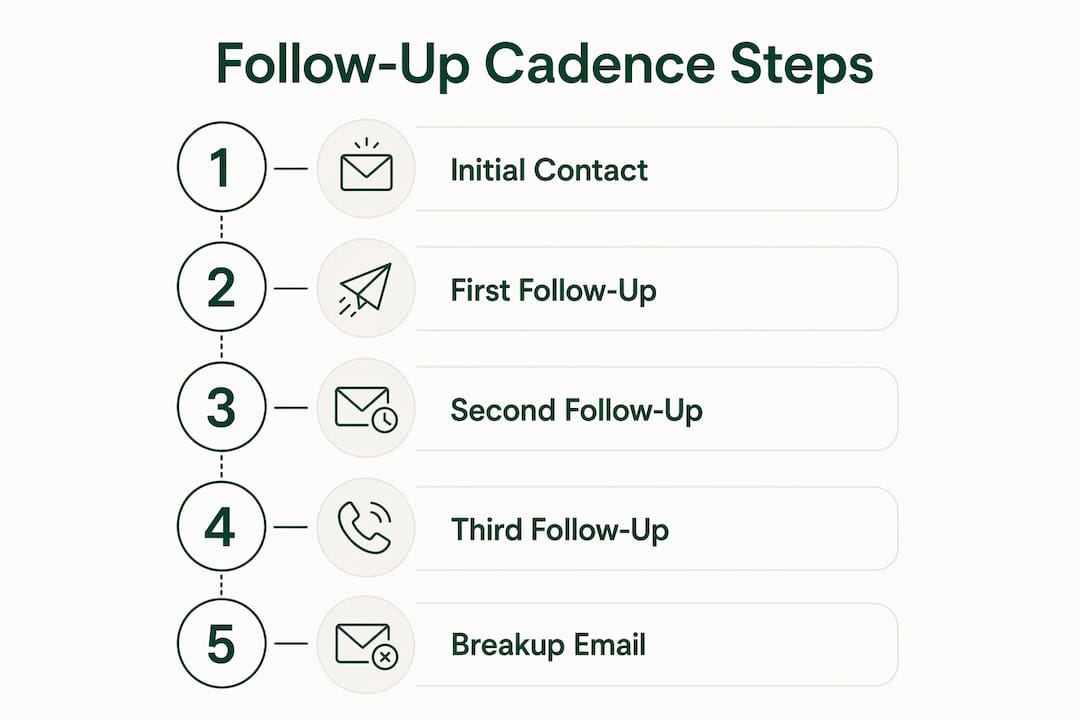
The proven spacing skeleton is day 1, day 4, day 8, and day 15, with a breakup email around day 21–35. Shorter gaps early in the sequence make sense because you’re fresh in the prospect’s mind. Longer gaps later give them breathing room before the close.
Tuesday through Thursday mornings in the prospect’s local time zone generally outperform other windows for sending emails. Monday inboxes are buried in backlog. Friday afternoons are mentally gone.
Message types at each touch
Every follow-up must add new value. “Just checking in” is not a follow-up. It’s a second first email with no reason to respond. Here’s what each touch should carry:
- Touch 1 (Day 1): Trigger-based intro with a clear, specific call to action.
- Touch 2 (Day 4–5): A new proof point, a customer result, or a relevant metric. Sent as a reply in the original thread. Short, under 80 words.
- Touch 3 (Day 7–8): A direct question about their priority. Change the angle, not the ask.
- Touch 4 (Day 14–15): A peer case study or industry-specific insight they haven’t seen.
- Touch 5 (Day 21–22): A new angle or a different pain point. This is also a strong slot for a personalized video.
- Breakup email (Day 30–35): A final resource offer with an explicit, honest exit. Mean it. Don’t bury a soft ask in the last line.
Two useful frameworks
The 3-3-3 rule is a minimal viable cadence for reps building the persistence habit: at least 3 touchpoints, across 3 different channels (email, LinkedIn, phone), spaced 3 days apart. It’s a starting point, not a final system.
The 2-2-2 rule fits longer sales cycles: follow up at 2 days, 2 weeks, and 2 months. The 2-month touch is particularly useful for prospects who were genuinely interested but had their timeline shift, which happens constantly in complex B2B deals.
Pro Tip: Reply-in-thread follow-ups preserve context and reduce friction for the prospect. Sending touch 2 as a reply to the original email, rather than a fresh message, keeps the conversation intact and makes it easier for the prospect to respond.

How Runleadpilot’s AI SDR automation enhances cadence effectiveness
Designing a strong cadence on paper is one thing. Executing it consistently across hundreds of prospects, without letting personalization slip or timing drift, is where most lean teams break down. That’s the problem Runleadpilot was built to solve.
Runleadpilot handles the full SDR workflow from the first touch through reply handoff. It reads your website to detect your ideal customer profile, sources and researches matching decision-makers, and writes personalized cold emails from real business signals, not templates. The platform manages dedicated sending domains and inboxes to protect deliverability, then runs the follow-up sequence automatically.
What separates Runleadpilot from a basic email sequencer is the signal layer. The platform adapts outreach based on prospect behavior, adjusting timing and content when engagement signals indicate active interest. Signal-based follow-up outperforms fixed schedules because it matches the moment of highest consideration. When a prospect opens an email multiple times without replying, that’s a buying signal. Runleadpilot surfaces it and acts on it.
Key capabilities that directly improve cadence outcomes:
- Automated sequence management across cold email automation with built-in spacing and reply detection.
- AI-personalized messaging at each touch, drawn from real company and buyer signals rather than generic copy.
- Dedicated domain and inbox management to keep deliverability high across the full sequence.
- Warm reply routing so the human team only engages when a prospect is ready to talk.
- Free campaign preview before any commitment, so you can see the targeting and messaging before launch.
For founders and lean sales teams running outbound sales automation without a full SDR headcount, Runleadpilot effectively runs the cadence layer end to end. Agencies managing multiple clients can consolidate everything in one workspace with shared billing.
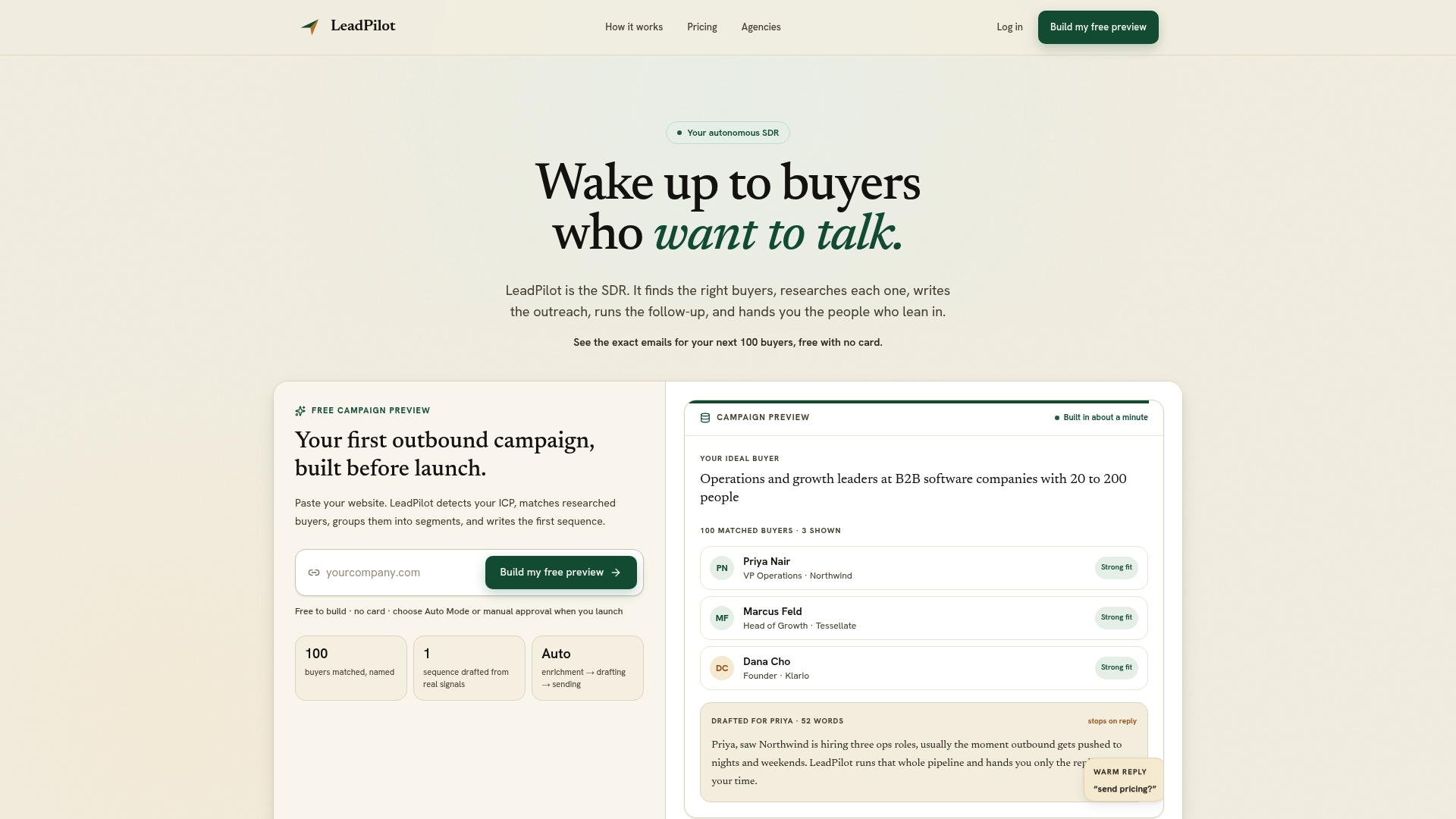
Ready to run a cadence that actually executes? See how Runleadpilot works and build a free campaign preview before you commit to anything.
Key Takeaways
A structured follow-up cadence, built on consistent timing, multi-channel touches, and value-driven messaging at every step, is the single most reliable way to convert cold outreach into pipeline.
| Point | Details |
|---|---|
| Follow-ups drive most replies | 42%–70% of replies come from follow-up touches, not the first email. |
| Optimal cadence length | Four to six follow-ups after the initial email, for 5–7 total touches, is the research-backed range for most B2B outbound. |
| Proven timing skeleton | Space touches at day 1, day 4, day 8, and day 15, with a breakup email around day 21–35. |
| Every touch needs new value | “Checking in” messages reduce reply rates. Each follow-up should add a proof point, case study, question, or new angle. |
| Signal-based timing wins | Adapting send timing to prospect behavior, like repeated email opens, outperforms fixed-schedule sequences. |
The discipline most sales teams skip
There’s a version of follow-up cadence advice that treats the whole thing as a scheduling problem. Pick the right days, write the right number of emails, and the replies will come. That framing misses the harder part.
The real discipline is treating each touch as a distinct conversation, not a reminder that you exist. Most reps who “do follow-up” are actually sending the same message with slightly different subject lines. They’re not adding value. They’re adding noise. And prospects can feel the difference immediately.
What actually works is thinking of your cadence as a decision tree, not a drip sequence. When a prospect opens your email three times and doesn’t reply, that’s not silence. That’s a signal to compress your timing and come in with a specific question. When someone replies but doesn’t commit, that’s not a stall. That’s a cue to tighten the cadence and introduce proof. The calendar matters less than your ability to read what the prospect’s behavior is telling you.
The other thing most guides underemphasize: the breakup email is not a failure. It’s often the highest-converting touch in the entire sequence, precisely because it changes the psychology of the interaction. A genuine, no-strings exit gives the prospect permission to respond honestly. That’s when the “actually, let’s talk” replies come in.
Build the sequence before you send the first email. Know what touch 4 says before touch 1 goes out. And when the data tells you something isn’t working, change the message, not just the timing.