B2B Data Quality: A Metric-First Playbook for Sales Teams
Enhance B2B data quality to boost sales. Discover key metrics and actionable steps to improve your CRM and stop pipeline decay.

B2B Data Quality: A Metric-First Playbook for Sales Teams
Start continuous enrichment plus prioritized field validation today. That single combination does more to stop pipeline decay than any one-time data cleanup project ever will. Industry research puts B2B contact decay at 20–30% per year, which means roughly one in four records in your CRM is already wrong or incomplete right now.
Three things to do this week:
- Run a 200-record enrichment sample against your highest-priority ICP segment and measure how many records return a verified email, a direct-dial number, and a current job title.
- Enforce validation rules at lead entry: required fields, allowed-value picklists, and email-format checks before a record saves.
- Assign a named data steward to your top 500 accounts. Ownership without a name attached is not ownership.
Four metrics to check right now:
- Bounce rate on your last outbound campaign (anything above 3% signals a deliverability problem rooted in stale data)
- Contact decay estimate: divide the number of hard bounces plus job-change alerts in the last 90 days by total active contacts
- Enrichment coverage rate: what percentage of records have all five priority fields populated (verified email, phone, job title, company name, firmographic segment)
- Field completion rate for your top-five fields across the full CRM, not just new leads
Key Takeaways
| Point | Details |
|---|---|
| Decay is faster than you expect | Contact data can appear to decay substantially annually under continuous re-verification, far above the classic 30% benchmark. |
| Usable record rate is the first metric | Multiply field completion rate by sampled accuracy rate; target 85%+ for active outbound segments. |
| Waterfall enrichment outperforms single-source | A 15-plus provider waterfall returned ~98% verified email and ~85% phone coverage versus materially lower single-source rates. |
| Governance needs a name attached | Assign a named data steward to your top accounts; ownership without a person is not ownership. |
| Runleadpilot for fast prospect freshness | Runleadpilot sources and verifies contacts at campaign launch, keeping outbound prospect data current without MDM infrastructure. |
Table of Contents
- What is B2B data quality, and why does it have six dimensions?
- Why poor B2B data quality costs more than you think
- What failure modes actually look like in your CRM
- How to measure B2B data quality with real formulas
- The data quality lifecycle: assess, clean, enrich, prevent, monitor
- A prioritized implementation playbook
- Data governance: who owns what and how to keep it running
- Which tools should you evaluate for B2B data management?
- When a managed outbound platform keeps prospect data fresher
- What I’d actually prioritize first
- Runleadpilot keeps your prospect data fresh without the MDM overhead
- Sources
What is B2B data quality, and why does it have six dimensions?
B2B data quality is the degree to which your contact and account records are fit for their intended use, whether that use is routing a lead to the right territory rep, scoring an account for ABM, or sending a cold email sequence without hitting spam traps. A record that is technically “complete” but carries a two-year-old job title is not quality data for outbound. Fitness for use is the operative phrase.
Six dimensions map to six distinct failure modes:
- Accuracy: the record reflects the real-world state of the contact or company (correct email, current employer, right phone number).
- Completeness: all fields required for a given workflow are populated. A record missing a direct-dial number is incomplete for a calling campaign, even if the email is valid.
- Consistency: the same entity is represented the same way across CRM, MAP, and data warehouse. “Acme Corp,” “Acme Corporation,” and “ACME” are three representations of one company.
- Timeliness / currency: the record was verified or refreshed recently enough to still be accurate. Given roughly 2.1% per month match-rate degradation when records are not actively refreshed, a record that was clean six months ago may already be unreliable.
- Uniqueness: each real-world entity appears exactly once. Duplicate contacts inflate pipeline, skew scoring, and trigger embarrassing double-outreach.
- Validity / conformity: values conform to defined formats and allowed values. A phone number stored as “see LinkedIn” fails every downstream system that tries to dial it.
The mnemonic that sticks in practice: ACTU-UV (Accuracy, Completeness, Timeliness, Uniqueness, Validity). Post it in your RevOps Slack channel.
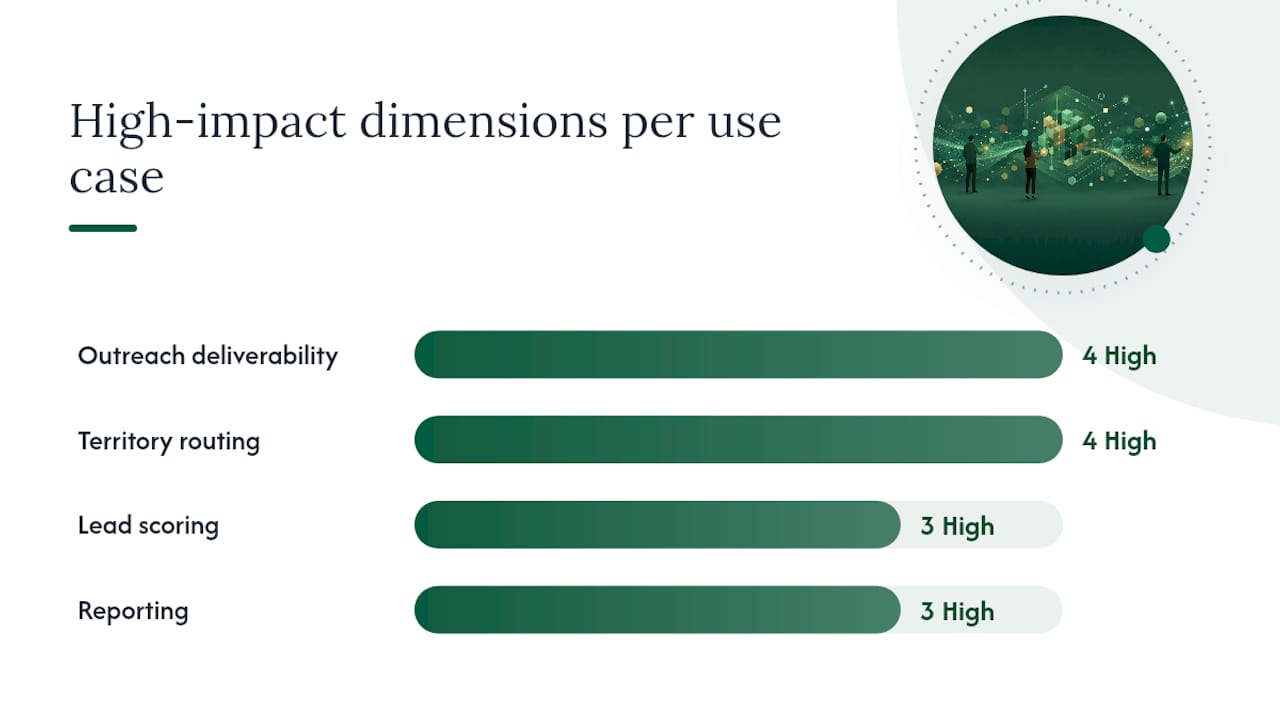
| Dimension | Outreach deliverability | Territory routing | Lead scoring | Reporting |
|---|---|---|---|---|
| Accuracy | High | High | High | High |
| Completeness | High | Medium | High | Medium |
| Timeliness | High | High | Medium | Medium |
| Uniqueness | Medium | High | High | High |
| Consistency | Low | High | Medium | High |
| Validity | High | Medium | Low | Medium |
Why poor B2B data quality costs more than you think
Gartner estimates the average organizational cost of poor data quality at $12.9 million per year. That figure covers wasted rep time, misdirected campaigns, bad forecasts, and the downstream cost of decisions made on wrong data. For most sales and marketing teams, the damage shows up in three places before it ever reaches a CFO’s spreadsheet.
Rep productivity. When a rep spends 20 minutes verifying a contact before dialing, that is not a people problem. It is a data problem. Multiply that across a 15-person team and a 200-call week, and you have lost dozens of selling hours to research that a clean CRM would have made unnecessary.
It damages your sending domain’s reputation, which raises bounce rates on future sends to contacts who are perfectly reachable. The damage compounds.
Pipeline accuracy. Duplicate records inflate open-opportunity counts. Stale job titles route deals to the wrong rep. Incomplete firmographics break ICP scoring models. Each failure mode produces a different kind of forecast error, and they tend to stack.
Short before-and-after examples from common fixes:
- A team that enforced email verification at lead entry cut its hard-bounce rate from 6.2% to under 1% within 60 days, recovering deliverability on a domain that had been flagged by major inbox providers.
- An outbound team that ran monthly re-enrichment on its top 1,000 accounts found that contact data can appear to decay substantially annually under continuous re-verification when measured with continuous re-verification, compared to the classic 30% annual benchmark, confirming that annual cleanup cycles miss the majority of decay events.
- A RevOps team that resolved duplicates before a Salesforce migration reduced its active-contact count by 22%, which immediately improved lead-scoring model precision because the training data no longer contained the same person twice under different names.
What failure modes actually look like in your CRM
Most data quality problems are not mysterious. They are predictable, they appear at predictable points in the data lifecycle, and they re-emerge on a predictable schedule if you do not build prevention into the process.
The six failure modes to watch:
- Duplicates: two or more records representing the same contact or account. Symptoms include multiple open opportunities for the same deal, conflicting owner assignments, and inflated contact counts in reports.
- Incomplete records: missing required fields. The most damaging gaps are verified email, direct-dial phone, job title, and company domain, because these four fields drive routing, deliverability, and ICP classification.
- Stale contacts: accurate at entry, now wrong. Job changes, company rebrands, and office closures all produce stale records. These are the hardest to detect without active re-verification.
- Invalid emails and phones: formatted correctly but not deliverable or dialable. A syntactically valid email that bounces is worse than a missing email because it consumes send credits and damages domain reputation.
- Integration mismatches: the same account represented differently in CRM, MAP, and data warehouse. Field-mapping errors during sync create phantom duplicates and break cross-system reporting.
- Unvalidated data: records that entered the system without passing through any format or existence check. Web form submissions and list imports are the two most common sources.
Detection methods:
- Fuzzy-dedup reports using tools like Dedupely or CRM-native duplicate detection with phonetic matching enabled
- Enrichment gap analysis: run your ICP list through an enrichment provider and measure what percentage of records return a verified email versus what you already have stored
- Bounce analytics from your email platform, segmented by list source and record age
- Field-completeness dashboards in your CRM or BI tool, filtered by segment and record-creation date
- Integration drift checks: compare account and contact counts between CRM and MAP on a weekly schedule; a growing gap signals a sync problem
Pro Tip: Most failure modes appear within the first 30 days after a record enters the system (bad import, unvalidated form fill) or after 6–12 months of inactivity (job change, company acquisition). Build detection checks at both points: a 30-day new-record audit and a 180-day re-verification trigger for dormant contacts.
How to measure B2B data quality with real formulas
Measurement is where most teams stall. They know data quality is a problem; they do not know how bad it is or whether it is getting better. These five KPIs give you a working scorecard.
| KPI | Formula | Target (top performers) |
|---|---|---|
| Contact decay rate | (Records invalidated in period ÷ Total records at start of period) × 100 | Under 5% per quarter with monthly re-verification |
| Field completion rate | (Records with field populated ÷ Total records) × 100, per priority field | 95%+ for verified email; 80%+ for direct-dial phone |
| Enrichment coverage rate | (Records enriched with verified data ÷ Total ICP records) × 100 | 90%+ for top-tier ICP segments |
| Dedupe rate | (Duplicate records resolved ÷ Total records before dedup) × 100 | Under 3% duplicate share after initial cleanup |
| Usable record rate | Field completion rate × Accuracy rate (sampled) | 85%+ for active outbound segments |
A few notes on these targets. The field completion rate for direct-dial phone is harder to hit than email. A 500-lead benchmark run through a 15-plus provider waterfall returned verified emails for roughly 98% of leads and direct-dial or mobile numbers for roughly 85%, while single-source runs returned noticeably lower verified coverage on the same list.
For accuracy rate, sample 100–200 records per quarter and manually verify a subset of fields against LinkedIn, company websites, and a live email verification tool. Sampling beats full-population checks for speed; it is statistically representative when done consistently.
Sample scorecard: who owns what and when
Implementation notes. Measure field completion in your CRM for operational visibility; measure accuracy and enrichment coverage in your data warehouse or enrichment platform where you can join multiple sources. When sampling for accuracy, stratify by record age (under 90 days, 90–180 days, over 180 days) so you can see where decay is accelerating. Explorium’s analysis recommends time-adjusted accuracy checks at Day 0, Day 30, Day 60, and Day 90 as the most reliable procurement signal for ongoing quality.
The data quality lifecycle: assess, clean, enrich, prevent, monitor
One-time cleanup projects fail because they treat data quality as a state to achieve rather than a process to run. The lifecycle below is repeatable and sustainable.
Five lifecycle stages:
- Assess: establish your baseline. Run field-completion reports, a sample accuracy check, and a dedup scan. You cannot prioritize fixes without knowing where the gaps are.
- Clean: resolve the problems the assessment found. Dedup, standardize formats, remove records that cannot be enriched and have no pipeline value.
- Enrich: fill verified data into gaps using a provider or waterfall architecture. Prioritize verified email, direct-dial phone, job title, company domain, and core firmographics in that order.
- Prevent: build rules that stop bad data from entering. Validation at form submission, required fields on lead creation, allowed-value picklists, and integration field-mapping audits.
- Monitor: track the five KPIs above on the cadences in the scorecard. When a metric drifts outside target, trigger the relevant stage (re-enrich, re-dedup, tighten a validation rule).
Cadence table
| Action | Cadence | Owner |
|---|---|---|
| Field-completion dashboard review | Weekly | Sales Ops |
| New-record validation audit (30-day cohort) | Monthly | Data steward |
| Re-enrichment of active ICP segments | Monthly | Marketing Ops / RevOps |
| Dedup scan and merge | Quarterly | Data steward |
| Full accuracy sample (200 records) | Quarterly | RevOps |
| Integration drift check (CRM vs MAP counts) | Weekly | IT / Engineering |
| Annual data quality program review | Annually | RevOps lead + executive sponsor |
Roles:
- Data steward: owns day-to-day record hygiene, exception resolution, and the dedup queue. Usually one person in RevOps or Sales Ops for teams under 100 employees.
- RevOps lead: owns the scorecard, the lifecycle cadence, and escalation to executive sponsors.
- Sales Ops: owns field-completion dashboards and rep-facing data entry rules.
- Marketing Ops: owns enrichment platform configuration, list hygiene before campaigns, and bounce analytics.
- IT / Engineering: owns integration pipelines, field-mapping audits, and data warehouse sync.
Tooling touches every stage: a CRM for storage and dashboards, an enrichment provider for the enrich stage, a dedup tool for the clean stage, and a BI or data warehouse layer for cross-system monitoring.
A prioritized implementation playbook
The fastest path from “we know data quality is bad” to “we have measurable improvement” is a sequenced program, not a big-bang project.
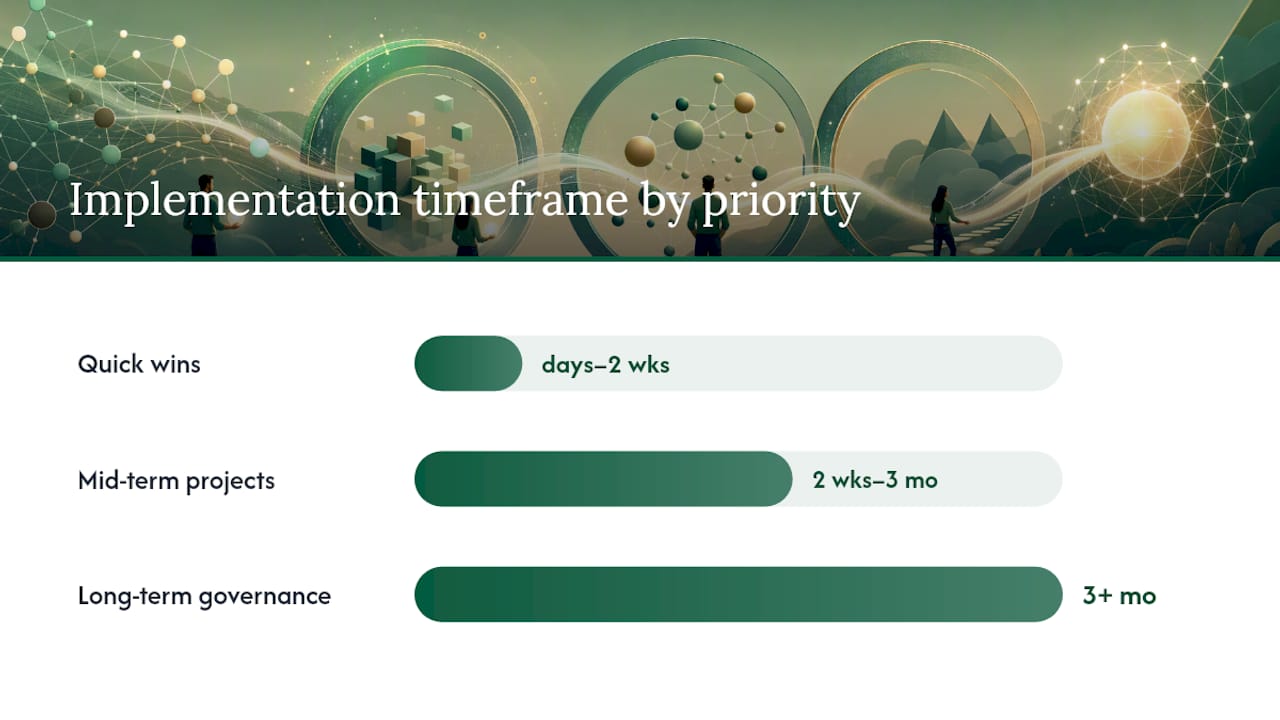
Quick wins (days to 2 weeks):
- Pull a field-completion report for your top five fields across all active contacts. This takes under an hour in any CRM and immediately shows you where the worst gaps are.
- Enable email-format validation on all web forms and CRM lead-entry screens. No code required in most platforms; it is a settings change.
- Run a dedup scan on your CRM using native duplicate detection or a tool like Dedupely. Merge obvious duplicates before doing anything else, because duplicates inflate every other metric.
- Set up a bounce-rate alert in your email platform: if a campaign exceeds 3% hard bounces, pause and investigate the list source before continuing.
- Identify and name a data steward. Even a part-time assignment is better than no ownership.
Mid-term projects (2 weeks to 3 months):
- Run a full enrichment pass on your ICP segments using a multi-source waterfall. Measure usable-record rate before and after.
- Build a field-completion dashboard in your CRM or BI tool, segmented by record source, age, and ICP tier.
- Implement required-field rules on lead and contact creation for your five priority fields.
- Audit integration field mappings between CRM and MAP. Fix any fields that are syncing to the wrong destination or not syncing at all.
- Establish a monthly re-enrichment cadence for your top 1,000 active accounts.
Long-term governance (3 months and beyond):
- Formalize a data quality SLA: define what “good” means for each field, who is responsible, and what the escalation path is when a metric falls below target.
- Build a stewardship RACI and review it quarterly.
- Evaluate a dedicated DQM platform or MDM layer if your record volume exceeds what CRM-native tools can handle cleanly.
- Integrate data quality KPIs into RevOps QBRs so executive sponsors see the numbers alongside pipeline and revenue metrics.
Cost-driver notes:
- Enrichment cost scales with record volume and provider tier. A waterfall architecture (multiple providers in sequence) costs more per record than a single-source run but delivers materially higher coverage.
- Verification cadence is the second-largest cost driver. Monthly re-verification on 50,000 records is a meaningful line item; prioritize your highest-value ICP segments first.
- Automation reduces the ongoing labor cost of stewardship but requires upfront configuration. Manual stewardship is viable for teams under 5,000 active records; above that, automation pays for itself quickly.
Change management. The biggest obstacle to sustained data quality is not tooling. It is rep behavior. Reps skip required fields when they feel the fields slow them down. The fix is making the benefit visible: show reps how a complete record routes faster, scores higher, and reaches a real person. Tie data quality metrics to pipeline outcomes in your QBR deck, not just to a compliance checklist.
Data governance: who owns what and how to keep it running
Governance is the difference between a data quality project and a data quality program. Projects end; programs run.
Role descriptions:
- Data steward: the operational owner of record hygiene. Resolves exceptions, runs the dedup queue, enforces field standards, and escalates systemic problems to the RevOps lead.
- Domain owner: owns the definition and allowed values for a specific data domain (contacts, accounts, opportunities). Usually a senior member of Sales Ops or Marketing Ops.
- RevOps lead: owns the governance framework, the scorecard, and the relationship with the executive sponsor. Translates data quality metrics into business impact language.
- Integration data owner: owns the field-mapping specifications and sync rules between systems. Usually sits in IT or Engineering but must coordinate closely with RevOps.
Governance artifacts every team needs:
- Data quality SLA: defines minimum acceptable values for each KPI, the measurement cadence, and the escalation path when a metric falls below threshold.
- Field definitions and allowed values: a shared data dictionary that specifies what each field means, what values are permitted, and what format is required. Stored in a wiki or a tool like Notion or Confluence.
- Exception workflows: a documented process for what happens when a record fails validation. Who reviews it? What is the resolution SLA? Where does it go if it cannot be resolved?
- Stewardship RACI: a matrix mapping each data quality task to Responsible, Accountable, Consulted, and Informed roles. Reviewed quarterly.
Pro Tip: *Executive sponsorship is easier to secure when you frame data quality in revenue terms, not data terms.
For teams seeking a formal standards foundation, the ISO 8000 family of data quality standards provides definitions and governance frameworks that align with the dimensions covered here.
Which tools should you evaluate for B2B data management?
The right tooling architecture depends on your record volume, your enrichment gap, and whether you dial or only email. Here is how the categories break down.
Vendor categories:
- Enrichment providers: append verified contact and firmographic data to existing records. Examples include ZoomInfo, Clearbit (now part of HubSpot), and Apollo. Coverage and accuracy vary significantly by segment and geography.
- DQM platforms: dedicated data quality management tools that handle dedup, standardization, validation, and monitoring. Useful when CRM-native tools are insufficient for your volume.
- CDP / MDM layers: customer data platforms and master data management systems that create a single customer record across all systems. Appropriate for enterprise teams with multiple data sources and complex integration needs.
- Verification services: real-time email and phone verification APIs (NeverBounce, ZeroBounce, Twilio Lookup) that confirm deliverability or dialability without appending new data.
- Integration connectors: tools like Fivetran, Stitch, or native CRM connectors that manage data pipelines between systems. Critical for preventing integration drift.
- Waterfall architectures: sequential enrichment runs across multiple providers, stopping when a verified result is found. A waterfall architecture plus post-cascade verification reduces bounce risk; the critical procurement question is whether verification runs after combining sources, not before.
Evaluation checklist:
- What is the provider’s refresh cadence? How often does the underlying database update?
- Does verification run after the waterfall cascade, or only on the primary source?
- What is the verified phone coverage rate on your specific ICP (industry, company size, geography)?
- What SLA does the provider offer on valid rate, and how is it measured?
- API (real-time) or batch? For high-velocity inbound, real-time API matters; for periodic enrichment runs, batch is fine.
- What is the pricing model: per record, per seat, or flat subscription? Model your actual usage before signing.
ZoomInfo is the most widely deployed large-scale B2B data provider in the U.S. market. Its coverage is broad, its refresh cadence is frequent, and it integrates natively with Salesforce, HubSpot, and most major MAPs. The tradeoff: it is expensive at scale, its phone coverage on SMB contacts is weaker than its enterprise coverage, and its accuracy on international records outside North America drops materially. For teams that primarily sell into mid-market and enterprise U.S. accounts, it is a reasonable anchor provider. For teams with a heavy SMB or international ICP, a waterfall that supplements ZoomInfo with secondary providers typically outperforms ZoomInfo alone.
Independent tests show wide variance in verified enrichment rates across providers. Published tests report real enrichment rates ranging from roughly 14% to roughly 87% depending on methodology, with stricter “real enrichment” measures (live send and bounce tracking) producing lower but more meaningful figures than vendor-reported match rates. Never buy on a vendor’s Day 0 accuracy claim alone.
Pro Tip: Run your own match-rate benchmark on a real ICP list before committing to a contract. Take 200–500 records from your actual target segment, run them through the provider’s trial or POC environment, and measure verified email rate, phone coverage, and job-title accuracy independently. Vendor claims matter far less than how a provider performs on your actual contacts.
POC steps for testing a data provider:
- Export 200–500 records from your highest-priority ICP segment (not a random sample; use your actual target accounts).
- Submit the list to the provider’s POC environment and request a waterfall run with post-cascade verification.
- Measure: verified email rate, direct-dial phone rate, job-title match rate, and company-domain accuracy.
- Re-run the same list 30 days later to measure time-adjusted accuracy. A provider that delivers 90% on Day 0 but drops to 75% by Day 30 is a worse choice than one that delivers 82% and holds at 80% by Day 30.
- Compare usable-record rate (verified email + at least one phone or job title) across providers on the same list.
For a broader look at sales prospecting tools that integrate with enrichment workflows, the LeadPilot blog covers how these categories fit together in a live outbound stack.
When a managed outbound platform keeps prospect data fresher
A full MDM or enterprise DQM implementation takes months and requires dedicated engineering resources. For lean teams, agencies, and founders running fast outbound campaigns, there is a faster path to fresher prospect data: a managed outbound platform that sources and verifies contacts as part of the campaign workflow itself.
Where managed outbound platforms reduce decay risk:
- Campaign-level enrichment: the platform sources and verifies contacts at campaign launch rather than relying on a static CRM export, so the data is current at the moment of send.
- Dedicated sending domains: managed deliverability means bounce events are contained to campaign-specific domains rather than your primary domain, protecting sender reputation while the team learns which segments have the highest decay.
- Reply routing: warm replies are surfaced to the human team immediately, which means the team is working from live signal rather than from a stale list.
When this option fits better than a full MDM build:
- Lean teams (under 20 people) that cannot staff a dedicated data engineering function.
- Outbound agencies managing multiple clients who need per-client data freshness without per-client MDM infrastructure.
- Fast time-to-live campaigns where a 6-month MDM implementation timeline is not compatible with a Q3 pipeline target.
- Teams that need managed deliverability and a campaign preview before committing budget, rather than a long-term platform contract.
One note on scope: a managed outbound platform is an adjacent solution, not a wholesale substitute for enterprise data governance or a full MDM program. If your organization has complex multi-system data integration needs, regulatory data requirements, or a record volume in the millions, a dedicated DQM or MDM layer is the right investment. For prospect-level freshness in outbound campaigns, a managed platform solves the problem faster.
Pro Tip: *If you are evaluating a managed outbound platform, ask specifically how it sources contacts: does it pull from a static database, or does it run live enrichment at campaign time?
For teams evaluating Clearbit alternatives or multi-source enrichment options, the tradeoffs between static databases and live-enrichment architectures are worth understanding before choosing a platform.
What I’d actually prioritize first
Most data quality programs fail not because the team lacks knowledge but because they try to fix everything at once. The teams that make real progress pick one metric, own it, and move.
Start with usable record rate on your active outbound segment.
Three honest tradeoffs worth naming:
- A waterfall enrichment architecture delivers better coverage than single-source, but it costs more and takes longer to configure. For a team with under 5,000 active records, a single quality provider is often sufficient. Scale the architecture when coverage gaps become measurable.
- Monthly re-verification is the right cadence for high-value ICP segments. For lower-priority segments, quarterly is defensible. Trying to re-verify everything monthly before you have the tooling and ownership in place is how programs stall.
- Governance artifacts (SLAs, RACIs, data dictionaries) matter enormously at scale. For a team of five, a shared Notion page and a named steward is enough. Do not let the perfect governance framework become a reason to delay the first enrichment run.
The teams that move fastest treat data quality as an operational habit, not a project. They measure one thing, fix one thing, and add the next metric when the first one is stable.
Runleadpilot keeps your prospect data fresh without the MDM overhead
Clean data in your CRM is one problem. Fresh prospect data for your next outbound campaign is a different one, and it moves faster. Runleadpilot solves the second problem for founders, lean sales teams, and outbound agencies: it reads your website to identify your ideal customer profile, sources and verifies matching decision-makers at campaign time (not from a static database), writes personalized cold emails from live business signals, and manages dedicated sending domains so your primary domain stays protected.
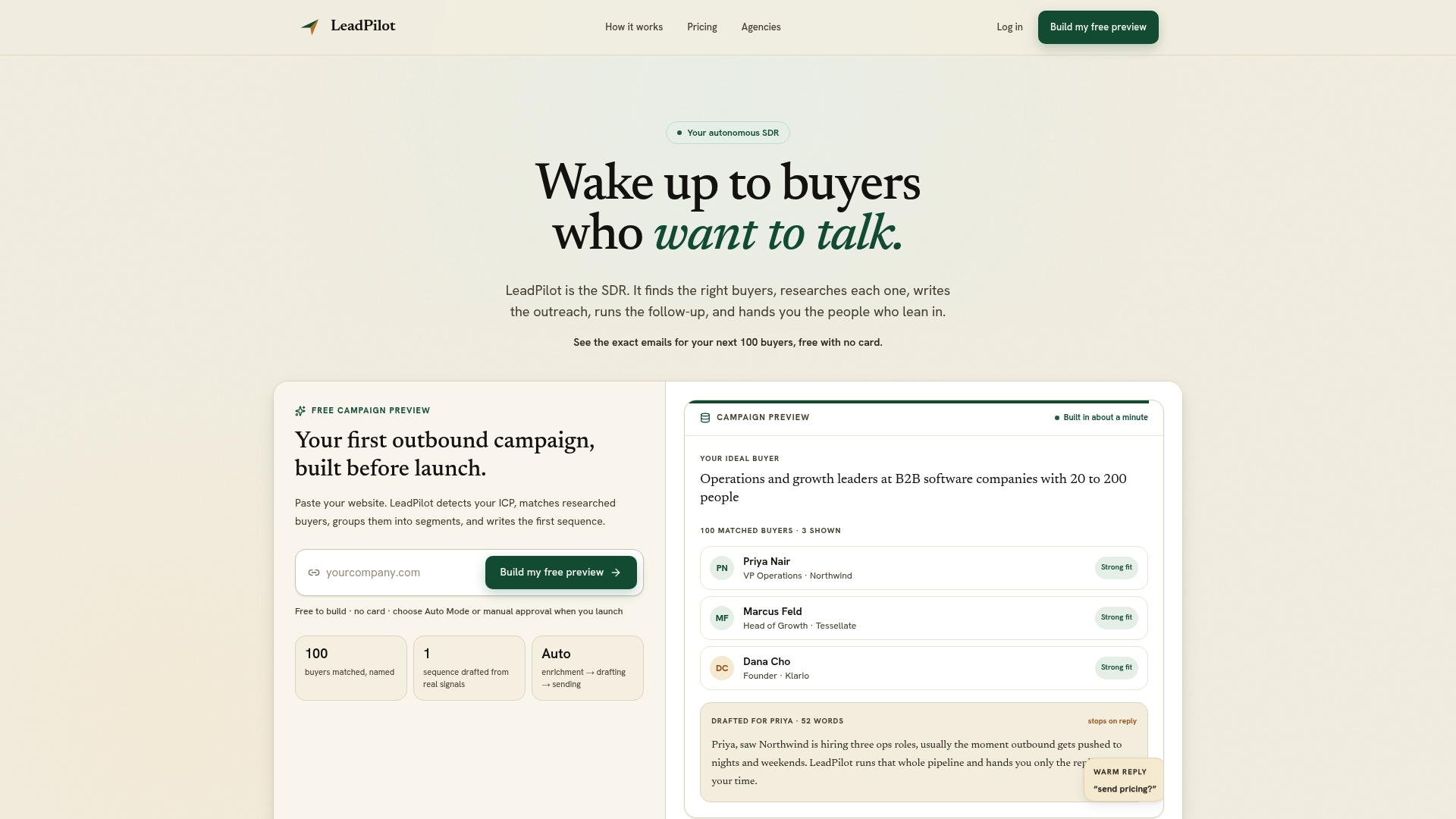
The result is a prospect list that is current when the campaign launches, not six months stale. Runleadpilot is not a replacement for enterprise MDM or a full DQM program. It is the faster path for teams that need pipeline now and cannot wait for a six-month data infrastructure project. Agencies running outbound for multiple clients get consolidated billing and per-client workspaces. Every account starts with a free campaign preview before any subscription begins. See how it works at Runleadpilot or start your free campaign preview today.
Sources
- Improving data quality in CRM
- The State of B2B Data in 2026: Enrichment Benchmark Report | Cleanlist
- B2B data API match rates & accuracy benchmarks 2026 | Explorium
- How to improve your data quality | Gartner