10–20% Replies: Signal Driven Account Based Outbound for Founders
Signal driven account based outbound for founders: a practical, tiered playbook to define ICPs, run 8–12 week cadences, act on 24–72 hour signals, and...

10–20% Replies: Signal Driven Account Based Outbound for Founders
Account-based outbound treats a named company as the unit of work, not the individual contact, and uses timely buying signals plus coordinated multi-channel sequences to move high-value accounts through the pipeline faster than volume outbound. It works best when deal size is large, multiple stakeholders sign off, and the buying committee needs consensus rather than a single yes. Expect a weeks-to-months runway, with Tier 1 accounts producing meetings relatively quickly and Tier 3 accounts converting on a slower, lower-touch clock.
TL;DR:
- Account-based outbound invests significantly more research per account, targeting hundreds of accounts with tiered effort and multi-channel sequences based on signals.
- High response rates, up to 10-20%, rely on rapid action within 72 hours of a signal, focusing on signals like funding, hiring, leadership changes, or product launches.
- Tiered outreach durations range from 8-12 weeks for Tier 1 high-value accounts to over 12 weeks with low-touch nurture for Tier 3, with escalation triggered by account activity.
- Multi-stakeholder sequences follow a structured, trigger-based opening, rotating follow-ups, and a focus on start-to-finish order of contact to maximize engagement.
- Consistent account tracking, rapid signal response, and disciplined segmentation distinguish successful teams from those that rely too heavily on automation and lack human oversight.
Table of Contents
- What Is Account-Based Outbound?
- How Do You Define an ICP for Account-Based Outbound?
- What Cadence Works for Tier 1, 2, and 3 Accounts?
- How Do You Write Multi-Stakeholder Outbound Sequences?
- Which Buying Signals Should You Act On First?
- How Do You Coordinate Email, LinkedIn, and Phone?
- What Should You Track to Scale Account-Based Outbound?
- How Should You Hand Off Warm Replies to Sales?
- What Do Top Account-Based Outbound Teams Do Differently?
- How Does LeadPilot Support Account-Based Outbound?
- Sources
What Is Account-Based Outbound?
Account-based outbound (sometimes shortened to ABP, for account-based prospecting) is what happens when account-based marketing tactics meet real cold outreach instead of just nurture campaigns and retargeting ads. It borrows the “account as the unit of work” logic from account based marketing tactics but applies it to sales motion: cold email, LinkedIn, and phone calls aimed at named companies rather than a scraped list of titles.
The distinction that trips up most teams is research time. Volume outbound treats a contact as an interchangeable row in a spreadsheet, spending maybe 30 seconds per lead before sending. Account-based prospecting spends closer to 30 minutes researching a single account before the first message goes out, according to the Account-Based Prospecting Playbook from AFF Lab. That is not a small gap. It means you cannot run account-based outbound at the same list sizes as generic outreach, and you should not try.
- Contact-as-unit (volume outbound): thousands of leads, generic templates, low per-contact investment, low reply rates.
- Account-as-unit (AB outbound): hundreds of named accounts, tiered investment, coordinated multi-channel touches, higher per-account cost but much higher relevance.
Three tiers organize that investment so you are not spending Tier 1 effort on every account:
- Tier 1 accounts get the most research and the most channels because they represent the biggest revenue opportunity or the strongest buying signals. The goal is speed to a qualified meeting.
- Tier 2 accounts get a lighter version of the same playbook. The goal is quality meetings without the labor cost of Tier 1.
- Tier 3 accounts get low-touch, mostly automated nurture. The goal is staying visible until a signal promotes them up a tier.
Track three numbers weekly across all tiers: meetings booked per account worked, pipeline generated per hour of rep or campaign time, and response quality (a real reply that engages the pitch versus an out-of-office or a flat no). Forrester’s analysis of shifting ABM budgets points to the same trend across the industry: budgets are moving toward signal-driven orchestration and away from static, calendar-based cadences, because the calendar-based version stops working the moment a target account gets acquired, hires a new VP, or changes tech stacks mid-sequence.
How Do You Define an ICP for Account-Based Outbound?
Start with four ICP dimensions and rank order them by predictive power for your product, not by convenience: company size (headcount and revenue band), industry vertical, ARR or funding stage, and tech stack markers you can actually detect (job postings mentioning a competitor tool, a public integration listing, a case study naming a specific platform). Skip vague qualifiers like “growth-minded” or “innovative” — they don’t filter anything.
Once the ICP is defined, prioritize named accounts using two hard tests instead of gut feel:
- Signal density. An account needs at least two recent signals (funding round, executive hire, product launch, expansion announcement) before it earns Tier 1 or Tier 2 status. One stale signal from eight months ago doesn’t count.
- Stakeholder discoverability. Can you find 3 to 5 real contacts at this account on LinkedIn or through enrichment tools right now? If you can’t map a buying committee, you can’t run account-based prospecting against it, no matter how attractive the logo looks.
- Deal size justification. Per-account research time only pays off when the potential contract value and buying-committee complexity justify it, a point the AFF Lab playbook makes directly when it frames ABP as account-as-unit work rather than a volume tactic wearing a fancier name.
Before an account moves into a sequence, run it through an operational checklist: enrich company and contact fields (title, seniority, LinkedIn URL, verified email), verify every email address to protect deliverability, and tag the account in your CRM with its tier, primary signal, and owner. Skipping verification is the single fastest way to torch a new sending domain’s reputation before the campaign even gets a fair test.
Pro Tip: Build your named-account list in batches of 50 to 250 rather than one giant master list. Smaller, signal-timed batches are easier to keep fresh, and stale accounts get cut instead of quietly dragging down your reply rate for months.
What Cadence Works for Tier 1, 2, and 3 Accounts?
Touch frequency and channel mix should scale down as tier number goes up. Running a Tier 1 cadence against every account in your database is how teams burn out reps and torch inboxes for no return; running a Tier 3 cadence against a genuine whale account is how you lose it to a competitor who called.
Tier 1: high-touch, 8 to 12 weeks. Phone, email, LinkedIn, and occasionally an executive-to-executive intro or a small gift tied to a real trigger, at 2 to 3 touches per week. This tier justifies a rep manually checking each account before every touch.
Tier 2: mid-touch, 6 to 8 weeks. Email and LinkedIn as the backbone, with an occasional call layered in, at 1 to 2 touches per week. Enough personalization to feel researched, without the full Tier 1 labor bill.
Tier 3: low-touch, 12+ weeks. Email-first nurture, one touch roughly every two weeks, largely automated with lighter human review. This tier exists so accounts that aren’t ready yet don’t fall off the map entirely.
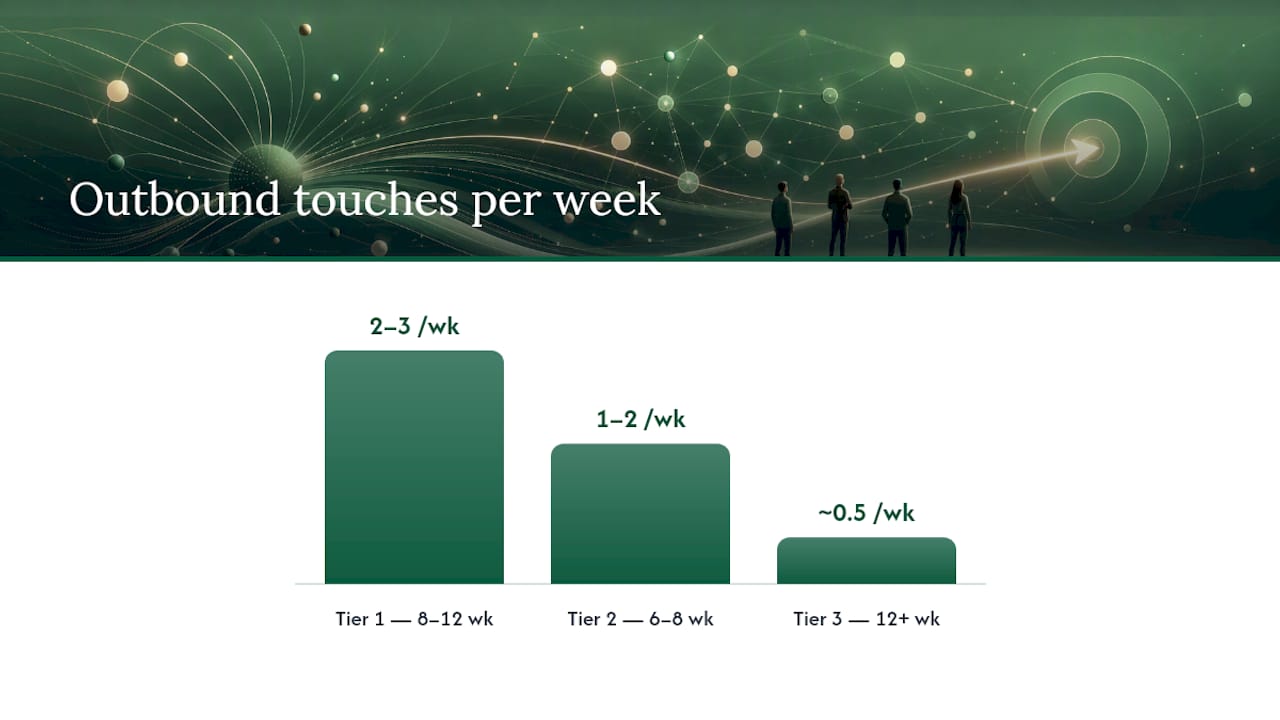
These bands track closely with the tiered ABM outbound benchmarks published by Abmatic AI, which recommend the same touch frequency and duration windows and pair them with explicit escalation rules.
Escalation should be signal-triggered, not calendar-triggered: a Tier 3 account that suddenly raises funding, posts three sales job openings, or gets a new VP of Marketing should jump to Tier 2 or Tier 1 within days, not wait for a quarterly review.
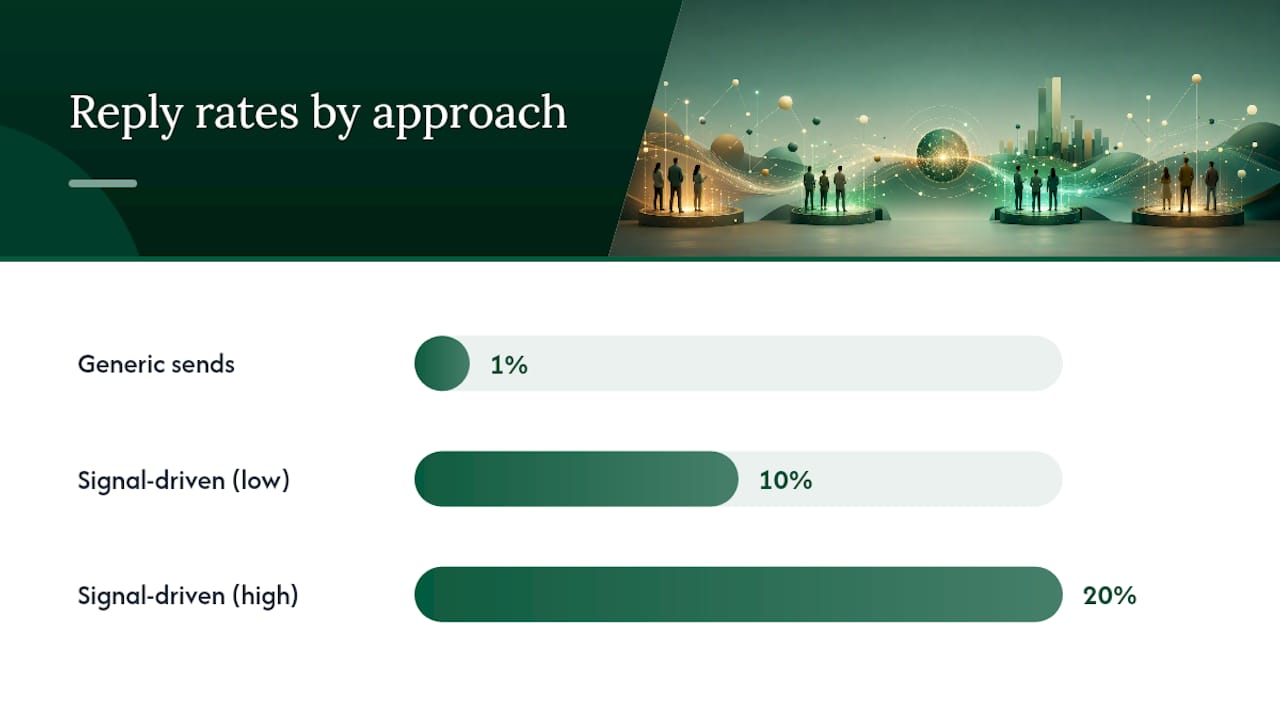
Reply rate is where tiering pays for itself. Generic, unpersonalized cold email typically converts around 1%, while a well-researched, signal-driven send can reach 10% to 20% reply rates. That gap alone justifies spending 30 minutes on a Tier 1 account instead of 30 seconds on a generic lead. The math doesn’t work in reverse: no amount of channel-stacking rescues an account with zero signal behind it.
- Move an account down a tier (or to nurture) if three consecutive touches produce zero engagement.
- Move an account up a tier the moment a second qualifying signal appears within a 30-day window.
- Pause an account entirely if a stakeholder explicitly asks to stop, regardless of tier.
How Do You Write Multi-Stakeholder Outbound Sequences?
Every sequence should open the same structural way, even when the wording changes per account: a three-line opener built as trigger, then relevance, then a low-commit ask. Line one names the specific event (a funding round, a new hire, a product launch). Line two connects that event to a problem your product solves for accounts at that stage. Line three asks for something small, like a 15-minute call or a one-line reply, never a demo commitment on the first touch. This structure is what pushes reply rates into that 10 to 20% range instead of the 1% baseline generic sends produce.
Follow-up messages should rotate through three angles rather than repeating the same ask with a “just following up” line, which is the fastest way to get marked as spam:
- New evidence. Reference a second signal or a fresh data point that reinforces the original trigger.
- Case or data asset. Share a relevant case study, benchmark, or short data point that speaks directly to the stakeholder’s function.
- Permission close. On the final touch in the sequence, explicitly ask whether now is the wrong time and offer to check back later. This gets surprisingly high reply rates because it removes pressure.
Stakeholder order matters as much as message content. Start with the user or champion, the person who will actually feel the pain your product solves day to day. Once you have their reaction (even a lukewarm one), loop in the technical buyer who will evaluate feasibility or integration. Bring in the economic buyer last, once the champion and technical buyer have both signaled interest, because an economic buyer who gets cold-emailed with no internal context tends to ignore it or forward it down without engagement.
Coordinating this order across a five-person buying committee is exactly the kind of orchestration that Gartner’s account-based marketing research points to when it recommends account-level measurement instead of tracking each contact in isolation. If you’re only counting replies per contact, you’ll miss that three different stakeholders each responded lukewarm while the account, as a whole, is actually warming up fast.
Which Buying Signals Should You Act On First?
Five signal types consistently produce the highest response rates: funding announcements, hiring surges in roles tied to your product (a wave of sales-ops job postings, for example), product launches, leadership changes, and public company announcements like expansions or new partnerships. Each one gives you a legitimate, timely reason to reach out that has nothing to do with your product and everything to do with theirs.
Turning a signal into an opener is a two-step move. First, state the signal in plain language: “Saw you closed a Series B last week.” Second, connect it to a consequence the reader already feels: “Teams scaling past 50 reps usually hit a wall in pipeline visibility around month three.” That’s the whole opener. Save the pitch for the ask line, not the hook.
- Funding round → connect to headcount growth and the operational strain that follows.
- Hiring surge in target roles → connect to the exact function those new hires will own.
- Leadership change → connect to the “first 90 days” priorities a new exec typically owns.
- Product launch → connect to the go-to-market gap a launch usually creates.
Speed matters more than most teams assume. A signal loses most of its relevance after 72 hours, and the strongest replies tend to come from outreach sent within 24 to 72 hours of the trigger. This is one reason micro-campaigns targeting small, tightly signal-matched lists of 50 to 250 accounts consistently outperform broad monthly batch sends: a batch process built around a monthly calendar simply can’t react inside a three-day window.
Pro Tip: Use automation to surface signals across your named-account list every morning, but keep a human reviewing the shortlist before anything goes out. Automated signal detection catches the event; it doesn’t catch the version of “relevance” that would make a VP roll their eyes instead of reply.
How Do You Coordinate Email, LinkedIn, and Phone?
Sequencing channels correctly protects both your sender reputation and your credibility with the actual human on the other end. A Tier 1 account might see an email Monday, a LinkedIn connection request Wednesday, and a phone call Friday, spaced so no single day feels like a barrage. A Tier 3 account might just get an email every other week, full stop.
Two rules prevent the most common self-inflicted damage:
- Pause email the moment a live conversation starts on another channel. Nothing signals a disorganized outbound program faster than a prospect who just replied on LinkedIn getting a scheduled follow-up email an hour later asking the same question.
- Never stack duplicate asks across channels on the same day. If email asked for 15 minutes today, LinkedIn shouldn’t ask for a demo in the same 24 hours.
Deliverability is the foundation underneath all of this, and it’s non-negotiable before volume ramps up: authenticate sending domains properly (SPF, DKIM, DMARC), verify every email address before it enters a sequence, and ramp up new domains gradually rather than blasting from day one. The Clay guide to modern outbound sales frames this correctly: enrichment and verification aren’t optional prep work, they’re the prerequisite that makes personalization possible at any scale beyond a handful of accounts by hand.
What Should You Track to Scale Account-Based Outbound?
Every account in the system needs a consistent set of CRM fields or the whole tiering model falls apart within a month: a stakeholder map (names, titles, engagement status), a signal history (what triggered outreach and when), a running touch count, and the date of the last touch across every channel. Without last-touch tracking, you will double up on the same stakeholder across email and LinkedIn without realizing it.
Run a weekly review built around three questions rather than a generic pipeline check:
- Which Tier 1 accounts have gone quiet for two or more touches, and should they be paused or escalated with a different angle?
- Which Tier 3 accounts just produced a new signal and need to move up?
- Is response quality trending down for any single message variant, which usually means it’s time to retire that opener?
Metric targets should differ by tier, not sit on one blended dashboard number. Tier 1 accounts should be judged on meetings booked and deal size; Tier 3 accounts should be judged on whether they’re still opening emails and clicking links at all. An account that shows zero engagement across six touches in any tier should move to long-cycle nurture or get cut from the active list entirely. Forrester’s research on promise-keeping in account-based programs backs this discipline: consistent, honest tracking of what was promised and delivered at each touch is what keeps trust, and conversion, intact through a long sales cycle.
How Should You Hand Off Warm Replies to Sales?
A warm reply that sits unread for two days loses most of its momentum, so the handoff package matters as much as the outreach that produced it. Include four things every time: the context of why this account was being worked, the signal timeline that triggered the sequence, the stakeholder map so far, and a suggested next step rather than a blank “over to you.”
Before handing off, run the reply through a short qualification check:
- Intent. Did they ask a real question, or just acknowledge the email?
- Authority. Is this person a stakeholder you mapped, or someone new who forwarded it internally?
- Timeline. Did they mention a project timeline, budget cycle, or urgency signal?
SLA expectations should be explicit and short: sales should respond to a qualified handoff within one business day, ideally within a few hours during the same day, with a follow-up cadence that mirrors the tier the account came from rather than defaulting to a generic sales sequence that ignores everything marketing already learned about the account.
What Do Top Account-Based Outbound Teams Do Differently?
Teams that win at this don’t out-personalize everyone else, they out-discipline them: real stakeholder maps kept current, signals acted on inside 72 hours, and tiers enforced instead of ignored under pipeline pressure. The biggest failure mode is over-automation with no human review, which produces technically personalized email that still reads hollow. LeadPilot’s approach mirrors this: it researches decision-makers and drafts from real signals, but replies still route to a human for judgment calls automation can’t make.
— Harsh
How Does LeadPilot Support Account-Based Outbound?
Running this playbook by hand across even 100 named accounts eats a rep’s entire week before a single reply comes in. There are platforms built specifically for that gap: they read your website to detect your ICP, source and research matching decision-makers, draft personalized cold emails from real signals, manage dedicated sending domains and inboxes to maintain deliverability as volume grows, automate follow-ups on schedule, and route warm replies to your team instead of leaving them buried in an inbox.
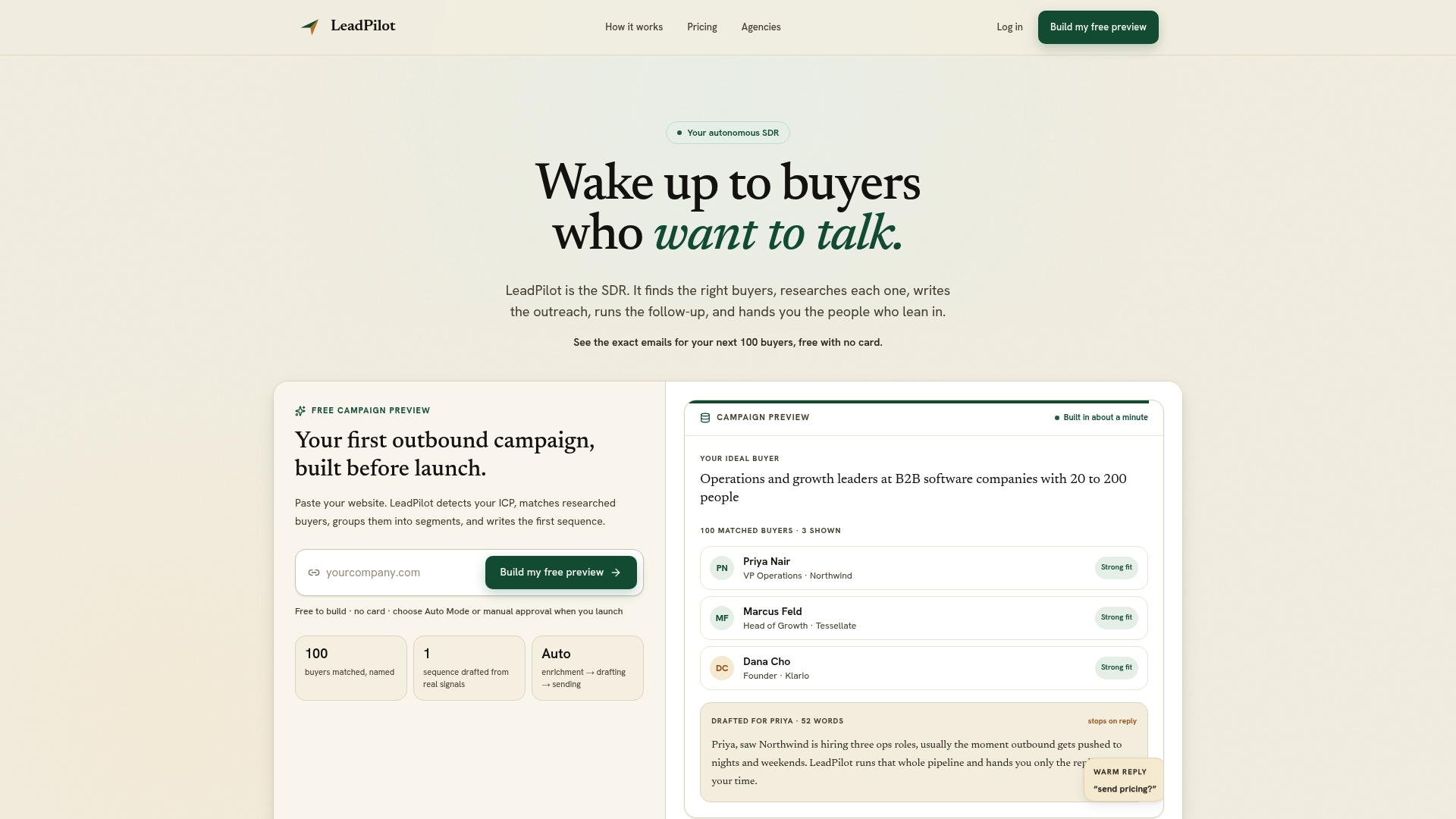
Such platforms are typically designed for founders running their own outbound, lean sales teams without a dedicated SDR bench, and agencies juggling account-based prospecting across multiple clients at once. Rather than requiring purchase of a database and a sequencer separately to stitch the workflow together yourself, these systems handle targeting through reply handoff as one unified process, which aligns with how the tiered model above actually needs to run in practice.
You can build a free campaign preview before committing to anything, using LeadPilot’s AI SDR platform to see how it maps your ICP and drafts sequences against real accounts. From there, check current plans to find the tier of managed outreach that matches your account list size.
Sources
- Cold Outbound That Actually Converts: A Framework for Founders | Greta Agency
- ABM Outbound Strategy Guide 2026 | Abmatic AI
- The Complete Guide to Outbound Sales (2026) | Clay
- Account-Based Prospecting Playbook: What Actually Works in 2026 | AFF Lab