How to Start Managed Outbound in 60 Days
Discover how to effectively start managed outbound in just 60 days. Unlock your ideal customer profile and drive quality meetings now!

How to Start Managed Outbound in 60 Days
A scoped managed outbound pilot, run correctly, validates your ICP and produces accepted meetings in about 60 days. The math only works if the fundamentals are locked before the first email sends: a written qualified-meeting definition, verified contact data, and warmed sending domains.
Your immediate next step is simple: request a free campaign preview or ask a provider to scope a 60-day pilot before you sign anything longer. Before you commit, make sure the preview includes:
- A defined ideal customer profile with named target accounts
- A written definition of what counts as a qualified meeting
- A sample sequence showing personalization, not templates
- A reporting plan showing what you’ll see weekly
Key Takeaways
A scoped 60-day managed outbound pilot with a written qualified-meeting definition and verified sending infrastructure is the fastest, lowest-risk way to validate ICP fit and generate real pipeline.
| Point | Details |
|---|---|
| Start with a pilot | Scope 60 days, not a long-term contract, so you get evidence before committing further. |
| Define “qualified” in writing | Agree on the meeting definition and AE acceptance criteria before any emails send. |
| Protect deliverability first | Warm dedicated domains for 3 to 4 weeks and keep bounce rates under roughly 2%. |
| Compare fully loaded costs | Weigh managed spend against total SDR hiring cost, not base salary alone. |
| Test LeadPilot with a preview | LeadPilot’s free campaign preview lets you validate messaging and targeting before signing anything. |
Table of Contents
- What Does Managed Outbound Actually Cover?
- Who Should Actually Use a Managed Outbound Provider?
- What Deliverability Setup Do You Need Before Sending?
- The 60-Day Pilot: A Week-by-Week Plan
- What Belongs in the Contract Before You Sign?
- Managed Program or an SDR Hire: What Actually Costs Less?
- Why LeadPilot Fits This Playbook
- What Most Advice on This Topic Gets Wrong
- Start a Free Campaign Preview
- Sources
What Does Managed Outbound Actually Cover?
Managed outbound is not a lead list with a mail merge attached. It’s the full SDR workflow, and providers who skip steps show up fast in your reply rates.
- ICP discovery and signal-based targeting. The provider studies your existing customers and current buying signals, not just job titles and firmographics.
- Prospect sourcing and verification. Contacts run through an enrichment waterfall, then a verification gate before they ever touch a sequence, which is the same eight-stage flow Clay’s outbound guide describes as the backbone of consistent reply rates.
- AI-personalized openers. Messages reference something real: a hire, a funding round, a product launch. Not “I noticed you’re in software.”
- Deliverability infrastructure. Dedicated domains, warmup schedules, authentication records.
- Reply classification and handoff. Positive replies route to a human, fast.
- CRM sync and reporting. Every touch and reply logged where your team already works.
Who Should Actually Use a Managed Outbound Provider?
Managed outbound fits three groups well: early-stage founders without bandwidth to hire a rep, small sales teams that need more volume than their headcount supports, and agencies scaling outbound across multiple clients at once, often leveraging AI lead outreach automation for small & large teams.
Choose managed when speed matters more than control, when you lack a sales manager to coach a new hire, or when your compliance risk (spam complaints, bad data) is better absorbed by a specialist. Keep outbound in-house when you already have a validated ICP, a manager with capacity to run the motion daily, and a strong reason to own every word of the messaging.
- Negotiate data ownership before you sign, not after
- Ask who controls messaging approval and how fast changes ship
- Confirm the contract has an exit clause tied to performance, not just a calendar date
Pro Tip: Ask any provider what happens to your researched contact list and email copy if you cancel. If the answer is vague, that’s your answer about how the relationship will go.
What Deliverability Setup Do You Need Before Sending?
Everything about managed outbound lives or dies on deliverability, and this is the part founders most often underestimate. Get it wrong and your domain is flagged before the campaign even gets a fair test.
Start with dedicated sending domains, never your primary company domain. Each one needs SPF, DKIM, and DMARC configured correctly, followed by a genuine warmup period. SyncGTM’s cold email guide treats verification and domain setup as non-negotiable steps, not optional extras, and recommends a 3 to 4 week warmup before any real volume goes out.
Statistic Callout: Bounce rates above roughly 2% start damaging domain reputation quickly, according to Clay’s outbound guide — which is why every contact list should pass a verification waterfall before it ever reaches a sequence.
Beyond the domain layer, a few operational pieces separate providers who protect your reputation from ones who burn it:
- Verification waterfall on every contact before send, not a spot check
- Multi-channel cadence combining email, LinkedIn, and calls, since single-channel blasts consistently underperform
- Reply routing inside 15 minutes for anything positive. Slow handoff kills momentum with a prospect who just raised their hand
- Rate limiting and inbox rotation so no single domain carries the full sending load
None of this is exciting work. It’s also the difference between a pilot that produces meetings and one that gets your domain quietly blacklisted.
The 60-Day Pilot: A Week-by-Week Plan
A short, structured pilot beats an open-ended engagement every time, mostly because it forces everyone to define success before the campaign starts. The Outbound Game’s 60-day roadmap lays out a similar structure: definition first, infrastructure second, then a real test.
- Weeks 1 to 2: Nail down your ICP using evidence from closed deals, not guesswork. Pick 10 to 20 named target accounts and write your qualified-meeting definition in plain language everyone agrees on.
- Weeks 3 to 4: Build a list of a small verified contact list. Run enrichment and verification, and start domain warmup in parallel so infrastructure is ready when the list is.
- Weeks 5 to 8: Launch at low volume with a moderate number of researched sends per day. Track replies and, more importantly, how many meetings your AE actually accepts.
- Weeks 9 to 12: Take what worked and scale it. Kill sequences that underperform, double down on the ones generating accepted meetings.
Check these numbers at each gate:
| Day | Decision Gate |
|---|---|
| 30 | Is the list verified and infrastructure warmed? |
| 60 | Are meetings being accepted by your AE, not just booked? |
| 90 | Is pipeline value trending toward your target ROI? |
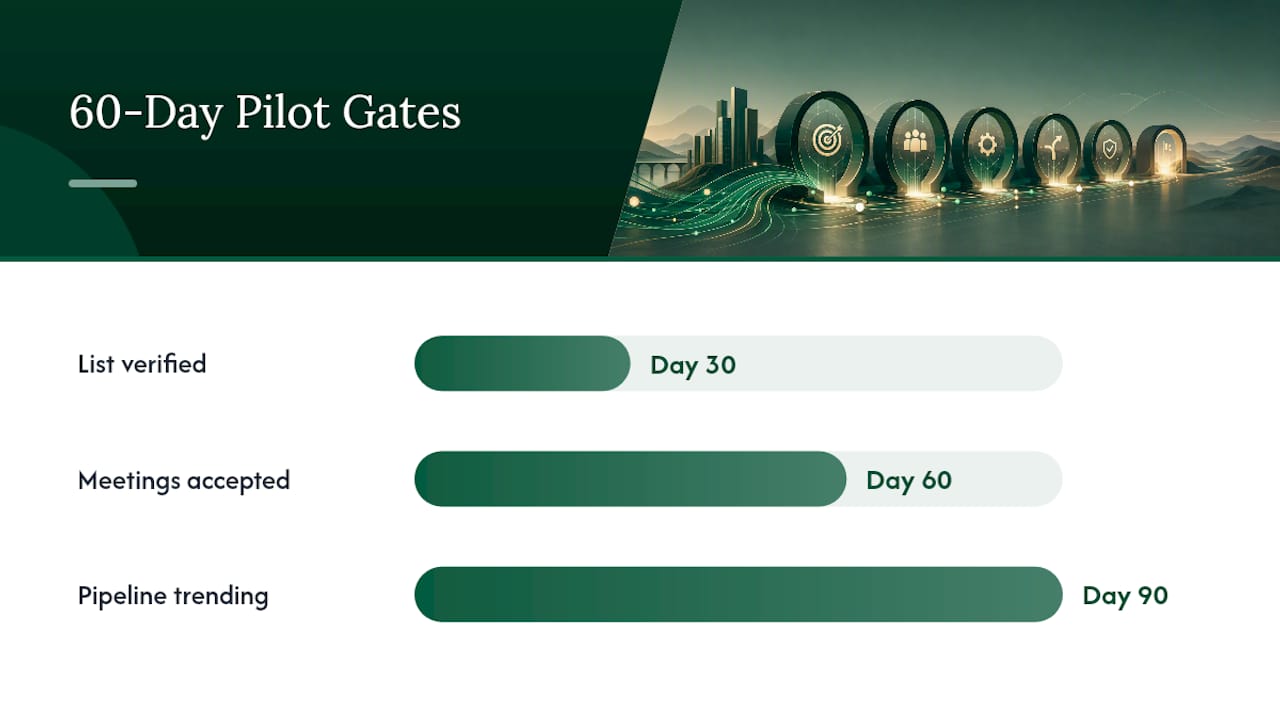
A pilot that fails a 60-day gate should get killed or redirected, not extended by default.
What Belongs in the Contract Before You Sign?
Outsourcing frameworks consistently flag the same failure point: engagements go sideways when nobody defined “qualified” in writing. LeadAdvisors’ outsourcing framework treats this as the single most common cause of mis-scoped outbound contracts.
Before you sign, require the provider to put these in writing:
- A specific qualified-meeting definition, plus the AE acceptance criteria that follow it
- Weekly reporting broken out by attempts per channel, contact rate, qualified conversation rate, accepted meetings, and estimated pipeline value
- Documentation of domain setup, the warmup schedule used, your baseline bounce rate, and the inbox rotation policy
- Clear data ownership terms: what happens to your contact list and messaging if you leave, including return or destruction timelines
- Suppression and duplication rules so the same prospect never gets hit by two overlapping campaigns
- SLA provisions covering performance floors, escalation timelines if metrics slip, and what termination actually looks like
Get this in writing before the first email sends, not after week six when something already went wrong.
Managed Program or an SDR Hire: What Actually Costs Less?
Compare fully loaded SDR cost against managed spend, not base salary against a monthly invoice. Once you add recruiting, benefits, tooling, management time, and the real cost of turnover, a managed pilot is often the cheaper test, according to outbound outsourcing practitioners.
Statistic Callout: A properly scoped pilot can validate a new vertical or offer inside roughly 60 to 90 days, well ahead of the months most new SDR hires need just to ramp.
Run the comparison on outcomes, not activity:
- Cost per accepted meeting, not cost per email sent
- Time to validated pipeline: weeks with a managed pilot versus months with a new hire
- A simple ROI check: (meetings held × close rate × average contract value) minus monthly managed cost
If that number is negative after 90 days, you have real data to renegotiate or walk away. That’s the actual point of running it as a pilot instead of a long-term bet.
Why LeadPilot Fits This Playbook
LeadPilot runs the entire workflow this article just walked through: ICP discovery from your own website, prospect research, AI-personalized email, dedicated sending domains with proper warmup, automated follow-ups, and handoff of warm replies to your team. It’s built as the AI SDR layer founders reach for when they don’t have bandwidth to hire and manage one internally.
Every operational item from the contract checklist above maps directly to how LeadPilot operates: documented deliverability setup, transparent weekly reporting, and clear data ownership terms.
- Start with a free campaign preview instead of a signed contract
- Use the preview to test ICP and messaging fit before any spend
- Review reporting weekly, the same cadence recommended for any managed pilot
Pro Tip: Treat the free preview as your due-diligence step, not a formality. If the sample messaging doesn’t sound like something your best AE would send, that’s a signal worth acting on before you scale anything.
What Most Advice on This Topic Gets Wrong
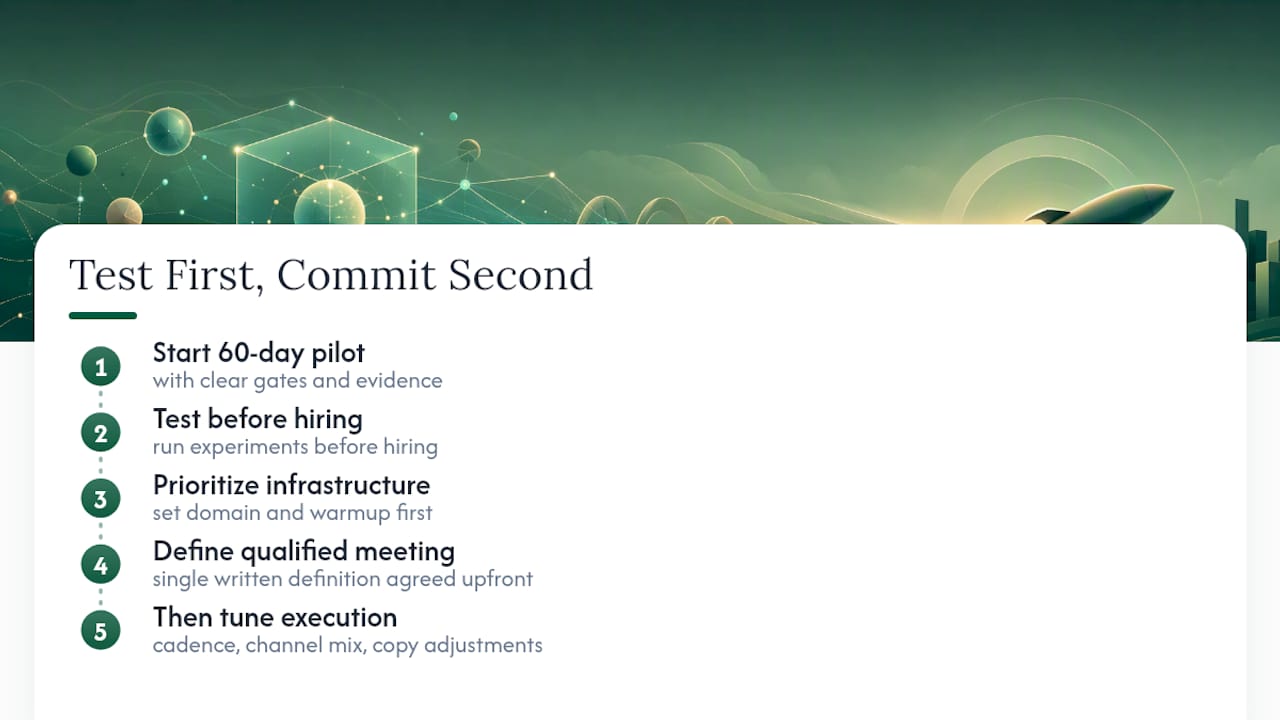
Most outbound advice treats the decision as binary: hire a rep or don’t. That framing wastes founders’ time and money, because the real decision is sequential. Test first, commit second. A 60-day pilot with clear gates gives you evidence before you make a hiring or contract decision that’s expensive to reverse.
The conventional wisdom also overweights list size and underweights the qualified-meeting definition. A provider promising 500 sends a week means nothing if nobody agreed on what counts as a real meeting. That single written definition, more than volume or even open rates, is the variable that separates pilots that produce pipeline from ones that produce noise.
What should you prioritize first? Infrastructure and definition, in that order. Skip the warmup period and your domain is compromised before message quality even gets tested. Skip the qualified-meeting definition and you’ll spend 60 days arguing about whether the pilot worked instead of looking at the numbers. Get those two things right, and everything else, cadence, channel mix, copy, becomes a tuning problem instead of a guessing game.
Start a Free Campaign Preview
LeadPilot gets you a working pilot without the six-figure bet of hiring and ramping an SDR yourself. Instead of spending months on recruiting and onboarding, you scope a campaign preview in days and see actual sequences and targeting before spending anything.
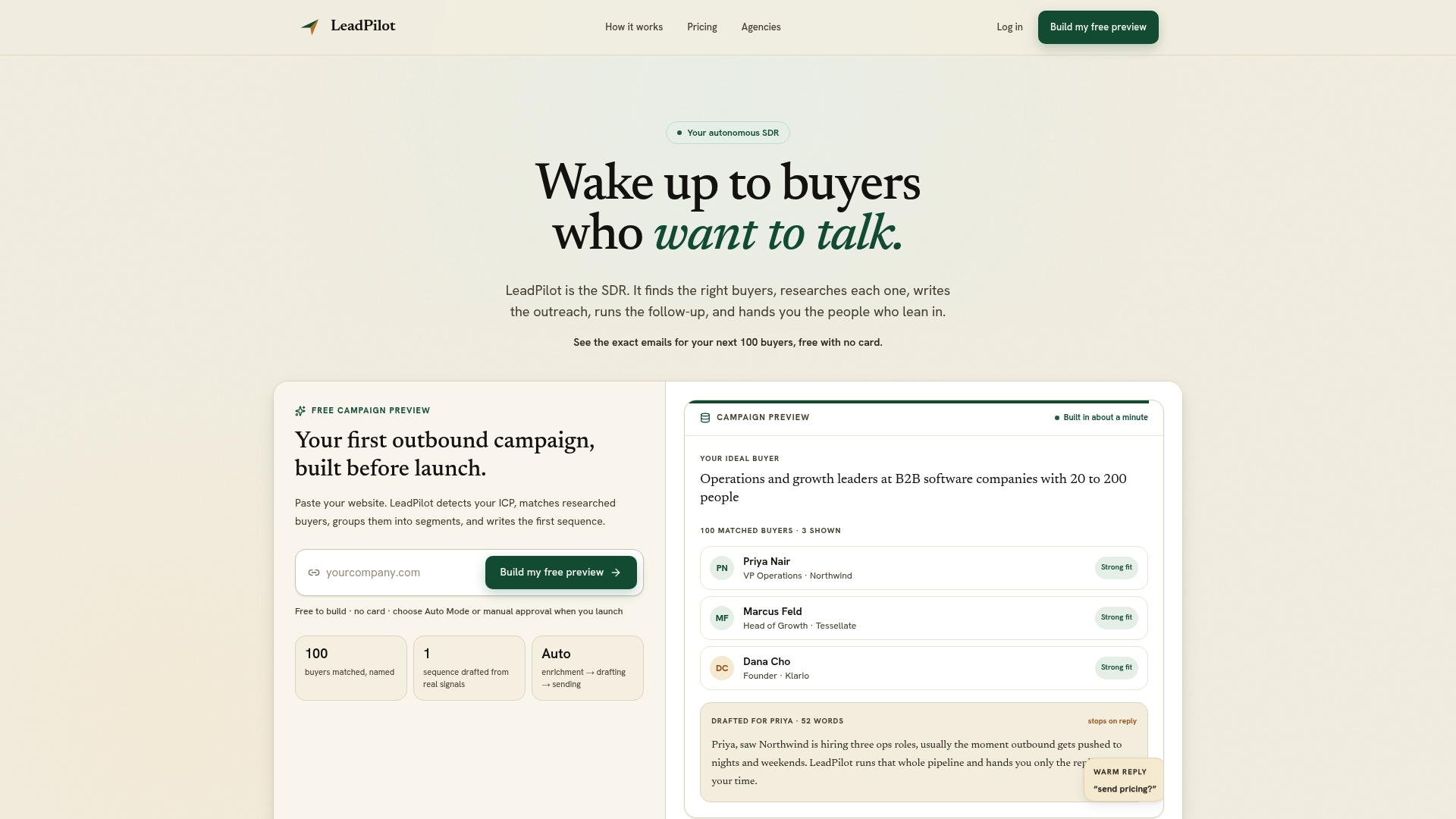
Scope your preview with 10 to 20 named target accounts, a written qualified-meeting definition, and a clear tracking plan for replies and accepted meetings. Visit the AI SDR page for capability details, or check LeadPilot’s pricing for transparent plan tiers before you request anything. During the first 30 to 60 days, measure contact rate, qualified conversation rate, and how many meetings your AE actually accepts, not just how many get booked. Agencies managing multiple clients can review the agency workspace details for consolidated billing across accounts. Request your free campaign preview today and see the targeting and messaging before committing to a full program.
Sources
For deeper reading, see Clay’s outbound guide and LeadPilot’s outsourcing guide.
- Outbound Sales Outsourcing: What Actually Works
- How to Start Outbound Sales in 2026 (60 Day Roadmap)