Best Salesloft Alternatives for B2B Sales Teams in 2026
Explore the best Salesloft alternatives for B2B sales teams in 2026. Discover platforms that enhance engagement, save time, and fit your budget.

Best Salesloft Alternatives for B2B Sales Teams in 2026
For most B2B sales leaders replacing Salesloft today, the fastest path to a decision is this: if your team lives in Salesforce, demo a Salesforce-native engagement platform first; if budget and time-to-value are the real constraints, demo a value leader that bundles prospecting data; and if you run a lean team or agency, Runleadpilot’s managed outbound model skips the self-serve setup problem entirely.
Here is the shortlist at a glance:
- Salesforce-native platforms (e.g., Revenue.io): Best for teams that want guided selling, real-time call coaching, and a native dialer without leaving Salesforce. Trade-off: higher cost, Salesforce-only.
- Enterprise sequencing leaders (e.g., Outreach): Best for large orgs running complex multi-channel cadences with embedded conversation intelligence. Trade-off: pricing and implementation complexity.
- Value leaders with built-in data (e.g., Apollo.io): Best for SMBs that need a contact database plus email automation in one tool. Trade-off: lighter coaching and CI features.
- Conversation-intelligence leaders (e.g., Gong): Best for teams where post-call coaching and deal analytics are the primary gap. Trade-off: not a sequencing tool.
- Managed outbound (Runleadpilot): Best for founders, lean sales teams, and agencies that want AI-powered outbound without hiring or configuring an SDR stack. Trade-off: less DIY control, purpose-built for cold outbound.
Gartner Peer Insights and G2 remain the most widely used trust signals when buyers research sales engagement platforms, so cross-reference any shortlist against verified reviews there before scheduling demos.
Table of Contents
- What do the top Salesloft alternatives look like side by side?
- Detailed profiles: what each alternative actually delivers
- Why are teams moving away from Salesloft right now?
- How do you choose the right Salesloft alternative?
- Which buyers should demo Runleadpilot first?
- Which alternative fits your GTM motion and tech stack?
- Key Takeaways
- The gap between what sales engagement tools promise and what actually matters
- LeadPilot handles the outbound your team doesn’t have time to run
- Useful sources and further reading
What do the top Salesloft alternatives look like side by side?
| Category | Best For | Pricing Signal | CRM Integration | Dialer & Outbound | Conversation Intelligence | Data Enrichment | Ease of Migration | AI Capabilities | Trial / Demo |
|---|---|---|---|---|---|---|---|---|---|
| Salesforce-native platforms | Salesforce-first teams | High | 100% native | Strong, native | Real-time coaching | No | Moderate | Guided selling AI | Demo available |
| Enterprise sequencing leaders | Large multi-channel orgs | High | Integrated sync | Strong | Embedded CI | No | Complex | AI task prioritization | Demo available |
| Value leaders with built-in data | SMB / budget-conscious | Low–Medium | Integrated sync | Basic–Moderate | Limited | Yes (large DB) | Easy–Moderate | AI email personalization | Free tier / trial |
| Conversation-intelligence leaders | Post-call coaching focus | Medium–High | Integrated sync | No sequencing | Deep analytics | No | Easy (add-on) | Deal analytics AI | Demo available |
| CRM-native hubs | HubSpot-first teams | Low–Medium | 100% native | Basic | Limited | Limited | Easy | AI sequences | Free tier |
| Lightweight SMB tools | Startups, small teams | Low | Integrated sync | Basic | None | Limited | Very easy | AI copy assist | Free trial |
| Behavior/adoption layers | Process adherence gaps | Medium | Integrated sync | None | None | No | Easy (overlay) | Playbook AI | Demo available |
| Managed outbound (Runleadpilot) | Lean teams, agencies | Medium | Handoff-based | Fully managed | N/A | Built-in targeting | Very easy | Full AI SDR workflow | Free campaign preview |

Pricing signal: Salesforce-native and enterprise sequencing platforms typically run at the high end of the market, often requiring custom quotes for teams above 10 seats. Value leaders with built-in data and CRM-native hubs tend to offer transparent per-seat pricing that SMBs can evaluate without a sales call. Lightweight tools and managed options like Runleadpilot sit in the middle, with clear plan structures and no long procurement cycle.
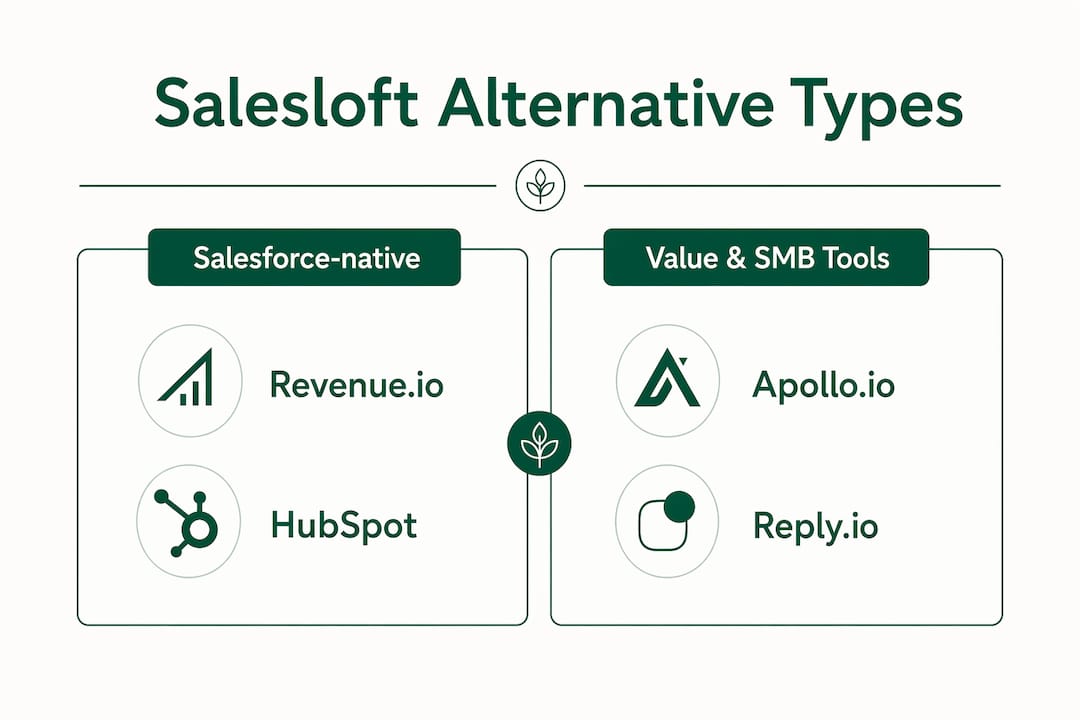
Market review criteria commonly weight engagement automation depth, process adherence, time-to-value, roadmap independence, and built-in prospecting data as the top five dimensions when ranking alternatives for mid-market teams.
Quick category badges:
- Best for Salesforce-first teams: Salesforce-native platforms
- Best value with bundled data: Value leaders with built-in data
- Best for post-call coaching: Conversation-intelligence leaders
- Best for lean teams and agencies: Managed outbound (Runleadpilot)
Detailed profiles: what each alternative actually delivers

Salesforce-native platforms (e.g., Revenue.io)
Revenue.io is the most cited example of a platform built entirely inside Salesforce, combining guided selling, a native dialer, and real-time call coaching through its Moments™ feature.
Key features:
- 100% native Salesforce execution, no data sync required
- Real-time rep coaching during live calls
- Multi-channel engagement (email, phone, SMS) from within the CRM
- AI-driven activity scoring and next-step recommendations
- SOC 2 compliance; enterprise security posture
Vs. Salesloft: Salesloft operates as a separate platform that syncs to Salesforce. Revenue.io eliminates that sync layer entirely, which removes a common source of data lag and rep context-switching. The real-time coaching capability is the sharpest differentiator Salesloft does not match.
Best for: Salesforce-centric teams of 20+ reps where phone is a primary channel. Pricing: high. Demo available.
Enterprise sequencing leaders (e.g., Outreach)
Outreach competes most directly with Salesloft on multi-channel cadence management, and edges ahead on AI-driven task prioritization and embedded conversation intelligence through its Kaia feature.
Key features:
- Advanced multi-channel sequences (email, phone, LinkedIn, SMS)
- Kaia embedded conversation intelligence
- Rhythm AI for rep task prioritization
- Deep analytics and pipeline visibility
- SOC 2 Type II; GDPR-ready
Vs. Salesloft: Both platforms cover similar ground. Outreach’s AI productivity layer and embedded CI give larger organizations more automation leverage. Salesloft tends to win on simplicity of cadence setup for teams that don’t need the full enterprise feature set.
Best for: Enterprise orgs (50+ reps) running complex, multi-channel outbound. Pricing: high, custom. Demo available.
Value leaders with built-in data (e.g., Apollo.io)
Apollo.io bundles a large contact database with email automation and basic sequencing, which removes the need for a separate data subscription. That single fact drives most SMB evaluations toward it.
Key features:
- Contact database with hundreds of millions of records
- Email sequencing and LinkedIn automation
- Basic dialer
- AI-assisted email personalization
- Free tier available; transparent per-seat pricing
Vs. Salesloft: Salesloft has no built-in contact database. Apollo.io’s bundled data is its primary advantage for SMB teams where budget and time-to-value are the real constraints. Coaching and CI are lighter.
Best for: SMBs and startups (1–50 reps) that need prospecting data plus outreach in one tool. Pricing: low–medium. Free tier and trial available.
Conversation-intelligence leaders (e.g., Gong)
Gong is not a sequencing tool. It is the deepest post-call analytics and deal intelligence platform in the market, and it belongs on your shortlist only if coaching and pipeline visibility are the primary gaps.
Key features:
- Deep call recording, transcription, and AI analysis
- Rep benchmarking and talk-track coaching
- Deal health scoring and pipeline risk alerts
- Integrates with most CRMs and engagement tools
- SOC 2 Type II; GDPR-ready
Vs. Salesloft: Salesloft includes lighter CI capabilities. Gong goes much deeper on post-call analysis and rep benchmarking. Pair Gong with a sequencing tool rather than replacing one with the other. For teams that want real-time coaching during calls, sales call intelligence tools like Amaya AI offer a complementary layer worth evaluating alongside Gong.
Best for: Teams of any size where manager coaching and deal analytics are the bottleneck. Pricing: medium–high. Demo available.
CRM-native hubs (e.g., HubSpot Sales Hub)
HubSpot Sales Hub is the natural choice for teams already on HubSpot CRM. Sequences, email tracking, a basic dialer, and pipeline management all live inside the same system.
Key features:
- Native HubSpot CRM execution
- Email sequences and templates
- Meeting scheduler and deal pipeline
- AI sequence suggestions
- Free tier; transparent per-seat pricing
Vs. Salesloft: HubSpot Sales Hub trades depth of sequencing for ease of use and CRM-native execution. Salesforce itself advises that many organizations don’t need a separate engagement tool when native CRM capabilities already cover their workflow, and the same logic applies here for HubSpot shops.
Best for: HubSpot-first teams (1–100 reps) that want to eliminate a separate engagement tool. Pricing: low–medium. Free tier available.
Lightweight SMB outreach tools (e.g., Reply.io)
Reply.io targets startups and small teams that need multi-channel email automation with AI-generated messaging at a price point well below enterprise platforms.
Key features:
- AI-generated email copy and personalization
- Multi-channel sequences (email, LinkedIn, calls)
- Basic CRM integrations
- Simple onboarding, fast time-to-value
Vs. Salesloft: Lighter on analytics and process governance, but significantly cheaper and faster to deploy. The right fit when you need sequences running in days, not weeks.
Best for: Startups and small teams (1–20 reps) where speed and cost matter more than depth. Pricing: low. Free trial available.
Behavior/adoption layers (e.g., Clari, ZoomInfo Sales)
This category addresses a problem engagement tools alone don’t solve: reps who have the tool but don’t run the play. Behavior and adoption layers surface playbook adherence, pipeline governance, and forecasting signals on top of whatever engagement platform you already use.
Key features:
- AI-driven revenue forecasting and pipeline governance (Clari)
- Intent data and contact enrichment layered onto sequences (ZoomInfo Sales)
- Rep adherence tracking and deal health alerts
- Integrates with most engagement platforms and CRMs
Vs. Salesloft: These tools complement rather than replace Salesloft-style sequencing. Analyst commentary consistently recommends pairing an engagement tool with a behavior layer when adoption is the real gap, because sends and opens don’t tell you whether reps are running the right plays.
Best for: Mid-market and enterprise teams (30+ reps) where forecasting accuracy and rep adherence are the bottleneck. Pricing: medium–high. Demo available.
Runleadpilot (LeadPilot): managed outbound for lean teams
LeadPilot is a different kind of option. Rather than giving your team another platform to configure and manage, it handles the full outbound SDR workflow: it reads your website to identify your ideal customer profile, sources and researches matching decision-makers, writes personalized cold emails from real business signals, manages dedicated sending domains and inboxes for deliverability, runs follow-ups, and routes warm replies to your team.
Key features:
- AI-driven ICP detection from your website
- Automated decision-maker sourcing and research
- Personalized cold email sequences with managed deliverability
- Dedicated sending domains and inbox management
- Multi-client workspaces for agencies
- Free campaign preview before purchase
Vs. Salesloft: Salesloft is a self-serve engagement platform that requires your team to build sequences, source contacts, and manage deliverability. LeadPilot handles all of that as a managed service, which is the right trade-off for founders and lean teams that don’t have an SDR function to operate the tool. The AI SDR workflow covers targeting through reply handoff.
Best for: Founders of B2B software/services companies (1–20 employees), lean sales teams (20–100), and cold email agencies managing outbound for multiple clients. Pricing: medium, subscription-based with a free preview. Campaign preview available.
Pro Tip: Before your first LeadPilot campaign goes live, review the ICP it detects from your website against your last 10 closed-won accounts. If they don’t match, update your website copy first. The AI reads what you say, not what you mean.
Why are teams moving away from Salesloft right now?
The 2025 Salesloft–Clari merger is the single biggest catalyst. Post-merger product overlap and integration uncertainty are valid procurement risk factors in 2026, and buyers are increasingly treating roadmap independence as a feature, not a soft preference.
Beyond the merger, four structural pain points drive most evaluations:
- CRM sync friction: Salesloft operates outside Salesforce and HubSpot, which means data sync delays, duplicate records, and reps toggling between systems.
- No real-time coaching: Salesloft’s coaching happens post-call. Teams that want in-call guidance need a different tool or an add-on.
- No built-in contact data: Salesloft doesn’t include a prospecting database, so teams pay separately for ZoomInfo, Apollo, or similar.
- Adoption gaps: Engagement tools don’t enforce playbook adherence. Reps can have full access and still not run the sequence correctly.
Buyer signal worth noting: After the 2025 merger activity, buyers are increasingly weighting roadmap independence and vendor stability as part of their feature evaluation, not just technical match. A platform that checks every feature box but has an unclear post-merger roadmap is a real procurement risk.
Three buyer personas and what they chose:
A SaaS team using Salesforce moved to a Salesforce-native platform after losing significant time each quarter to sync errors and duplicate records. The native dialer and real-time coaching were secondary wins.
A small founding team at a B2B services company chose Runleadpilot because they had no SDR and no time to build sequences, source contacts, and manage deliverability separately. The managed model meant outbound started in days.
A large enterprise organization running account-based outbound added a behavior/adoption layer on top of their existing engagement platform after discovering that sequence enrollment was high but actual rep execution was inconsistent.
One honest caveat: if your current contract has favorable terms, your team has strong adoption, and your CRM sync is clean, switching costs may outweigh the gains. Evaluate the actual gap before committing to a migration.
How do you choose the right Salesloft alternative?
Evaluation checklist
Work through these in order. The first three are the most predictive of whether a platform will actually stick.
- CRM fit: Does the platform run natively inside your CRM, or does it sync? Native eliminates a class of problems.
- Dialer depth: Is phone a primary channel? If yes, test the dialer in the demo, not just the slides.
- CI needs: Do you need real-time coaching, post-call analytics, or both? These are different tools.
- Built-in data: Do you have a data subscription already? If not, a bundled database saves real money.
- Pricing shape: Per-seat vs. usage-based vs. managed subscription. Match the model to your team’s growth rate.
- Security and compliance: SOC 2 Type II and GDPR readiness are table stakes for enterprise buyers.
- Time to value: How long until reps are running live sequences? Days vs. weeks matters.
- Support SLA and onboarding: Is there a dedicated CSM? What does the first 30 days look like?
- Customizability: Can you build custom fields, stages, and playbooks, or are you locked into the vendor’s model?
- AI features: Are AI capabilities core to the workflow or bolted on? Test them in the demo.
- Trial or demo quality: Can you run a real pilot on live data, or is it a sandbox?
- Exit clauses: What does offboarding look like? Can you export your data cleanly?
Vendor questions to ask on the demo
- “Show me a live record-level sync between your platform and our CRM, including how you handle duplicate merging and custom field conflicts.” (A practical procurement trick: ask your CRM admin to validate the sync demo against your actual field structure.)
- “What is the typical time from contract sign to first live sequence?”
- “How do you handle sending-domain warm-up and deliverability monitoring?”
- “What does your post-merger roadmap look like for the next 12 months, and which integrations are being maintained?”
- “What does offboarding look like if we decide to leave in 12 months?”
Red flags that should shorten your list
- The vendor can’t show a live CRM sync demo and defers to documentation.
- Onboarding is described as “self-serve” for a platform that costs enterprise prices.
- Post-merger roadmap answers are vague or reference “future alignment” without specifics.
- The trial requires full data migration before you can test core features.
Migration timeline
| Phase | Timeframe | Key Activities | Owner |
|---|---|---|---|
| Discovery | Weeks 1–2 | Audit current sequences, CRM fields, data sources, and integration dependencies | RevOps / Sales Ops |
| Pilot | Weeks 3–5 | Run live sequences on 1–2 persona segments; test deliverability and CRM sync | Sales Ops + 2–3 reps |
| Data migration / sync | Weeks 5–7 | Migrate contact lists, sequence templates, and custom fields; validate sync | RevOps + IT |
| Training | Weeks 7–8 | Rep onboarding, playbook documentation, manager coaching setup | Enablement |
| Full roll-out | Week 9+ | Full team live; monitor adoption metrics for 30 days | Sales leadership |
Which buyers should demo Runleadpilot first?
Runleadpilot is the right first demo for founders of B2B software or services companies, lean sales teams without a dedicated SDR function, and agencies managing outbound for multiple clients. The core value proposition is managed outbound: LeadPilot handles targeting, copy, deliverability, and follow-ups so your team focuses on warm replies, not pipeline plumbing.
Three use cases where LeadPilot consistently outperforms a general-purpose engagement tool:
- Lean teams that need managed setup: If you don’t have a RevOps function to configure sequences, manage sending domains, and monitor deliverability, a self-serve tool creates more work than it solves. LeadPilot’s outbound sales automation handles that layer entirely.
- Agencies running multi-client outbound: LeadPilot’s multi-client workspace with consolidated billing is purpose-built for agencies. Most engagement platforms require separate instances and separate billing per client.
- Teams that want built-in targeting without a separate data subscription: LeadPilot sources and researches decision-makers as part of the managed workflow, removing the need for a separate data tool.
For pricing and plan details, see LeadPilot’s pricing page. For a free campaign preview before committing, the how LeadPilot works page walks through the full workflow from website analysis to warm reply handoff.
Pro Tip: During a 30-day pilot, measure reply rate and positive reply rate separately. Total replies include out-of-office and unsubscribes. Positive reply rate, the share of responses that express interest, is the only number that tells you whether the targeting and messaging are working.
Which alternative fits your GTM motion and tech stack?
| GTM Motion | Recommended Category | Primary Reason |
|---|---|---|
| Enterprise outbound (50+ reps, Salesforce) | Salesforce-native platforms | Eliminates sync friction; real-time coaching at scale |
| SMB volume outbound (1–50 reps) | Value leaders with built-in data | Bundled database removes separate data cost |
| Account-based selling (ABM) | Enterprise sequencing leaders + behavior layer | Deep sequencing + adherence tracking for complex plays |
| Product-led growth (PLG) | CRM-native hubs | Lightweight, fast to deploy, native to existing CRM |
| Agency-managed outbound | Managed outbound (Runleadpilot) | Multi-client workspaces, fully managed workflow |
| Post-call coaching focus | Conversation-intelligence leaders | Deepest analytics; pairs with any sequencing tool |
Sample use cases:
A SaaS company on Salesforce running enterprise outbound should evaluate a Salesforce-native platform first, then layer a behavior/adoption tool if rep adherence is inconsistent. The native CRM execution eliminates the most common source of data quality complaints.
A small B2B services firm with no SDR should skip self-serve engagement platforms entirely and pilot Runleadpilot. The managed model means outbound is running in days, not after a six-week configuration project.
Mix-and-match guidance: Engagement platforms and conversation-intelligence tools are not mutually exclusive. Many mid-market teams run an engagement platform for sequencing and add a CI tool for post-call coaching. For teams that want to improve call outcomes specifically, AI-driven call analysis is a practical add-on regardless of which sequencing platform you choose.
Key Takeaways
The single most predictive evaluation step is testing CRM integration with a live record-level sync demo before signing any contract, because sync failures are the most common source of post-migration regret.
| Point | Details |
|---|---|
| Demo by profile first | Salesforce teams demo native platforms; lean teams and agencies demo Runleadpilot first. |
| CRM fit is the top predictor | A live sync demo with your CRM admin present reveals hidden migration work before you commit. |
| When to stay on Salesloft | If your adoption is strong, contract terms are favorable, and sync is clean, switching costs may outweigh gains. |
| Behavior layers are underused | Engagement tools don’t enforce playbook adherence; add a behavior layer when rep execution is the real gap. |
| Runleadpilot for managed outbound | Founders, lean teams, and agencies get a fully managed AI SDR workflow with a free campaign preview before purchase. |
The gap between what sales engagement tools promise and what actually matters
Most sales engagement platform evaluations go wrong at the same point: buyers optimize for feature count and miss the adoption question entirely. A platform with 40 sequence types, a native dialer, and embedded CI is worth nothing if your reps log in twice a week.
The 2025 merger environment makes this worse. When a vendor’s roadmap is uncertain, buyers tend to over-index on current features as a hedge, stacking requirements that look good in a scorecard but don’t reflect how the team actually sells. The right question isn’t “does this platform have real-time coaching?” It’s “will our reps use real-time coaching, and do we have the manager bandwidth to act on it?”
The other mistake I see consistently: skipping the CRM-native option because it looks less impressive in a demo. Salesforce and HubSpot’s native engagement features have closed the gap significantly. Before you pay for a third-party engagement layer, spend 30 minutes with your CRM admin reviewing what you already have. You might not need to switch at all.
For teams that genuinely need managed outbound, the managed model isn’t a compromise. It’s a different answer to a different problem. Self-serve engagement platforms assume you have the people and process to operate them. Most lean teams don’t, and that’s not a failure of ambition. It’s just an honest assessment of where to spend the hours.
LeadPilot handles the outbound your team doesn’t have time to run
If the platforms above require more configuration, headcount, or RevOps bandwidth than your team has right now, Runleadpilot is built for exactly that situation. LeadPilot reads your website, identifies your ideal customer profile, sources matching decision-makers, writes personalized cold emails from real business signals, manages dedicated sending domains for deliverability, and routes warm replies to your team. No SDR hire. No sequence-building sprint. No separate data subscription.
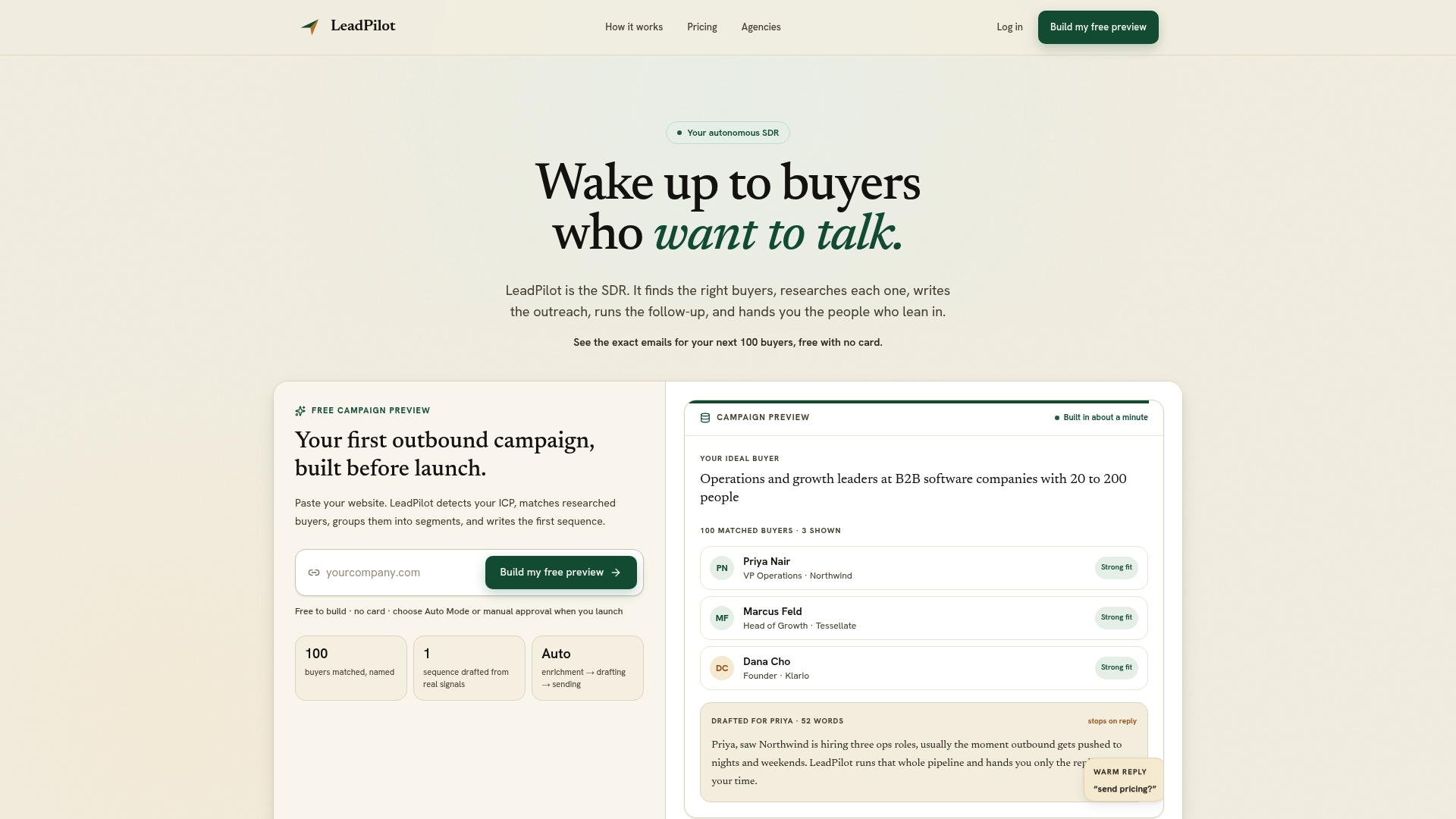
Agencies get multi-client workspaces with consolidated billing. Founders and lean teams get a fully managed outbound function from day one. You can build a free campaign preview before committing to a plan, so you see exactly who LeadPilot would target and what the outreach looks like. Check pricing and plan options to find the right sending volume for your team.
Useful sources and further reading
- G2: Top Salesloft Alternatives and Competitors — Verified buyer reviews and category rankings; the most widely used peer-review signal for sales engagement platform comparisons.
- Gartner Peer Insights: Salesloft Alternatives — Enterprise-weighted verified reviews; useful for validating shortlists against analyst-grade buyer feedback.
- Revenue.io: The 12 Best Salesloft Alternatives — Detailed feature-level comparison of Salesforce-native and enterprise sequencing categories; strong on dialer and CI trade-offs.
- Supered: Salesloft Alternatives 2026, Graded by the Job — Covers post-merger risk factors, roadmap independence criteria, and behavior/adoption layer guidance; the most practically framed evaluation guide in the market.
- Salesforce: Best Salesloft Competitors and Alternatives — Salesforce’s own guidance on when native CRM features replace the need for a third-party engagement tool; worth reading before adding any platform to your stack.
- Amaya AI: Sales Call Intelligence — Conversation-intelligence and call-coaching capabilities; useful for teams evaluating CI as a standalone add-on to their engagement platform.
- Amaya AI: How to Improve Sales Calls with AI Analysis — Practical examples of AI-driven call analysis improving rep outcomes; good pre-demo reading for teams evaluating a CI layer.
- LeadPilot: How LeadPilot Works — Step-by-step walkthrough of the managed outbound workflow from website analysis to warm reply handoff; the right starting point for lean teams and agencies evaluating a managed option.