Outreach vs Salesloft: Which Platform Wins in 2026?
Explore Outreach vs Salesloft in 2026. Discover which platform suits your team’s needs for optimized sales processes and management.

Outreach vs Salesloft: Which Platform Wins in 2026?
If you run a Salesforce-heavy enterprise with a full RevOps team, Outreach is the stronger call. If your org leans HubSpot or you need faster onboarding with bundled forecasting, Salesloft fits better. And if you lead a lean team or agency that wants managed cold-email execution without the six-figure platform overhead, LeadPilot is the practical alternative worth running first.
Here is the quick profile-to-platform map before you dig into the evidence:
- Large Salesforce-anchored orgs (50+ reps, dedicated RevOps): Outreach. Deeper field mapping, granular API, and closed-agent AI built for complex object models.
- Mid-market teams or HubSpot-adjacent orgs: Salesloft. Faster time-to-value, the Rhythm engine for buyer-signal prioritization, and bundled forecasting from the Clari merger.
- Founders, lean sales teams (under 50 reps), and agencies: LeadPilot. Managed SDR workflow, dedicated sending domains, and a free campaign preview before you commit a dollar.
- Buyers running a broader shortlist: SalesRobot is worth including in a proof-of-concept when pricing or feature differentials matter to your procurement team.
The comparison table below shows the side-by-side evidence behind these calls.
Table of Contents
- Outreach vs Salesloft: at-a-glance comparison
- How do sequencing and automation actually differ day-to-day?
- What is the real difference in AI and conversation intelligence?
- Does your CRM determine which platform you should pick?
- Who actually owns pipeline truth in your analytics stack?
- How long does it actually take to get reps productive?
- What does this actually cost over three years?
- How do you make the final call for your team?
- What does implementation actually look like on the ground?
- How we compared these platforms
- What is a sales engagement platform, and when do you actually need one?
- What does customer support actually look like after you sign?
- What are real users saying about each platform?
- How well do these platforms scale and support custom workflows?
- What are the contract terms and cancellation realities?
- Key Takeaways
- The platform decision most teams get wrong
- LeadPilot: the managed alternative for lean teams and agencies
- Useful sources and primary links to verify features and pricing
Outreach vs Salesloft: at-a-glance comparison
| Dimension | LeadPilot | Outreach | Salesloft | SalesRobot |
|---|---|---|---|---|
| Best for | Founders, lean teams (under 50 reps), agencies | Large Salesforce-anchored enterprises | Mid-market, HubSpot-adjacent teams | Buyers evaluating additional SEP entrants |
| Sequencing & automation | Managed AI sequences, follow-ups, reply routing | Advanced branching, A/B testing, autonomous agents | Rhythm engine, buyer-signal cadences, multi-channel | Basic sequencing, LinkedIn-focused automation |
| AI & conversation intelligence | AI SDR workflow, ICP detection, personalized email drafts | Closed-agent AI (Omni, Agent Studio), usage-billed | Open MCP server for third-party LLMs, Rhythm signals | Limited AI features |
| CRM integrations | Lightweight; warm-reply handoff to your CRM | Deep Salesforce sync, granular field mapping, robust API | Strong HubSpot fit; solid Salesforce; open ecosystem | Basic CRM connectors |
| Analytics & forecasting | Campaign-level reporting | Native forecasting, pipeline analytics | Bundled forecasting (post-Clari), deal inspection | Basic reporting |
| Usability & onboarding | Fast; managed setup, free campaign preview | Steeper learning curve; heavy admin required | Faster onboarding; higher usability scores | Moderate |
| Scalability | Lean teams and agencies; multi-client workspaces | Enterprise-grade; high governance overhead | Mid-market to enterprise; moderate governance | SMB-focused |
| Pricing shape | Monthly subscription; starts with free preview | $145–$185/user/month effective | $115–$155/user/month effective | Lower entry price |
| Deliverability | Managed dedicated sending domains included | Buyer-managed; domain setup extra | Buyer-managed; domain setup extra | Basic deliverability tools |
| Admin/security | Minimal admin lift; managed by LeadPilot | SSO, SCIM, audit logs; 1–2 FTE admin recommended | SSO, SCIM, permissioning; moderate admin lift | Basic security |
| Support | Managed onboarding included | Dedicated CSM at enterprise tiers | Strong support reputation; higher G2 satisfaction | Community-based |
| G2 reviews | — | 4.3★ (3,565 reviews) | 4.5★ (4,287 reviews) | — |
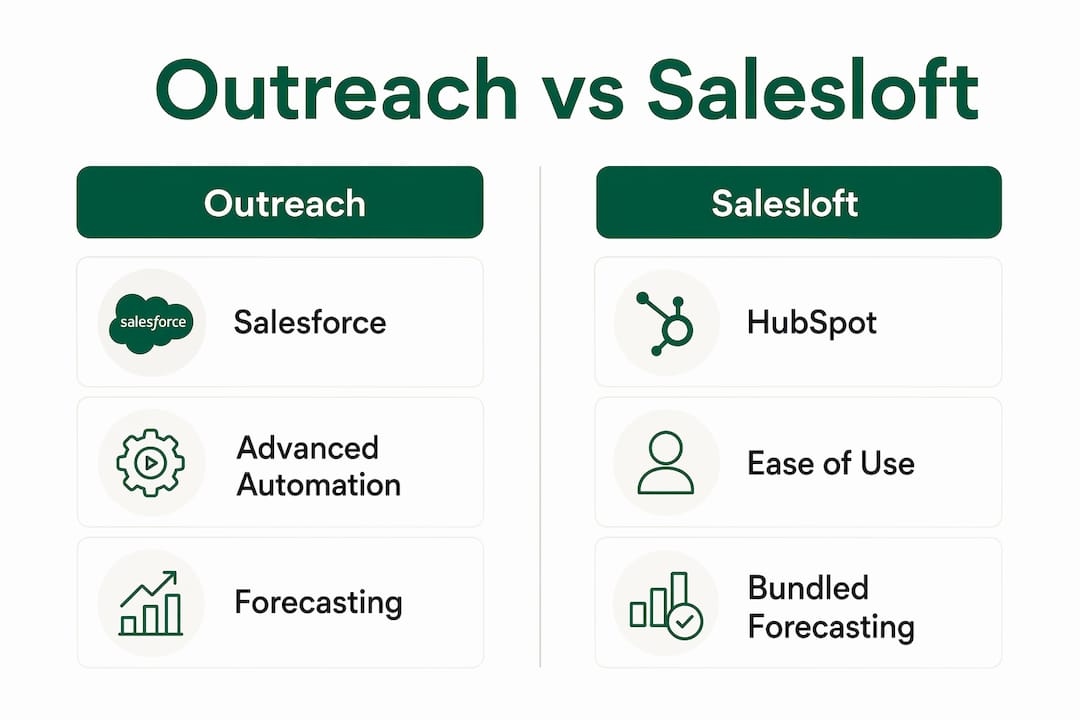
The single most important cell in that table is the CRM integrations row. Ecosystem fit drives the decision more than any feature list comparison.
Pro Tip: Before you run a vendor demo, answer two questions: What is your CRM of record, and how much admin capacity do you have to maintain the platform post-launch? Those two answers will eliminate at least one of the top two options before you see a single slide deck.
How do sequencing and automation actually differ day-to-day?
Both Outreach and Salesloft have moved well past basic email sequencing. The practical difference shows up in how much configuration work your team carries.

Outreach supports advanced branching logic, multi-step conditional sequences, and autonomous sequence agents that can adjust cadence based on engagement signals. Its A/B testing is granular. Multi-channel touches (email, call tasks, LinkedIn steps) are all native. The tradeoff: building and maintaining a high-complexity cadence in Outreach requires someone who knows the platform well. A typical enterprise sequence with five branches and three A/B variants can take a trained admin several hours to configure correctly.
Salesloft’s Rhythm engine takes a different approach. Rather than building static branches, it ingests buyer signals (email opens, site visits, intent data) and prescribes the next action for the rep. That shifts some of the sequencing intelligence from the admin to the platform. Both platforms have evolved into revenue execution suites, but Rhythm’s signal-based prioritization is genuinely different from Outreach’s branch-heavy model.
LeadPilot handles this differently still. The outbound sales automation is fully managed: sequences are built, maintained, and optimized by the platform, not your team. Sending domains are provisioned and warmed for you. Follow-ups run automatically. Warm replies route to your inbox for human pickup. For a team without a dedicated SDR or RevOps admin, that managed model eliminates the configuration overhead entirely.
Key sequencing differences to know:
- Outreach: Best for complex, multi-branch sequences with high governance; requires dedicated admin to maintain.
- Salesloft: Signal-driven prioritization via Rhythm; lower branch complexity but smarter rep-action queuing.
- LeadPilot: Fully managed sequences; no admin overhead; ideal for teams that want outbound running without building it.
- SalesRobot: LinkedIn-first automation; useful for LinkedIn-heavy prospecting motions but limited on email complexity.
What is the real difference in AI and conversation intelligence?
The architecture gap here is significant, and it has long-term implications for IT governance.
Outreach ships closed-agent AI features under the Omni and Agent Studio labels. These agents can autonomously draft emails, prep meeting briefs, and suggest next actions. The catch: agent runs are usage-billed, which means your AI costs can spike unpredictably as adoption grows. Outreach’s closed model also means you are using Outreach’s LLM infrastructure, not your own.
Salesloft went the opposite direction. Its MCP Server lets teams plug in third-party LLMs, including enterprise models running on private infrastructure. For organizations with data-residency requirements or legal constraints on sending customer data to external AI providers, this open-vs-closed distinction is not a feature preference. It is a compliance question.
For day-to-day reps, the AI differences show up in meeting prep, call coaching, and email drafting. Outreach’s agents can auto-generate a meeting brief from CRM context before a call. Salesloft’s conversation intelligence surfaces coaching cues in real time and flags deal risk from transcript patterns. Both are genuinely useful. Neither replaces a well-trained rep.
LeadPilot’s AI SDR automation works differently: it reads your website to detect your ICP, sources matching decision-makers, and writes personalized cold emails from real business signals before a human ever touches the sequence. That is not conversation intelligence. It is pre-pipeline intelligence, which is exactly what lean teams need before they have enough pipeline to coach on.
Pro Tip: Before signing any contract with usage-billed AI features, ask the vendor for a 90-day AI usage projection based on your rep count and expected sequence volume. Then ask what the hard cap mechanism looks like. Uncapped usage billing on agent runs has caught several buyers off guard at renewal.
Does your CRM determine which platform you should pick?
Short answer: yes, more than almost any other factor.
Outreach has deeper Salesforce integration, with more granular field mapping and a comprehensive API suited to enterprise-scale syncs. If your Salesforce tenant has custom objects, complex opportunity stages, or multi-currency configurations, Outreach’s sync architecture handles that more cleanly. Salesloft’s Salesforce integration is solid but less granular at the object level.

Salesloft is the better fit for HubSpot-anchored teams. Its open ecosystem approach and faster setup make it easier to connect without a heavy integration project. For teams running HubSpot as their CRM of record, Salesloft typically reaches a working state weeks faster than Outreach.
Common integration gotchas that break pilots:
- Custom object mapping: Outreach handles complex custom objects better, but both platforms require explicit field mapping during setup. Skipping this step causes duplicate activity records.
- Bidirectional sync delays: Activity sync from SEP to CRM is rarely real-time. Test the actual lag in your POC environment before go-live.
- Contact ownership conflicts: When a rep reassigns a contact in the CRM, does the SEP update automatically? Test this explicitly.
- API rate limits: At high sequence volumes, both platforms can hit Salesforce API limits. Ask the vendor for your projected daily API call volume at your rep count.
Integration checklist for your POC:
- Map every custom object your team uses in Salesforce or HubSpot and confirm the SEP can sync it.
- Run a bidirectional test: create a contact in the SEP, update it in the CRM, and verify both sides reflect the change within your acceptable lag window.
- Ask the vendor’s integration engineer what happens to activity records if the sync breaks and restarts.
- Confirm the API rate limit headroom at your projected sequence volume.
Who actually owns pipeline truth in your analytics stack?
This is where the Clari merger changes the Salesloft conversation materially.
Salesloft’s post-Clari roadmap bundles forecasting and engagement into a single platform. For buyers who were already paying for Clari separately, that bundling can simplify procurement and reduce vendor sprawl. For buyers with no existing Clari contract, it adds forecasting capability that previously required a separate tool.
Outreach has native forecasting and pipeline analytics built in. Its deal inspection views are mature and integrate tightly with Salesforce opportunity data. For CROs who want to run their weekly pipeline review inside the SEP rather than switching to a separate forecasting tool, Outreach’s analytics are comprehensive.
The metrics your leadership team should expect from either platform weekly: activity-to-opportunity ratios, sequence conversion rates by step, meeting-to-opportunity conversion, and pipeline velocity by segment. If your current stack cannot produce those four numbers reliably, that is the gap a SEP should close.
Pro Tip: If you have an existing Clari contract, bring your Clari renewal date to the Salesloft negotiation. The bundled pricing conversation changes significantly when you can show the vendor you are consolidating two contracts into one.
How long does it actually take to get reps productive?
Salesloft has a reputation for faster time-to-value and higher usability scores in operator surveys. Outreach is steeper to learn but more powerful once configured. That is not a knock on Outreach. It is a realistic expectation-setter for your onboarding timeline.
Rough onboarding estimates by company size:
- Outreach, 50–200 reps: 8–14 weeks to first full cadence with proper admin setup; plan for a dedicated admin from day one.
- Salesloft, 20–100 reps: 4–8 weeks to first cadence; lighter admin burden during setup.
- LeadPilot, any size: First campaign preview available before purchase; managed launch typically within days.
Admin overhead is the hidden cost most buyers underestimate. Buyers should budget for 1.0–2.0 FTE of dedicated admin to maintain CRM hygiene, permissions, and field mappings. That overhead is higher for Outreach than Salesloft, and effectively zero for LeadPilot’s managed model.
Mobile capabilities: both Outreach and Salesloft have mobile apps, but neither is a primary coaching surface. Managers can review activity summaries and flag deals on mobile, but deep sequence editing and coaching workflows are desktop-first on both platforms.
Security checklist to verify before signing:
- SSO and SCIM provisioning (both platforms support this at enterprise tiers)
- Role-based permissioning and sequence-level access controls
- Audit logs for admin actions and data exports
- Data residency options if your org has regional compliance requirements
Pro Tip: Run your IT security review in parallel with your POC, not after. Both platforms have enterprise security features, but the specific configuration your IT team requires (SCIM group mapping, audit log retention periods) can add weeks to go-live if you discover gaps at contract signing.
What does this actually cost over three years?
Neither platform publishes a simple list price. What you negotiate depends on rep count, contract length, and which add-ons your team needs.
Representative effective per-user monthly ranges from operator teardowns: Outreach typically costs $145–$185 per user per month, while Salesloft is generally $115–$155 per user per month. Multi-year discounts can reduce these rates, especially for private-equity-backed platforms.
| TCO Component | Outreach (est.) | Salesloft (est.) | LeadPilot |
|---|---|---|---|
| License (per user/month) | $145–$185 | $115–$155 | Monthly subscription; see pricing page |
| Dedicated admin FTE | 1.5–2.0 FTE | 1.0–1.5 FTE | 0 (managed) |
| Implementation services | Significant additional cost | Moderate additional cost | Included |
| Data vendor fees | Separate | Separate | Included |
| Deliverability domains | Buyer-managed | Buyer-managed | Included |
| Dual-run overlap (migration) | Several weeks | Several weeks | Minimal |
Effective total cost of ownership over multiple years can range from $1M to $5M for mid-to-large deployments once admin and data costs are included. That range surprises most buyers who anchor on seat license math alone.
Hidden costs to budget explicitly:
- Data vendor fees (ZoomInfo, Apollo, or similar) are separate from both platforms.
- Deliverability domain setup and warming are buyer-managed on both Outreach and Salesloft.
- Implementation services are typically quoted separately and can run $15K–$50K+ depending on CRM complexity.
- Variable AI usage billing on Outreach’s agent runs requires a separate budget line.
- Migration commonly includes 6–12 weeks of dual-paid overlap, and buyers often under-budget by 30–50%.
Stat to know: Operator teardowns show that effective three-year TCO for mid-to-large SEP deployments frequently reaches $1M–$5M once admin FTE, data, and implementation costs are counted alongside seat licenses.
How do you make the final call for your team?
Neither platform is objectively better. The winning choice maps cleanly to your CRM schema and daily rep workflow. Here is the decision framework.
Five decisive filters, in priority order:
- CRM anchor: Salesforce-heavy with complex objects → Outreach. HubSpot-primary or lighter Salesforce → Salesloft.
- Rep count and admin capacity: Under 50 reps with no dedicated RevOps admin → consider LeadPilot or CRM-native sequencing first. Teams under ~50 reps often over-index on capability and cost with either platform.
- AI architecture appetite: Need to run private LLMs or have data-residency requirements → Salesloft’s open MCP. Want a closed, managed agent suite → Outreach.
- Procurement style: Multi-year deal with aggressive discount negotiation → model both platforms at 2-year and 3-year terms. Month-to-month flexibility → neither platform is built for it at enterprise scale.
- Bundle vs. best-of-breed: Already paying for Clari → Salesloft bundling may consolidate costs. Running a best-of-breed forecasting tool you want to keep → Outreach’s native analytics may fit better.
Vendor questions to ask in your RFP or POC call:
- What is the exact field mapping process for our custom Salesforce objects, and who owns that work?
- What are the API rate limits at our projected sequence volume, and what happens when we hit them?
- How is AI usage billed, and what is the hard cap mechanism?
- What does migration support include, and what is out of scope?
- What are the contract cancellation terms and the process for mid-term seat adjustments?
Red flags that should stop a purchase:
- Vendor cannot show you a live POC environment with your actual CRM data within 30 days.
- No data export available at POC end (you should own your sequence and contact data).
- AI usage billing has no hard cap or requires a separate finance approval process to set limits.
- Deliverability policy is vague or the vendor cannot explain their domain warming process.
- Contract requires 12-month notice for cancellation or seat reduction.
What does implementation actually look like on the ground?
Most buyers plan for a clean cutover. Almost none execute one. The realistic migration path involves a dual-run period that costs real money and attention.
Typical implementation timeline:
- Weeks 1–3 (pre-work): CRM audit, field mapping documentation, sequence inventory, admin training.
- Weeks 4–6 (dual-run overlap): Old platform stays live while new platform is configured and tested. Both licenses are active.
- Weeks 7–10 (sequence rebuild): Existing cadences are rebuilt in the new platform. A/B variants and branching logic are re-created.
- Weeks 11–14 (manager coaching): Managers learn reporting, coaching views, and deal inspection workflows.
- Week 15+ (go-live): Old platform decommissioned; new platform is primary.
| Phase | Duration | Key risk |
|---|---|---|
| Pre-work and CRM audit | 1–3 weeks | Incomplete field mapping discovered late |
| Dual-run overlap | 2–4 weeks | Duplicate activity records in CRM |
| Sequence rebuild | 3–4 weeks | Lost A/B test history and variant logic |
| Manager coaching | 2–3 weeks | Low adoption from managers who skip training |
| Go-live and decommission | 1–2 weeks | Deliverability warm-up not completed |
Common gotchas and how to avoid them:
- Duplicate activity records: Happens when both platforms sync to the same CRM contact simultaneously. Pause the old platform’s sync before the new one goes live.
- Deliverability warm-up: New sending domains need 4–6 weeks of gradual volume increase. Starting at full volume on day one tanks deliverability.
- Sequence history loss: Neither platform imports historical sequence performance from a competitor. Document your top-performing sequences and their metrics before migration.
Stat to know: Migration commonly includes 6–12 weeks of dual-paid overlap, and buyers often under-budget implementation costs by 30–50%.
Pro Tip: Stage AI usage caps in your contract before go-live. Set a monthly agent-run ceiling that requires a finance approval to raise. This prevents a surprise bill in month two when reps discover the AI features and start using them at scale.
How we compared these platforms
This comparison draws on vendor documentation, G2 review aggregates, operator teardown analyses, and publicly available pricing guidance from RevOps practitioners. No platform paid for placement or reviewed this article before publication.
Comparison criteria used:
- Feature depth: sequencing, AI architecture, conversation intelligence, multi-channel support.
- CRM integration quality: field mapping granularity, API capability, bidirectional sync reliability.
- Admin effort: estimated FTE overhead for ongoing maintenance.
- Pricing and TCO: effective per-user ranges from operator teardowns, plus hidden cost categories.
- Security and compliance: SSO, SCIM, permissioning, audit logs, data residency options.
- Usability and onboarding: time-to-first-cadence estimates and G2 usability scores.
- AI architecture: closed-agent vs. open-MCP implications for governance and portability.
Primary source types: vendor documentation and feature pages, G2 review aggregates (Outreach: 3,565 reviews, 4.3 stars; Salesloft: 4,287 reviews, 4.5 stars), operator teardown analyses from RevOps practitioners, and publicly available pricing guidance. Pricing ranges cited are representative operator estimates, not vendor-published list prices. Verify current pricing and contract terms directly with each vendor before signing.
Runleadpilot publishes this article and LeadPilot is one of the compared options. That is disclosed here. LeadPilot’s inclusion reflects genuine fit for a buyer segment (lean teams and agencies) that both Outreach and Salesloft routinely over-serve and over-charge.
What is a sales engagement platform, and when do you actually need one?
A sales engagement platform (SEP) sits between your CRM and your reps, automating the sequencing, tracking, and prioritization of outbound touches across email, phone, and LinkedIn. Its job is to make sure every rep follows up at the right time with the right message, and that every interaction logs back to the CRM without manual entry.
The threshold question is not “should we have a SEP?” It is “do we have enough rep volume and sequence complexity to justify the overhead?” For teams under 50 reps, CRM-native sequencing (HubSpot Sequences, Salesforce Cadences) or SMB-focused tools frequently deliver most of the value at a fraction of the cost. The SMB-focused alternative case is real: teams under ~50 reps often get 70–80% of the outcome without the enterprise SEP overhead.
Core capabilities that distinguish a SEP from CRM-only workflows:
- Multi-step, multi-channel sequence automation with conditional branching.
- Conversation intelligence: call recording, transcript analysis, and coaching cues.
- Deliverability management: sending domain health, bounce handling, and inbox rotation.
- Rep activity prioritization: signal-based queuing of next actions across the full book of business.
- Analytics beyond CRM: sequence conversion rates, step-level engagement, and meeting attribution.
Pro Tip: If your reps are manually logging more than 30% of their outbound activity in the CRM, that is the clearest signal you need a SEP. If they are logging less than that, fix the CRM workflow first before adding another platform.
What does customer support actually look like after you sign?
Support quality diverges significantly between the two platforms once you are past the sales cycle.
Salesloft scores higher on support satisfaction in G2 reviews, with users consistently noting responsive assistance and quality of help received. Outreach’s support is rated lower on G2, with some users flagging a desire for faster response times and more proactive guidance. At enterprise tiers, both platforms offer dedicated customer success managers, but the day-to-day support experience for mid-market buyers is where the gap shows up.
Outreach’s support model leans heavily on its professional services team for complex configurations. That is appropriate for enterprise deployments but adds cost for mid-market buyers who expected more included support. Salesloft’s onboarding support is generally included at more tiers and requires less paid services engagement to reach a working state.
For LeadPilot, support is embedded in the managed model. There is no configuration you are left to figure out alone because the platform manages the setup for you. That is a structural difference, not just a service-level one.
What are real users saying about each platform?
G2 data gives a clear picture. Salesloft holds a 4.5-star rating across 4,287 reviews; Outreach holds 4.3 stars across 3,565 reviews. The review themes are consistent across both platforms.
Salesloft users consistently praise:
- Intuitive interface and faster onboarding.
- Rhythm engine for signal-based rep prioritization.
- Salesforce sync reliability for day-to-day prospecting.
- Quality of support and responsiveness.
Salesloft users flag:
- Missing features at the sequence complexity level that Outreach handles.
- Call quality issues noted in a meaningful share of reviews.
- Post-Clari bundling creating confusion about which features are included at which tier.
Outreach users consistently praise:
- Automation depth and sequence complexity handling.
- AI-driven reporting and activity analytics.
- Robust interaction logging and CRM sync for Salesforce tenants.
Outreach users flag:
- Steeper learning curve and higher admin burden.
- Lower ease-of-use and ease-of-setup scores compared to Salesloft.
- Support responsiveness at non-enterprise tiers.
The pattern is consistent: Salesloft wins on usability and support; Outreach wins on automation depth and Salesforce integration complexity. Neither platform has a clean sweep.
How well do these platforms scale and support custom workflows?
Outreach is the stronger choice for organizations with genuinely complex workflow requirements. Its API is comprehensive, its sequence logic supports deep conditional branching, and its Agent Studio lets technical teams build custom AI workflows on top of the platform’s data model. For a 200-rep enterprise with five distinct sales motions and a dedicated RevOps team, Outreach’s customization ceiling is high.
Salesloft scales well to mid-market and is adding enterprise capability through the Clari integration. Its open MCP architecture means you can extend it with external AI models and custom integrations without being locked into Salesloft’s own AI stack. That openness is a genuine customization advantage for teams with specific LLM requirements.
LeadPilot scales differently. Its multi-client workspace model is built for agencies running outbound for multiple clients simultaneously, with consolidated billing and separate campaign environments per client. For a lean internal team, the agency-grade managed outbound infrastructure handles volume that would otherwise require a dedicated SDR and RevOps admin.
SalesRobot fits best for teams with a LinkedIn-heavy prospecting motion who want a lighter-weight tool alongside their primary SEP. It is not a replacement for either Outreach or Salesloft at scale.
What are the contract terms and cancellation realities?
Both Outreach and Salesloft are annual contracts at minimum, with multi-year deals available at steeper discounts. Neither platform is designed for month-to-month flexibility at enterprise scale. Mid-term seat reductions are typically not permitted under standard terms, and cancellation notice periods can run 60–90 days before renewal.
Procurement style matters here. Both platforms are private-equity-backed, and multi-year commitments unlock meaningfully better pricing. Buyers who model only list price and sign a one-year deal often pay 20–30% more than buyers who negotiate a two-year term upfront.
Key contract questions to resolve before signing:
- What is the seat reduction policy mid-term if headcount changes?
- What is the cancellation notice period, and when does it start relative to renewal?
- Are AI usage fees capped in the contract, or are they variable and uncapped?
- What happens to your data if you cancel? How long does the vendor retain it, and in what format can you export it?
LeadPilot operates on monthly subscription plans, which gives lean teams and agencies flexibility that annual enterprise contracts do not. The pricing structure is transparent, and the free campaign preview means you can validate fit before committing to a paid plan.
Key Takeaways
Outreach fits Salesforce-heavy enterprises with dedicated RevOps capacity; Salesloft fits mid-market and HubSpot-adjacent teams that need faster onboarding and bundled forecasting; LeadPilot is the practical alternative for lean teams and agencies that want managed outbound without the enterprise overhead.
| Point | Details |
|---|---|
| CRM fit is the primary filter | Outreach for complex Salesforce tenants; Salesloft for HubSpot-adjacent or lighter Salesforce orgs. |
| TCO runs higher than seat math | Three-year TCO for mid-to-large deployments often reaches $1M–$5M once admin FTE, data, and implementation are counted. |
| AI architecture has governance implications | Outreach’s closed-agent model vs. Salesloft’s open MCP server determines whether you can run private LLMs in-house. |
| Migration costs are routinely underestimated | Dual-run overlap runs 6–12 weeks; buyers commonly under-budget implementation by 30–50%. |
| LeadPilot for lean teams and agencies | Managed SDR workflow, included deliverability domains, and a free campaign preview make it the lower-TCO alternative for teams under 50 reps. |
The platform decision most teams get wrong
The conventional wisdom in this comparison is that you pick Outreach for power and Salesloft for ease of use. That framing is not wrong, but it misses the more important question: which platform will your reps actually use six months after go-live?
Feature lists are easy to compare. Adoption curves are not. The most common failure pattern in SEP deployments is not a bad platform choice. It is a mismatch between the platform’s configuration complexity and the team’s actual capacity to maintain it. A team that buys Outreach for its advanced branching logic but has no dedicated admin to maintain those branches ends up with a $180-per-user-per-month email sender. That is an expensive way to do something a simpler tool handles fine.
The Clari merger adds another wrinkle. Salesloft’s bundled forecasting is genuinely compelling for buyers who were paying for Clari separately. But for buyers with no existing Clari relationship, it means paying for forecasting capability bundled into a platform they may not fully use. Bundling is only a win if you were going to buy both products anyway.
For lean teams and agencies, the honest answer is often that neither Outreach nor Salesloft is the right starting point. The managed model, where the platform handles targeting, sequences, deliverability, and follow-ups, removes the configuration overhead that kills adoption on both platforms. That is not a consolation prize. For a 10-person team trying to run outbound without a dedicated SDR, it is the more rational choice.
LeadPilot: the managed alternative for lean teams and agencies
Outreach and Salesloft are serious platforms built for teams with the RevOps capacity to configure and maintain them. If that is your situation, the comparison above gives you the framework to choose. But if you are running a lean team or an agency and you want outbound producing warm replies without a six-figure platform and a dedicated admin, LeadPilot is the faster path.
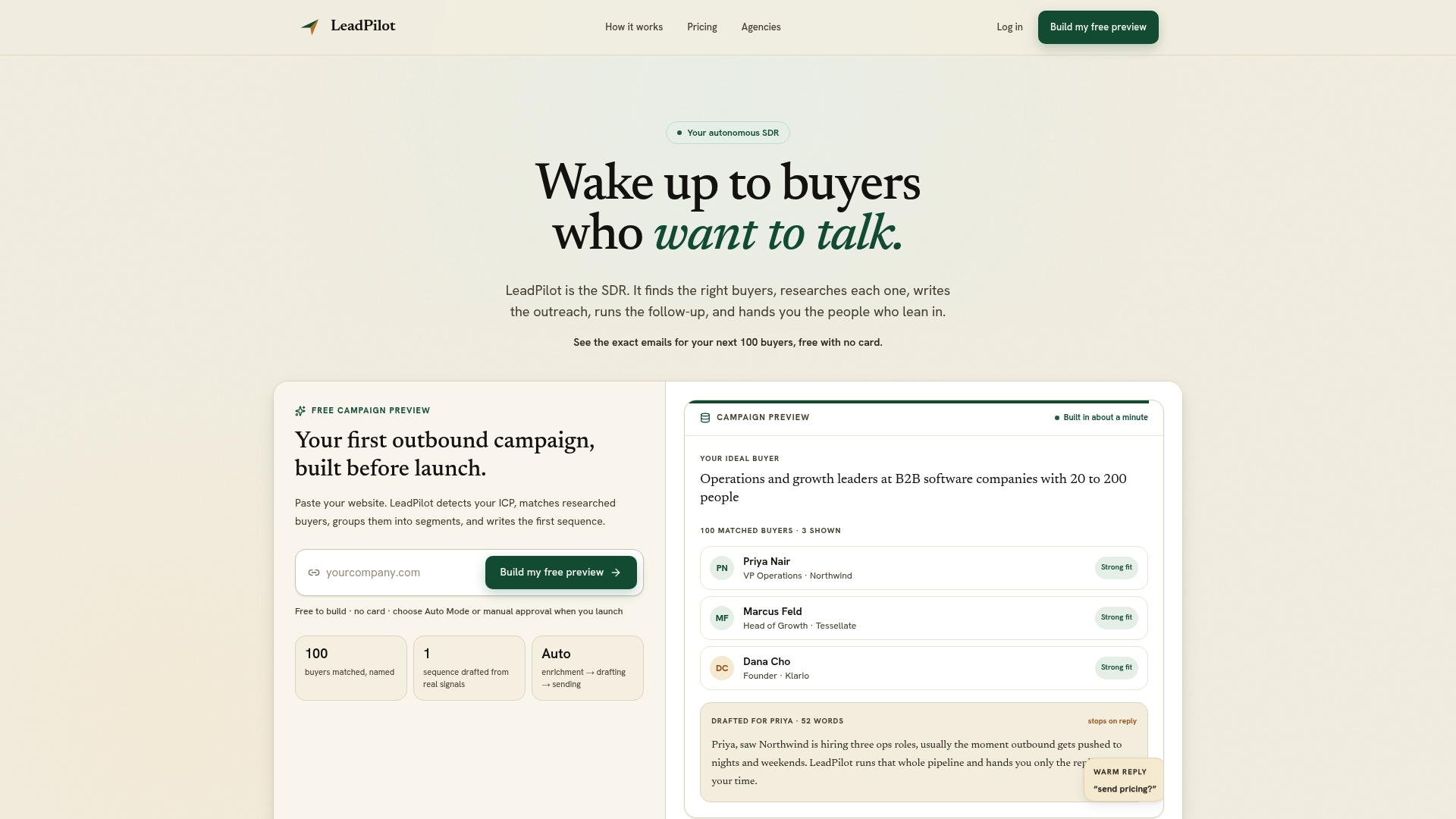
LeadPilot reads your website to detect your ICP, sources and researches matching B2B decision-makers, writes personalized cold emails from real business signals, manages dedicated sending domains for deliverability, and routes warm replies to your team for human follow-up. The AI SDR workflow handles everything from targeting through reply handoff. There is no sequence builder to configure, no domain warming to manage, and no admin overhead to staff. Agencies get multi-client workspaces with consolidated billing. And before you pay anything, you can build a free campaign preview to see exactly who LeadPilot would target and what it would send. Start your free campaign preview at runleadpilot.com.
Useful sources and primary links to verify features and pricing
Use these sources to verify specific feature claims, current pricing, and integration details before signing any contract. Vendor docs change frequently; always check the current release notes.
- G2: Outreach vs. Salesloft comparison: Review aggregates, usability scores, and user-reported pros and cons. Check the “ease of setup” and “quality of support” scores specifically.
- Salesloft pricing page: Verify current tier structure and what is included at each level post-Clari merger.
- Salesloft Clari merger announcement: Understand what the merger means for forecasting bundling and licensing.
- PulseRevOps: Outreach vs. Salesloft operator analysis: Operator-level teardown of ecosystem fit, pricing ranges, and TCO considerations.
- Coommit: Post-Clari decision guide: Covers AI architecture differences and migration cost realities in detail.
- Dashpick: Salesloft vs. Outreach usability comparison: Operator survey data on time-to-value and usability scores.
- LeadPilot pricing and free campaign preview: For lean teams and agencies evaluating the managed alternative.
Three things to verify directly with each vendor before signing: current AI usage billing terms and cap mechanisms, contract cancellation notice periods and mid-term seat adjustment policies, and what migration support is included versus what requires paid professional services. Run a 60-day POC with your actual CRM data before committing to a multi-year contract. For change management and adoption planning during a SEP rollout, external consulting resources can reduce the adoption risk that kills otherwise-sound platform decisions.