Best Outreach Alternatives for B2B Sales Teams in 2026
Discover effective outreach alternatives for B2B sales teams in 2026. Explore managed options like Runleadpilot for streamlined outbound success.

Best Outreach Alternatives for B2B Sales Teams in 2026
For lean B2B teams that want end-to-end outbound handled without building an SDR stack from scratch, Runleadpilot is the managed alternative to trial first. It detects your ideal customer profile from your website, sources and researches matching decision-makers, writes personalized cold emails from real business signals, manages dedicated sending domains and inboxes, and routes warm replies to your team. The main trade-off: it is a managed service, not a self-serve sequencer, so teams that want full manual control over every sequence step will find it less flexible than a DIY platform.
Here is the shortlist by buyer fit, so you can skip to the right section:
- Runleadpilot (managed outbound): Best for founders, lean teams, and agencies that want the full SDR workflow handled. Read the deep-dive and promo sections.
- CRM-native sequencer (e.g., HubSpot Sales Hub, Salesforce Sales Engagement): Best for teams already living in a CRM that want sequencing without a separate tool. Read the comparison table.
- Sequencer + data bundle (e.g., Apollo.io): Best for in-house SDR teams that need prospecting and sequencing under one roof. Read the deep-dive vendor section.
- Enterprise sequencer (e.g., Salesloft): Best for mid-market and enterprise revenue teams that need pipeline analytics, coaching, and process enforcement at scale. Read the deep-dive and buying checklist.
- Conversation intelligence platform (e.g., Gong, Revenue.io, ZoomInfo/Chorus): Best for teams whose gap is call coaching and deal inspection, not sequencing. Read the comparative analysis section.
- Behavior-layer tool: Best for teams whose reps skip discovery or run deals inconsistently. A behavior layer lives inside the CRM and enforces process adherence rather than adding more send volume.
Pro Tip: Before you demo anything, write down whether your bottleneck is sequencing, prospect sourcing, deliverability, or rep process adherence. The right answer changes the category you should evaluate, not just the vendor.
Table of Contents
- How do these Outreach alternatives compare at a glance?
- Deep-dive breakdowns: features, strengths, and who should pick each category
- How do you choose the right Outreach alternative?
- Why do teams actually switch from Outreach?
- How we picked and compared these alternatives
- Key Takeaways
- The tool swap that does not fix the real problem
- Runleadpilot handles the full SDR workflow so your team does not have to
- Useful sources and vendor pages to read next
How do these Outreach alternatives compare at a glance?
The table below maps each platform category to the buying dimensions that matter most. Use it to eliminate categories that do not fit your team before reading the full breakdowns.

| Category | Best for / team size | Sequencing & cadence automation | CRM integration | AI / conversation intelligence | Deliverability & domain management | Data enrichment / lead sourcing | Reporting & coaching | Pricing model | Onboarding & managed services |
|---|---|---|---|---|---|---|---|---|---|
| Runleadpilot (managed outbound) | Founders, lean teams 1–20, agencies | Fully managed; automated follow-ups and reply routing | Warm-reply handoff; no native CRM sync required | AI ICP detection, signal-based personalization | Dedicated sending domains and inboxes managed for you | Built-in; ICP-matched decision-maker sourcing | Reply and campaign reporting | Flat monthly subscription; includes a free campaign preview | Fully managed; no SDR hire needed |
| CRM-native sequencer | HubSpot or Salesforce-first teams | Native sequencing inside CRM | Native; zero sync friction | Limited; depends on CRM tier | Shared sending infrastructure; limited domain isolation | Relies on CRM data or third-party enrichment | CRM-native dashboards | Per-seat; bundled with CRM tier | Self-serve; vendor support varies |
| Sequencer + data bundle | In-house SDR teams needing prospecting + sending | Strong multi-step cadences | Third-party CRM sync (Salesforce, HubSpot) | Basic AI email assist | Shared sending; some domain warm-up tools | Large built-in contact database | Sequence analytics; limited call coaching | Per-seat; entry around $100/month | Self-serve; onboarding docs and chat |
| Enterprise sequencer | Mid-market and enterprise revenue teams | Advanced cadence, A/B testing, branching | Deep CRM bi-directional sync | Pipeline analytics, deal inspection | Shared infrastructure; some enterprise controls | Limited; relies on CRM or enrichment add-ons | Advanced coaching, call recording, playbooks | Per-seat enterprise pricing | Dedicated CSM; structured onboarding |
| AI SDR / autonomous outbound | Teams wanting fully automated prospecting to reply | Autonomous; AI-driven sequences | API or native CRM push | AI reply handling and routing | Varies by vendor; domain management often included | AI-driven sourcing and research | Engagement and reply analytics | Flat or usage-based | Varies; often self-serve with setup guides |
| Conversation intelligence | Teams with call coaching and deal inspection gaps | None; not a sequencer | CRM integration for deal data | Core product: call recording, AI summaries, coaching | Not applicable | None | Deep call and deal analytics | Per-seat; enterprise tiers | Structured onboarding; coaching playbooks |
| Agency multi-client platform | Cold email agencies managing multiple clients | Multi-workspace cadences | Per-client CRM or webhook | Limited | Domain isolation per client; consolidated billing | Varies | Per-client campaign reporting | Flat or per-seat agency pricing | Agency-focused onboarding; account management |
The single most important trade-off: managed platforms like Runleadpilot remove execution burden but reduce manual control; self-serve sequencers give full control but require an SDR or ops person to run them. Pick the category that matches your team’s actual capacity, not your ideal future state.
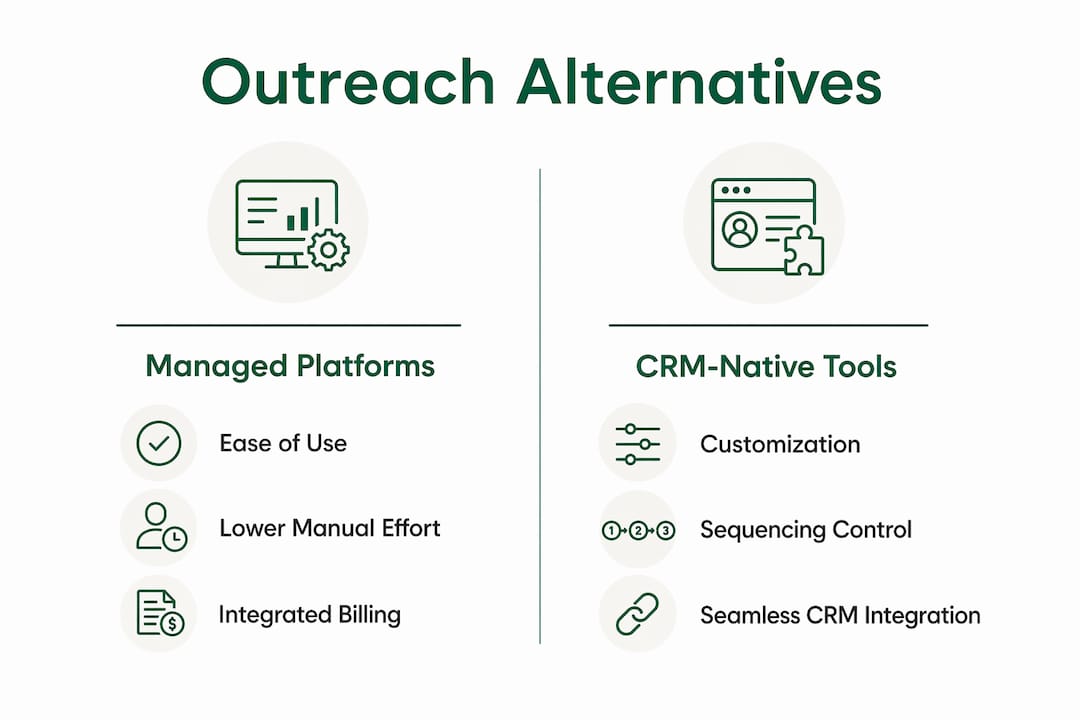
Deep-dive breakdowns: features, strengths, and who should pick each category

Runleadpilot: fully managed AI outbound
Runleadpilot reads your website to detect your ICP, then sources and researches matching B2B decision-makers, writes personalized cold emails from real business signals, and manages dedicated sending domains and inboxes so your team never touches deliverability setup. Follow-ups run automatically, and warm replies get routed to your human team for closing. There is no SDR to hire, no inbox to warm up manually, and no sequence to build from scratch.
- Wins vs. a traditional sequencer: Zero execution overhead; deliverability managed for you; built-in prospect sourcing; free campaign preview before you pay.
- Who should pick it: Founders of B2B software or services companies (1–20 employees), lean sales teams without a dedicated SDR, and cold email agencies managing outbound for multiple clients.
- Pricing shape: Flat monthly subscription based on the number of researched buyers and sending capacity; agencies get multi-client workspaces with consolidated billing. Start with a free campaign preview to see targeting and messaging before committing.
- Migration note: No sequence migration needed. Runleadpilot builds campaigns from your website, so the onboarding input is your URL and ICP details, not exported CSV files.
CRM-native sequencer: HubSpot Sales Hub, Salesforce Sales Engagement, Microsoft Dynamics 365 Sales
If your team already lives in HubSpot or Salesforce, adding a separate sequencer creates sync friction, data duplication, and another vendor contract. CRM-native sequencing solves that by running cadences inside the tool your reps already use. HubSpot Sales Hub is the cleaner fit for SMB and mid-market teams; Salesforce Sales Engagement and Microsoft Dynamics 365 Sales suit larger orgs with complex CRM customizations.
- Wins vs. Outreach: No sync lag; contact and activity data stay in one place; lower total cost of ownership for teams already paying for the CRM.
- Weaknesses: Sending infrastructure is shared; domain isolation is limited; prospecting data relies on the CRM or a separate enrichment tool.
- Who should pick it: Teams where the CRM is the system of record and reps resist context-switching.
- Pricing shape: Bundled with CRM tier; per-seat costs vary by plan. HubSpot Sales Hub starts at a lower entry point than enterprise sequencers; Salesforce Sales Engagement pricing is not publicly listed and requires a quote.
- Migration note: Sequence logic migrates relatively cleanly from Outreach if your CRM data is tidy. The harder work is rebuilding custom fields and activity mappings.
Sequencer + data bundle: Apollo.io
Apollo.io combines a large B2B contact database with multi-step email and phone cadences, so SDR teams can prospect and sequence without switching tools. The sequencer + data bundle category appeals to teams that want engagement and prospecting under one roof, removing a separate data provider from the stack.
- Wins vs. Outreach: Built-in contact database; lower per-seat entry cost; faster time to first sequence for teams without existing data.
- Weaknesses: Sending infrastructure is shared; data freshness varies; call coaching is limited compared to dedicated conversation intelligence tools.
- Who should pick it: In-house SDR teams of 3–15 reps that need prospecting and sequencing without a separate data contract.
- Pricing shape: Per-seat pricing starting at an entry-level rate for premium tiers. A free tier exists with limited exports.
- Migration note: Contact data exports from Outreach map reasonably well to Apollo’s import format. Sequence logic requires manual rebuild.
Enterprise sequencer: Salesloft
Salesloft is built for revenue teams that need pipeline analytics, deal inspection, and coaching alongside sequencing. Following its merger with Clari, the combined platform targets enterprise buyers who want forecasting and engagement in one product. That merger is still in transition, so buyers should ask vendors directly about product roadmap and integration timelines before signing.
- Wins vs. Outreach: Stronger pipeline analytics and forecasting (post-Clari); deep CRM bi-directional sync; structured coaching playbooks.
- Weaknesses: Enterprise pricing; complex onboarding; the Clari integration is still maturing.
- Who should pick it: Mid-market and enterprise revenue teams (50+ reps) with a dedicated RevOps function.
- Pricing shape: Per-seat enterprise pricing; not publicly listed. Expect annual contracts.
- Migration note: Sequence and template migration from Outreach is supported but requires ops involvement. Allow 4–6 weeks for a full production cutover.
AI SDR / autonomous outbound
This category covers platforms that automate the full prospecting-to-reply workflow using AI, from identifying prospects to sending and responding to initial replies. Runleadpilot’s AI SDR capabilities sit in this category, with the added layer of managed service so your team does not configure the AI. Other vendors in this space vary widely on how much human oversight they require.
- Wins vs. Outreach: Removes the SDR execution layer entirely; faster ramp for small teams; often includes domain management.
- Weaknesses: Less manual control; AI personalization quality varies; not suited for complex enterprise sales cycles that require heavy human judgment.
- Who should pick it: Founders and lean teams that want outbound running without hiring an SDR; agencies testing new client verticals quickly.
- Pricing shape: Flat or usage-based; varies by vendor.
Conversation intelligence: Gong, Revenue.io, ZoomInfo/Chorus
Gong, Revenue.io, and ZoomInfo/Chorus are not sequencers. They record and analyze sales calls, surface deal risks, and provide coaching recommendations. If your team’s gap is that reps are not running discovery well or deals are stalling after the first call, a conversation intelligence platform addresses that directly. A new sequencer will not.
- Wins vs. Outreach: Deep call recording and AI-powered coaching; deal inspection and risk flagging; integrates with most CRMs and sequencers.
- Weaknesses: Does not replace a sequencer; adds per-seat cost on top of existing stack.
- Who should pick it: Teams with 10+ quota-carrying reps where call quality and deal execution are the bottleneck, not top-of-funnel volume.
- Pricing shape: Per-seat; enterprise tiers. Gong and ZoomInfo/Chorus pricing is not publicly listed; Revenue.io pricing requires a quote.
For teams exploring async video follow-up alongside conversation intelligence, TrailerCast offers AI-assisted stage-by-stage sales support that complements call recording workflows.
Agency multi-client platforms
Agencies running outbound for multiple clients need more than a sequencer. Domain isolation per client and separate sending inboxes are non-negotiable: one client’s poor sending reputation should never damage another’s. Platforms built for agency use also support consolidated billing, per-client campaign reporting, and role-based access so account managers can work independently.
- Wins vs. Outreach: Multi-workspace architecture; consolidated billing; domain isolation by default.
- Weaknesses: Fewer enterprise coaching features; less CRM depth than dedicated sequencers.
- Who should pick it: Cold email agencies managing 5+ client campaigns simultaneously.
- Pricing shape: Flat or per-seat agency pricing; varies by platform.
- Migration note: Client domain and inbox setup is the most time-consuming part of onboarding. Budget 1–2 weeks per client for domain warm-up.
Runleadpilot’s agency workspace handles multi-client domain isolation and consolidated billing natively, making it a practical managed option for agencies that want to offload the infrastructure work entirely.
Behavior-layer tools
Many comparison lists miss this category entirely. A behavior layer runs inside the CRM, defines what good looks like at each deal stage, and measures whether reps are actually following the process. If your reps skip discovery, fail to log calls, or run deals inconsistently, adding more sequence touches will not fix that. A behavior layer will.
- Wins vs. Outreach: Addresses process adherence directly; lives in the CRM where reps already work; provides leading indicators of deal health.
- Weaknesses: Not a sequencer; does not replace outbound automation.
- Who should pick it: Teams where the root cause of missed quota is inconsistent execution, not insufficient outreach volume.
- Pricing shape: Varies; typically per-seat SaaS.
How do you choose the right Outreach alternative?
Decision checklist by buyer priority
Work through these before you book a demo:
- Team size and SDR capacity: Do you have a dedicated SDR or ops person to run a self-serve sequencer? If not, a managed platform removes that dependency.
- Outbound volume: How many new prospects do you need to contact per month? High-volume teams need robust domain management; low-volume teams often overpay for enterprise sequencer seats.
- Prospect sourcing: Do you have a clean contact list, or do you need the platform to source and research prospects? If sourcing is part of the job, a sequencer-only tool leaves a gap.
- Deliverability requirements: Are you sending from shared infrastructure or dedicated domains? Shared sending pools create risk, especially for agencies.
- CRM fit: Is your CRM the system of record, or is it a secondary tool? CRM-native sequencers only make sense if the CRM is genuinely central.
- Managed services: Do you want the platform to handle targeting, personalization, and domain setup, or do you want to configure everything yourself?
Questions to ask vendors in demos
- How do you manage sending domains and inboxes? Are they shared across customers or isolated per account?
- What happens to my sending reputation if another customer on your infrastructure gets flagged for spam?
- Does your platform support multi-client workspaces with separate billing and domain isolation?
- How does CRM sync work? Is it real-time bi-directional, or batch one-way?
- Who owns the contact data if I cancel? Can I export everything?
- Is there a free trial or pilot period, and does it include real sending, or is it a sandbox only?
- What does onboarding look like for a team our size, and how long before we are sending at full volume?
Red flags to watch for
- Opaque deliverability claims: Any vendor that cannot explain exactly how sending domains are managed and isolated is a risk.
- No domain isolation: Shared sending pools mean your reputation is tied to every other customer on the platform.
- Annual-only contracts with no pilot: A vendor that will not let you test with real prospects before a 12-month commitment is not confident in their product.
- Limited reporting granularity: If you cannot see reply rates, bounce rates, and domain health by campaign, you cannot diagnose problems.
Buyer-profile recommendations
- If you are a founder or lean team without an SDR: trial Runleadpilot first.
- If your team lives in HubSpot: trial HubSpot Sales Hub’s sequencing before adding a separate tool.
- If you have in-house SDRs and need prospecting built in: trial Apollo.io.
- If your reps are skipping discovery and deals stall after the first call: implement a behavior layer inside your CRM before buying another sequencer.
- If you run outbound for multiple clients: evaluate agency-focused platforms with domain isolation, or use Runleadpilot’s agency workspace.
Pro Tip: Run a two-week proof-of-value pilot using a small batch of real prospects (50–100 contacts) on a fresh sending domain. Measure reply rate, bounce rate, and inbox placement before you commit to production sending. A vendor that resists this kind of pilot is telling you something.
Why do teams actually switch from Outreach?
The honest answer is that most teams switch for one of five reasons, and only some of them are actually platform problems.
Common reasons teams leave
- Per-seat cost: Premium sequencer pricing can be cost-prohibitive for small and mid-size teams, encouraging them to consider lower-cost or flat-fee alternatives.
- CRM alignment: Teams that want sequencing inside their CRM rather than synced to it find dedicated sequencers create data friction and duplicate workflows.
- Built-in prospecting: Teams that need contact sourcing alongside sequencing end up paying for two tools; a sequencer + data bundle or managed platform removes that.
- Behavior enforcement: Some teams realize their problem is not sequencing volume but rep process adherence. A sequencer swap does not fix that.
- Vendor consolidation risk: The Salesloft/Clari merger and broader market consolidation have made some buyers nervous about product roadmap stability.
What switching actually fixes, and what it does not
Switching platforms tends to improve deliverability when you move to dedicated domain management, reduce tool sprawl when you consolidate sequencing and data, and lower cost when you move from per-seat enterprise pricing to a flat-fee model. What it rarely fixes on its own: conversion rates driven by weak messaging, low reply rates caused by poor ICP targeting, and deal stall caused by inconsistent discovery.
Swapping a sequencer when the real problem is process adherence is like buying a faster car when the issue is that you keep taking wrong turns. The tool is not the bottleneck. The process is. Before you migrate, run a two-week audit of where deals actually stall — sequence step, first call, or post-demo. The answer tells you which category of tool to buy, or whether to buy one at all.
Migration timeline: what to expect
| Phase | What happens | Realistic duration |
|---|---|---|
| Pilot | Test new platform with a small prospect batch on a fresh domain | 2 weeks |
| Domain setup | Register, configure, and warm up sending domains and inboxes | 2–4 weeks |
| Sequence migration | Rebuild or import sequence templates and cadence logic | 1–2 weeks |
| QA | Test deliverability, CRM sync, and reply routing | 1 week |
| Ramp | Gradually increase send volume to full production | 2–4 weeks |
Full production cutover typically takes 6–10 weeks for a team migrating from a mature Outreach setup. Managed platforms like Runleadpilot compress this significantly because domain setup and sequence building are handled for you.
How we picked and compared these alternatives
This comparison was built around buyer problems, not vendor brand recognition. The selection criteria:
- Feature coverage: Does the platform address the buyer’s primary job (sequencing, prospecting, coaching, process adherence, or managed outbound)?
- Deliverability controls: Does the platform offer dedicated domain management, inbox isolation, and sending reputation monitoring?
- CRM integration depth: Is the integration native or third-party? Real-time or batch? Bi-directional or one-way?
- Managed services: Does the platform handle targeting, personalization, and domain setup, or does it require a dedicated ops person?
- Pricing transparency: Is pricing publicly listed, or does it require a sales call to get a number?
- Multi-client support: Does the platform support agency-style multi-workspace architecture with consolidated billing?
Primary data sources include vendor documentation, G2 category reviews, third-party comparison posts, and expert practitioner analysis. Pricing figures are sourced from publicly available vendor pages and third-party research; they change frequently, so treat them as directional rather than exact. Some products are in active transition (notably Salesloft post-Clari merger), and feature sets may shift.
A note on framing: this comparison models platform categories rather than ranking direct competitors against each other. Runleadpilot is presented as the recommended managed option for the buyer profiles described because it handles the full SDR workflow end-to-end, which is a genuinely different value proposition from a self-serve sequencer.
Key Takeaways
The right Outreach alternative depends on your team’s actual bottleneck: managed outbound, CRM-native sequencing, built-in prospecting, call coaching, or process enforcement are four different problems that require four different categories of tool.
| Point | Details |
|---|---|
| Diagnose before you buy | Identify whether your gap is sequencing, sourcing, deliverability, or process adherence before evaluating any platform. |
| Managed vs. self-serve | Runleadpilot handles the full SDR workflow end-to-end; self-serve sequencers require a dedicated ops or SDR resource to run. |
| Domain isolation matters | Shared sending infrastructure creates deliverability risk; always ask vendors how domains and inboxes are isolated per account or client. |
| CRM-native wins on simplicity | For HubSpot or Salesforce-first teams, a CRM-native sequencer removes sync friction and reduces total cost of ownership. |
| Runleadpilot for lean teams | Founders, lean B2B teams, and agencies should trial Runleadpilot first for managed outbound with a free campaign preview. |
The tool swap that does not fix the real problem
Most buyers shopping for Outreach alternatives are solving the wrong problem. They see flat reply rates or missed quota and assume the sequencer is the issue. Sometimes it is. More often, the sequencer is fine and the problem is upstream: weak ICP targeting, messaging that does not connect to a real business pain, or reps who skip discovery and jump straight to the pitch.
The behavior-layer category exists precisely because this pattern is so common. Teams add more sequence steps, more follow-ups, more channels, and the numbers barely move. Then they switch platforms, rebuild everything, and get the same results six months later. The platform did not cause the problem, and the new platform will not fix it.
Three mistakes I see repeatedly in this buying process: First, teams treat a sequencer swap as a strategy, not a tactic. The sequencer is a delivery mechanism. If what you are delivering is not resonating, a faster or cheaper delivery mechanism does not help. Second, buyers ignore deliverability until it becomes a crisis. Domain isolation and inbox warm-up are not optional extras. They are the foundation. A platform that cannot explain exactly how it manages sending reputation is a liability, not an asset. Third, agencies test multi-client deliverability in a sandbox and assume production will behave the same way. It will not. Test with real prospects on real domains before you commit.
The practical correction is straightforward: before you demo any platform, run a two-week audit of where your current sequences actually break down. Map the drop-off by step. If prospects are not opening, the problem is deliverability or subject lines. If they open but do not reply, the problem is messaging or ICP fit. If they reply but do not convert, the problem is discovery and qualification. Each of those diagnoses points to a different category of tool, or to a process fix that no tool will substitute for.
Pro Tip: Track process adherence (did the rep complete each required step?) separately from sequence touches (how many emails went out?). Adherence is the leading indicator. Volume is the lagging one. Teams that measure only touches consistently misdiagnose their conversion problems.
Runleadpilot handles the full SDR workflow so your team does not have to
Most outbound tools hand you a sequencer and leave the hard parts to you: finding the right prospects, warming up domains, writing emails that actually connect, and figuring out why deliverability dropped last Tuesday. Runleadpilot takes a different route.
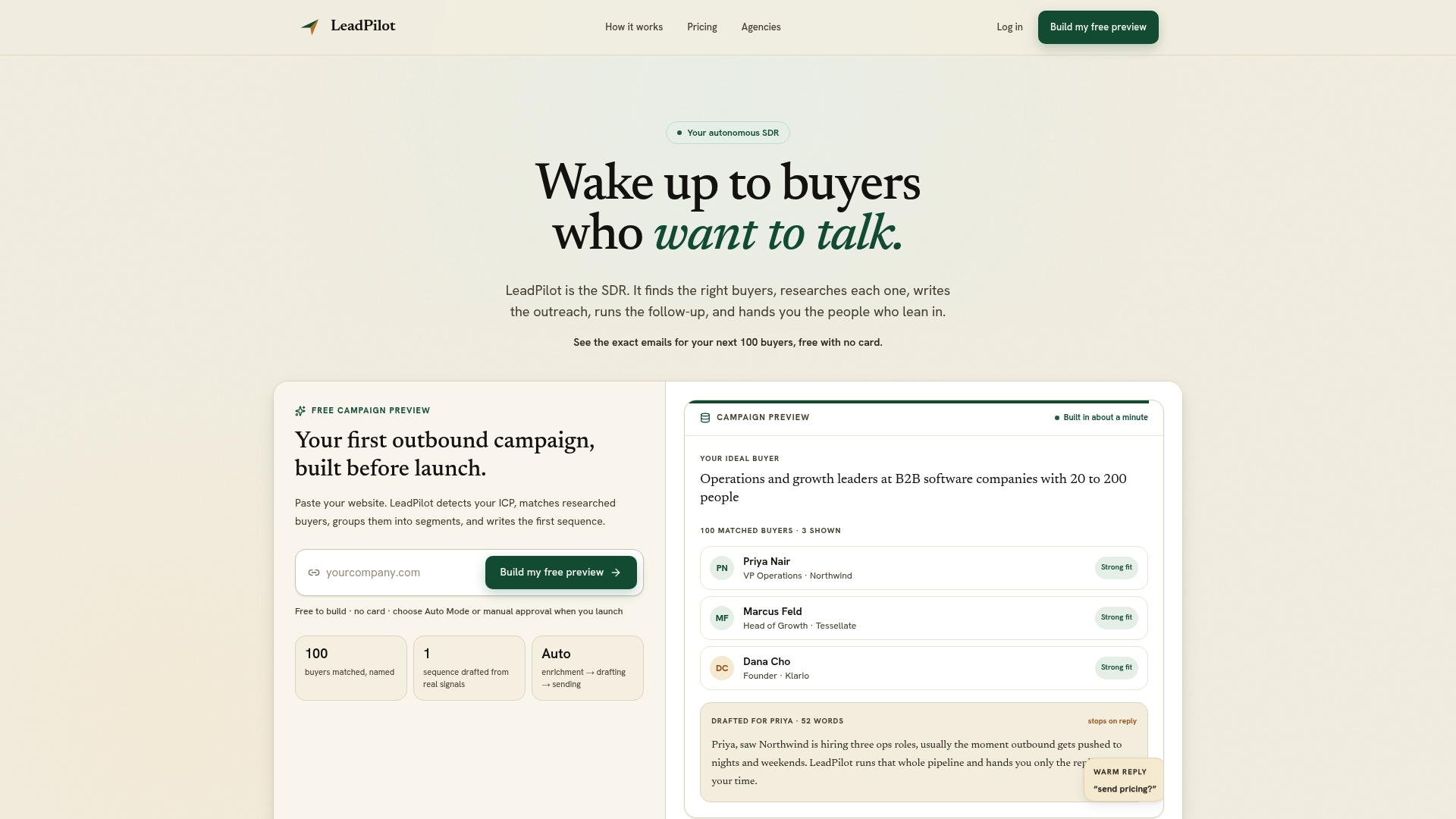
It reads your website to detect your ICP, sources and researches matching B2B decision-makers, writes personalized cold emails from real business signals, manages dedicated sending domains and inboxes, runs follow-ups automatically, and routes warm replies to your team for closing. Founders, lean sales teams, and cold email agencies get a complete outbound motion without hiring an SDR or building a sending infrastructure from scratch. You can see your targeting and messaging before you pay with a free campaign preview. When you are ready to compare plans and sending capacity, the pricing page has the details. If you want to go straight to the AI SDR capabilities, start here.
Useful sources and vendor pages to read next
- Outreach Alternatives (2026): An Honest Comparison — Practitioner analysis of behavior-layer tools and why sequencer comparisons often miss the process-adherence category.
- 6 Best Outreach Alternatives in 2026 — Side-by-side feature and pricing breakdown of sequencer and sequencer + data options, including per-seat cost ranges.
- G2 Sales Enablement Category — Peer reviews and ratings across the full sales engagement and enablement category; useful for validating vendor claims.
- G2 Salesloft Reviews — User reviews covering cadence features, CRM sync, and enterprise onboarding experience.
- G2 Apollo.io Reviews — User reviews on data quality, sequencing, and pricing for the sequencer + data category.
- G2 HubSpot Sales Hub Reviews — Reviews covering CRM-native sequencing, ease of use, and SMB fit.
- G2 Gong Reviews — User reviews on conversation intelligence, call coaching, and deal inspection features.
- Backlinko: Link Building Tools — Best practices for team outreach at scale, including shared prospect data and consolidated campaign tracking.
- LeadPilot: How It Works — Process walkthrough of Runleadpilot’s managed outbound workflow and free campaign preview.
- LeadPilot for Agencies — Details on multi-client workspaces, domain isolation, and consolidated billing for agency buyers.
- LeadPilot Pricing — Current plans, sending capacity tiers, and agency pricing options.