How to Use Links in Cold Emails Without Killing Deliverability
Discover how to effectively use links in cold emails to improve reply rates while maintaining deliverability. Maximize your outreach success!

How to Use Links in Cold Emails Without Killing Deliverability
Most first-touch cold emails should not include a link. That is the short answer, and it is backed by A/B test data: a no-link variant outperformed a linked version by 26% in reply rate in one SaaS cold outreach test (1.9% with a link vs. The goal of a first-touch email is a reply, not a click. Links shift that dynamic and add inbox-filter risk at the same time.
Three things you can do right now:
- Remove any link from your current first-touch template. Replace it with a plain-text ask (“Would a 15-minute call this week work?”).
- In follow-up emails sent after an open or reply, use one direct HTTPS link to a page on your main domain or a branded subdomain. No shorteners.
- Before sending anything, verify these three signals:
- SPF, DKIM, and DMARC are published and passing for your sending domain (check with MXToolbox or Google Admin Toolbox).
- Sending domain age and reputation are clean. A domain under 30 days old with no warm-up history will struggle regardless of link count.
- Visible URL trust. If a prospect hovers over your link and sees a redirect chain or a generic shortener domain, that is a red flag to them and to the filter.
Key Takeaways
Keeping links out of first-touch cold emails and using one direct, branded link in follow-ups is the single highest-impact change most sales teams can make to improve reply rates and inbox placement simultaneously.
| Point | Details |
|---|---|
| No links on first touch | A/B tests show no-link first-touch emails produce up to 26% higher reply rates than linked versions. |
| One branded link maximum in follow-ups | Use a direct HTTPS link on your main domain or a branded subdomain; never a third-party shortener. |
| Authenticate before you send | SPF, DKIM, and DMARC must pass before any link in any email; domain reputation is the foundation. |
| Warm up the sending domain first | Run a 6-week ramp before introducing links; add links only in week 5 of the warm-up sequence. |
| Optimize for replies, not clicks | Reply rate is the right primary metric for early cold outreach; click tracking belongs in post-reply sequences. |
Table of Contents
- How links in cold emails trigger spam and phishing filters
- Which outreach stage should actually include a link?
- How many links to include and where to place them
- Which link formats actually work in cold outreach
- Setting up your domain and sending infrastructure before you add any links
- How to track clicks without damaging deliverability
- Signature links and CAN-SPAM compliance
- Pre-send checklist and three cold email templates
- Want deliverability handled for you?
- The tradeoffs nobody talks about honestly
- Sources
How links in cold emails trigger spam and phishing filters
Links increase spam and phishing signal weight because they add redirect chains, mismatched display text, and external destinations that inbox providers evaluate before a human ever sees the message. That evaluation happens in milliseconds, and the filter does not give you the benefit of the doubt.
Modern inbox providers like Gmail and Microsoft 365 Defender analyze several link-specific signals simultaneously: the reputation of the destination domain, whether the link resolves through one or more redirects, whether the anchor text matches the actual URL domain, and whether tracking parameters create a chain of hops before landing. A single clean link on a reputable domain barely moves the needle. A link through a generic shortener that redirects twice before landing on a new domain moves it a lot.
“Phishing emails often contain links that look legitimate but lead to fraudulent websites. Be suspicious of any email that asks you to click a link.” — FTC Phishing Guidance
Spam filters borrow heavily from phishing-detection logic. That means the same signals the FTC flags for consumers are the same signals Gmail’s filters score against your email. Concrete red flags to avoid:
- URL shorteners (bit.ly, tinyurl.com, ow.ly): they mask the destination and add a redirect hop.
- Mismatched anchor text: showing “Click here to see our case study” while the underlying URL points to a different domain than your company.
- Multiple redirects: a tracking pixel domain that bounces to a CDN that bounces to your landing page.
- Immediate file downloads: links that trigger a download rather than a page load are treated as high-risk by most filters.
- New or low-reputation domains: a link to a domain registered last month with no prior sending history.
Jay Mount Consulting’s cold email format guide makes the point plainly: spam filters evaluate structure and format alongside content, which is why a plain-text email with one clean link behaves very differently from an HTML-heavy email with three tracked links.
Which outreach stage should actually include a link?
The stage of the conversation matters more than most sales teams realize. A link that is appropriate in a third follow-up can hurt a first-touch email. Here is a stage-based framework:
| Stage | Recommended link policy | Acceptable link types | Example use |
|---|---|---|---|
| First touch | No link preferred | None; plain-text ask only | “Would a quick call this week work?” |
| Second touch (after open, no reply) | One link maximum | Direct HTTPS to main domain | Link to a relevant case study or product page |
| Post-reply (prospect engaged) | One to two links acceptable | Branded domain, calendar link | Calendly link or a specific resource they asked about |
| Asset send (prospect requested) | One link required | Direct HTTPS, no shorteners | Link to a gated PDF landing page or demo recording |
Mailpool’s 2026 analysis confirms that links are generally safer than attachments when used carefully, but the risk calculus shifts depending on how many signals stack together. A new sending domain plus a shortener plus a link in a first-touch email is a combination that will land in spam. Any one of those factors alone is manageable; all three together is not.
The practical exception: if a prospect has explicitly requested a resource before you send (say, from a LinkedIn exchange), include the link in the first email. The context justifies it, and the prospect is already expecting it.
How many links to include and where to place them
The numeric rule is simple: zero links on first touch, one link maximum in early follow-ups, and no more than two links until after a prospect has replied. Campaign Monitor’s analysis supports this directly: fewer links reduce the chance an email reads as promotional and improve inbox placement.
Placement matters almost as much as count. Best practices:
- Put the link after your ask, not before it. The ask is the point of the email. The link is supporting evidence.
- Never put a link in the subject line or preview text. Filters scan those fields first, and a link there raises immediate flags.
- Signature links are low-trust fallback territory. They are acceptable, but they carry less credibility than a link placed naturally in the body.
- Never show anchor text that points to a different domain than the visible URL. “See our results” linking to a domain other than your company’s is a mismatch that filters catch and prospects notice.
A good placement looks like this:
A bad placement:
The second version fails on three counts: it uses a shortener, the anchor text is generic, and the link appears before any context is established.
Which link formats actually work in cold outreach
The format of the link itself carries deliverability weight. Here is how the main options stack up:
Direct HTTPS link on your main domain The safest option. The domain has history, the HTTPS certificate signals legitimacy, and there is no redirect chain. Use this whenever possible.

Naked URL (full URL displayed as text) Slightly less readable than anchor text, but transparent. Prospects can see exactly where they are going, which builds trust. Filters treat it similarly to a direct link.
Branded tracking subdomain (e.g., track.yourcompany.com) Acceptable if it is a single hop and the subdomain is on your main domain. Set it up with its own SPF/DKIM alignment and warm it up before using it in volume sends.
Third-party shorteners (bit.ly, tinyurl, ow.ly, etc.) Avoid entirely in cold outreach. Onur Genc’s analysis is direct on this: shorteners, multiple links, and tracking redirects frequently lower both deliverability and reader trust. The domain reputation of a shared shortener service is not yours to control.
UTM parameters
Keep them short and use them sparingly in early touches. A URL that ends in ?utm_source=cold&utm_medium=email&utm_campaign=q2-outbound&utm_content=variant-a adds noise that some filters flag and most prospects find off-putting if they hover over the link. For first and second touches, prefer server-side tracking over appending long parameter strings.
Pro Tip: If you need click tracking, set up a branded subdomain (e.g., go.yourcompany.com) that redirects in a single hop to the destination. This gives you click data without the shared-reputation risk of a generic shortener, and it keeps the URL visually consistent with your sending domain.
Do-and-don’t examples:
- Do:
https://yourcompany.com/case-study - Do:
https://go.yourcompany.com/demo(single-hop branded redirect) - Don’t:
https://bit.ly/3xKp9mZ - Don’t:
https://yourcompany.com/lp?utm_source=cold&utm_medium=email&utm_campaign=outbound-2026&utm_content=first-touch-v3&utm_term=saas
Setting up your domain and sending infrastructure before you add any links
Domain authentication and a thoughtful warm-up ramp have more impact on deliverability than any link-format tweak. Gartner’s sales technology research reinforces this: tools alone do not replace proper domain setup and warm-up. Get the infrastructure right first.
Authentication checklist:
- SPF: Publish a Sender Policy Framework record that lists your sending IPs. Keep it under 10 DNS lookups.
- DKIM: Enable DomainKeys Identified Mail signing for your sending domain. Use a 2048-bit key minimum.
- DMARC: Set a DMARC policy. Start at
p=noneto monitor, then move top=quarantineafter 30 days of clean data, andp=rejectonce you are confident in alignment. - BIMI (optional but useful): Brand Indicators for Message Identification lets you display your logo in supported inboxes (Gmail, Yahoo). It requires a DMARC policy at
p=quarantineorp=rejectand a verified mark certificate. - Dedicated sending domain: Use a subdomain or a separate domain for cold outreach (e.g., mail.yourcompany.com or yourbrand-outreach.com). This protects your main domain’s reputation if a campaign underperforms.
Warm-up ramp (first 6 weeks):
| Week | Daily send volume | Target reply/open rate | Notes |
|---|---|---|---|
| 1 | 10 | 40%+ open rate | Send only to warm contacts or internal addresses |
| 2 | 20 | Reply rate varies depending on campaign | Begin small cold batches; monitor bounce rate |
| 3 | 40 | 30%+ | Expand cold volume; check spam folder placement |
| 4 | 80–150 | Response rate varies depending on outreach | Add follow-up sequences; keep link count at zero |
| 5 | 150 | Response rate varies depending on outreach | Introduce one link in follow-up emails only |
| 6 | 250 | 15%+ | Full cadence; monitor domain reputation weekly |

Check your sending domain’s reputation using Google Postmaster Tools and Microsoft SNDS. If either shows a red or medium reputation score, pause volume increases and investigate bounce and spam-complaint rates before adding links.
Runleadpilot handles dedicated sending domains and managed warm-up as part of its managed outbound platform, which removes most of this operational burden for lean teams.
How to track clicks without damaging deliverability
Avoid multi-hop tracking redirects in first-touch emails. The deliverability cost of a redirect chain is real, and the click data you get from a first-touch email is rarely actionable anyway. A prospect who clicks but does not reply is still a cold prospect.
Safe tracking approaches:
- Server-side post-click tracking: Log the click on your server when the prospect hits your landing page, rather than routing through a tracking redirect. No extra hop, no shared-domain risk.
- Branded single-hop redirect domain: One redirect from go.yourcompany.com to yourcompany.com/landing. Set up SPF/DKIM alignment on the subdomain.
- Reply-based segmentation: Use reply behavior as your primary engagement signal for early sequences. Harvard Business Review’s consultative sales research frames this well: the goal of early outreach is a conversation, not a click. Optimize for replies first.
- Permissioned tracking after reply: Once a prospect has replied, they have signaled interest. At that point, click tracking in follow-up emails is lower-risk and more meaningful.
Pro Tip: Turn off click tracking entirely for your first-touch sequence and measure success by reply rate alone. You will get cleaner deliverability data and a more honest picture of whether your copy is working.
When click tracking genuinely helps: post-reply sequences where you send a resource and want to know if the prospect engaged before your next call. At that stage, the relationship exists, the prospect expects the link, and a single branded redirect is unlikely to hurt placement.
Avoid cloaking (hiding the real destination URL behind a redirect that shows a different URL in the status bar) entirely. Filters detect it, and it is a fast path to the spam folder.
Signature links and CAN-SPAM compliance
Signature links are acceptable but carry less weight than body links. Keep them minimal, consistent, and aligned with your sending domain. A signature with five links, a banner image, and a social media icon row reads as marketing collateral, not a personal email, and filters treat it accordingly.
CAN-SPAM requirements for cold outreach:
- Physical mailing address: Required in every commercial email. Place it in the footer or signature. A P.O. box is acceptable under the law.
- Unsubscribe mechanism: Required. For cold outreach, a plain-text reply-to-unsubscribe instruction (“Reply ‘unsubscribe’ to be removed”) satisfies the requirement and avoids adding a tracked unsubscribe link to a first-touch email.
- Honest sender identification: The “From” name and domain must accurately identify the sender.
- No deceptive subject lines: Subject lines cannot misrepresent the content of the email.
Signature formatting best practices:
- Use plain-text links in the signature, not HTML buttons or image-based links.
- Limit signature links to two at most: your company website and one other (LinkedIn profile or a booking page).
- Keep the signature under five lines total.
- Match the signature domain to your sending domain. A signature linking to a different domain than the one you are sending from is a mismatch signal.
When to move mandatory links: if your sequence is highly deliverability-sensitive, move the physical address and unsubscribe instruction to a footer page linked from a plain-text note (“To unsubscribe, visit [yourcompany.com/unsubscribe]”) rather than embedding them inline in every email. This keeps the email body clean while remaining compliant.
Pre-send checklist and three cold email templates
Pre-send checklist:
- SPF, DKIM, and DMARC are published and passing for the sending domain.
- Sending domain is at least 30 days old with a completed warm-up ramp.
- First-touch email contains zero links (or one link maximum if context requires it).
- Any link used is a direct HTTPS URL on your main domain or a branded subdomain.
- No URL shorteners anywhere in the sequence.
- Anchor text matches the destination domain.
- Click tracking is off for first-touch emails; server-side or reply-based tracking is in place.
- Signature contains two links maximum, both on your sending domain.
- Physical address and unsubscribe instruction are present in footer.
- Email is under 150 words for first touch (aim for 80 words per The Outbound Game’s cold email guide).
Template 1: First touch (no link)
Subject: Quick question, [First Name]
Hi [First Name],
[Company] helps [ICP description] do [specific outcome] without [common pain point].
We did this for [similar company] in about [timeframe].
Worth a 15-minute call this week?
[Your name]
Template 2: Follow-up after open or reply (single direct link)
Subject: Re: Quick question, [First Name]
Hi [First Name],
Wanted to follow up. Here is a quick breakdown of how we helped [similar company] achieve [result]: yourcompany.com/case-study
Happy to walk you through it on a call if that is easier.
[Your name]
Template 3: Asset send after permission (link with context)
Subject: The [resource name] you asked about
Hi [First Name],
Here is the [resource] we discussed: yourcompany.com/resource-name
The section on [specific topic] is most relevant to what you mentioned. Let me know if you have questions after you take a look.
[Your name]
Pro Tip: A/B test link vs. no-link on the same follow-up template by splitting your sequence into two equal cohorts for two weeks. Measure reply rate, not click rate. If the no-link variant wins, you have your answer for that audience.
Want deliverability handled for you?
Managing dedicated sending domains, warm-up ramps, link formatting, and follow-up sequences is a full-time operational job. Runleadpilot’s cold email automation platform handles all of it: dedicated sending domains, managed warm-up, personalized sequences written from real business signals, and reply handoff to your team.
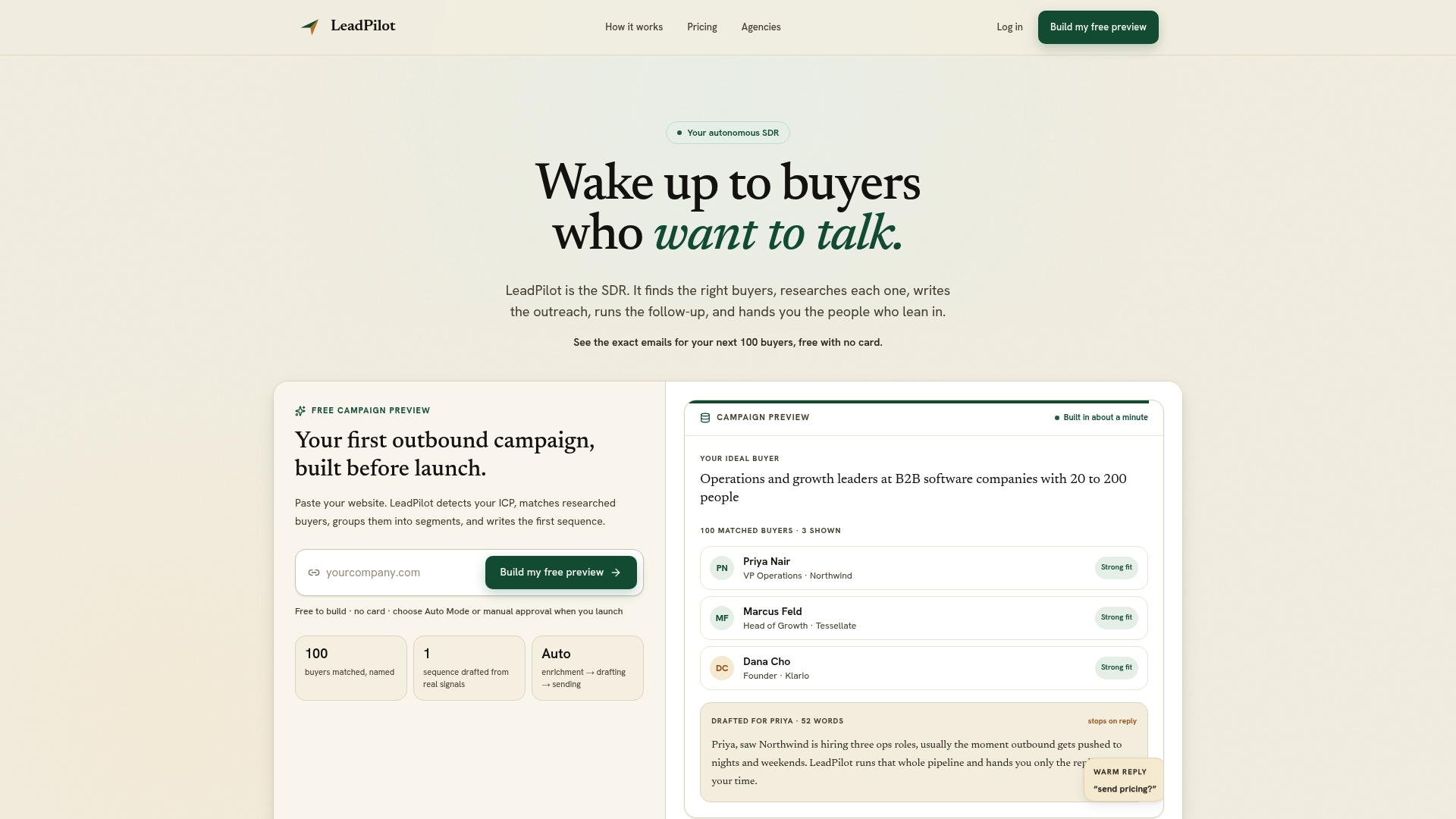
Agencies running outbound for multiple clients can manage separate domain configurations and billing from a single workspace. See how it works for agencies.
If you want to see what a managed campaign looks like before committing, Runleadpilot offers a free campaign preview built from your website.
The tradeoffs nobody talks about honestly
Most deliverability advice treats links as a binary: include them or do not. The real tradeoff is between two different campaign goals that require different email architectures.
A reply-focused sequence, which is what most early-stage B2B cold outreach should be, is optimized for conversation. No links, short copy, a single plain-text ask. The email looks like it came from a person, because it did. Filters treat it that way. Prospects respond to it that way.
A click-focused sequence, which makes sense for retargeting, post-reply nurture, or event promotion, needs links. But it also needs a warmed domain, a branded tracking setup, and an audience that already has some context for who you are. Sending a click-focused email to a cold list on a new domain is where teams get burned.
The mistake I see most often is teams running click-focused infrastructure on reply-focused campaigns. They add tracking redirects, UTM chains, and HTML formatting to a first-touch email because that is what their marketing automation tool defaults to. Then they wonder why their reply rates are flat and their domain reputation is declining.
The fix is usually simple: strip the email back to plain text, remove the links, and measure replies for two weeks. In most cases, reply rates go up. The ImiSofts A/B test data backs this up across multiple SaaS outreach contexts. Once you have replies and a warmer relationship, you can reintroduce links safely.
Sources
- FTC — Phishing scams
- Campaign Monitor — Less links are better
- Mailpool Blog | Cold Email Attachments vs Links: What’s Safe in 2026 (and What’s Not)
- Cold Email Format: The Anatomy of a Reply-Worthy Email | JMC