ICP vs Persona: The B2B Marketer's 2026 Guide
Discover the critical differences between ICP vs persona. Optimize your B2B marketing strategy to target the right companies and contacts effectively.

ICP vs Persona: The B2B Marketer’s 2026 Guide
An ideal customer profile (ICP) defines the companies worth targeting; a buyer persona defines the individuals inside those companies worth engaging. Confusing the two is one of the most common reasons B2B sales and marketing teams waste budget on the wrong accounts and send the wrong message to the right ones. The ICP vs persona distinction is not semantic. It determines whether your outreach reaches a $5M SaaS company in its growth phase or a $500M enterprise that will never buy. Both frameworks are necessary, and neither works without the other.
What is an ICP and how is it different from a buyer persona?
An ideal customer profile is a firmographic and situational description of the companies most likely to buy, retain, and expand with your product. It operates at the account level, not the contact level. Attributes include industry vertical, annual revenue, employee count, tech stack, geographic market, and growth signals such as recent funding rounds or hiring surges. The ICP answers one question: is this company worth pursuing at all?
A buyer persona, by contrast, describes a specific individual inside an ICP-fit company. It captures role, decision authority, motivations, objections, and behavioral patterns. ICP represents company-level attributes such as industry and revenue, while buyer personas represent individual roles, decisions, and pain points within those companies. That distinction matters because the same company can have six or more relevant contacts, each requiring a different message.

The ICP is a filter. The persona is a communication guide. Teams that conflate the two end up with documents that are too vague to drive targeting and too generic to drive engagement.
Why the order of creation matters
ICPs should be built first to define best-fit companies. Buyer personas then derive from contacts within those companies. Building personas before the ICP produces archetypes that are too broad because they are not anchored to a specific company type. A VP of Engineering at a 20-person seed-stage startup behaves very differently from a VP of Engineering at a 500-person Series C company, even though both carry the same title.
How is an ideal customer profile constructed?
The most reliable ICP construction method works backward from closed-won data. ICP is constructed from analysis of closed-won versus lost accounts to isolate attributes that predict successful sales outcomes. Attributes that appear in both won and lost accounts are market traits, not ICP criteria. The ICP criteria are the attributes that appear consistently in won accounts and rarely in lost ones.
The core firmographic attributes to capture include:
- Industry and sub-vertical: Not just “technology” but “B2B SaaS with a sales-led motion.”
- Revenue range: The band where your product delivers clear ROI without being out of reach.
- Employee count: Proxy for organizational complexity and budget authority.
- Tech stack: Signals integration compatibility and existing sophistication.
- Growth signals: Recent funding, new executive hires, or geographic expansion indicate buying readiness.
Fit and intent are two separate axes in ICP scoring. Separating fit from intent in ICP scoring allows more accurate account prioritization. A high-fit, low-intent account belongs in a nurture sequence. A high-intent, low-fit account is a distraction that will drain sales capacity. Treating them the same is a common and costly mistake.
Pro Tip: Encode your ICP on the Account object in your CRM, not in a slide deck. A CRM-encoded ICP enables automated lead scoring and routing, which is where the real efficiency gain lives.
How is a buyer persona developed?
A buyer persona is a detailed profile of a specific decision-maker or influencer inside an ICP-fit account. It goes beyond job title to capture what that person cares about, what they fear, how they buy, and what language they use to describe their problems. The persona operates at the contact level and informs every piece of messaging, content, and outreach your team produces.
The most reliable persona development inputs include:
- Customer interviews: Direct conversations with buyers who chose you and those who did not.
- Call transcripts: Win-loss calls reveal the exact language buyers use to describe pain.
- Win-loss analysis: Patterns across deals show which personas champion versus block purchases.
- CRM contact data: Role, seniority, and engagement history across closed deals.
Each ICP typically maps to 6–13 buyer personas, reflecting different decision and influence roles in a B2B buying committee. Common persona types include the Economic Buyer, who controls budget; the Champion, who advocates internally; the Technical Validator, who assesses fit; the End User, who lives with the product daily; and Procurement, who manages the contract. Each requires a different message, even within the same account.
Pro Tip: Never build a persona from assumptions alone. If your persona document does not include at least five direct quotes from real buyers, it is not a persona. It is a guess.
Key differences between ICP and buyer persona
ICPs act as filters to select the right companies; personas define the right messaging for individuals within those companies. The table below captures the core structural differences between the two frameworks.
| Dimension | Ideal Customer Profile (ICP) | Buyer Persona |
|---|---|---|
| Level of analysis | Account (company) | Contact (individual) |
| Data types used | Firmographic, situational, technographic | Behavioral, psychological, role-based |
| Primary purpose | Target selection and lead qualification | Messaging, content, and sales engagement |
| Creation sequence | Built first, from closed-won data | Built second, from contacts within ICP accounts |
| CRM placement | Account object | Contact or Lead object |
| Scope per deal | One ICP per market segment | Multiple personas per ICP account |
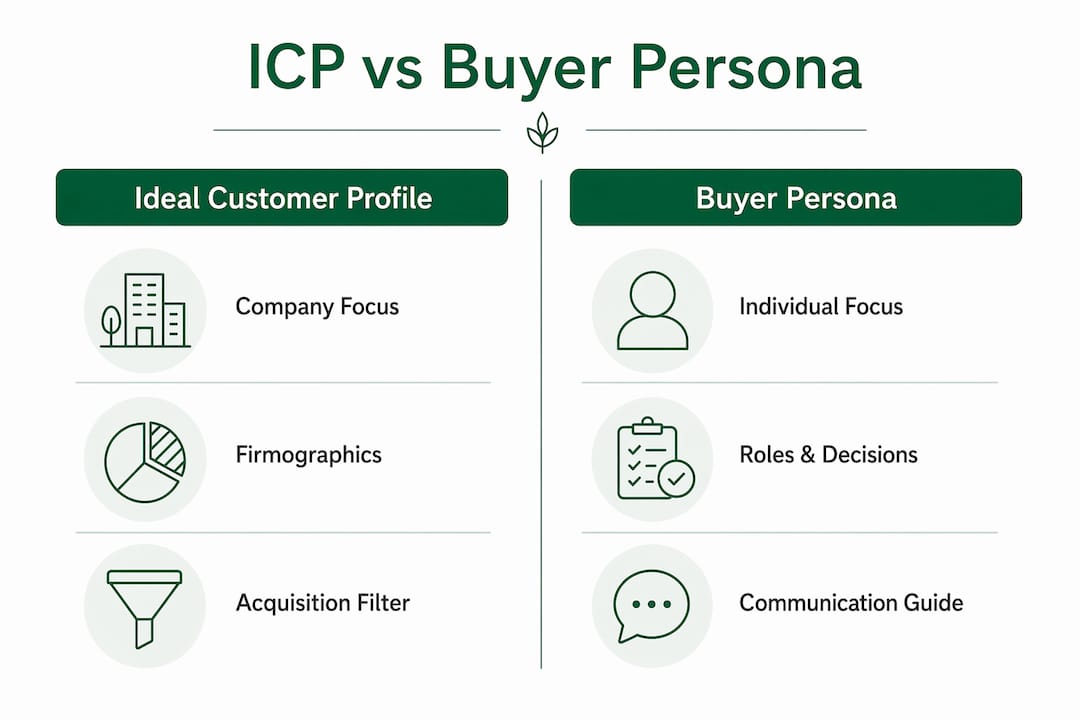
The most important row in that table is creation sequence. Teams that build personas before the ICP produce archetypes that do not map to real buying situations. The ICP narrows the universe of companies. The persona defines how to communicate inside that universe.
How do ICPs and buyer personas work together in B2B sales?
The ICP and persona frameworks are not parallel tracks. They are sequential layers. The ICP defines which accounts enter the pipeline. The persona determines how every stakeholder inside those accounts gets engaged. Teams that operationalize both ICP and buyer personas in their CRM convert at significantly higher rates than those who treat them as isolated documents.
Modern B2B buying is a group decision. B2B buying committees in 2026 typically involve 8–13 stakeholders, requiring engagement with multiple personas per account. That means a single deal at a mid-market SaaS company might require simultaneous outreach to a VP of Sales, a Head of RevOps, a CFO, and an IT security lead, each with a distinct message tied to their specific role and concern.
The practical workflow looks like this:
- Define the ICP. Use closed-won data to identify the company attributes that predict success.
- Score and route accounts. Encode the ICP in your CRM to automate qualification.
- Map personas to ICP accounts. Identify the 3–5 roles most likely to appear in a buying committee.
- Build persona-specific messaging. Tailor email sequences, content, and talk tracks to each role.
- Align RevOps, marketing, and sales enablement. RevOps owns ICP definition based on closed-won analysis; marketing and enablement own persona libraries.
Account-based marketing (ABM) programs that skip this structure tend to produce broad campaigns that resonate with no one. The ICP tells you which accounts to run ABM against. The personas tell you what to say to each contact inside those accounts.
Common pitfalls when building and using ICP and buyer personas
The most damaging mistake is mixing ICP and persona data in the same document. When firmographic criteria and individual behavioral traits share a single template, neither serves its purpose. The ICP becomes too narrow to scale, and the persona becomes too abstract to guide messaging.
Other frequent failures include:
- Building from assumptions, not data. An ICP built from gut feel rather than closed-won analysis targets the companies you wish would buy, not the ones that actually do.
- Ignoring multiple personas per account. Sending one message to an entire account treats a buying committee like a single person. It fails every time.
- Letting definitions go stale. Markets shift, products evolve, and buyer behavior changes. An ICP or persona that has not been updated in 18 months is likely wrong.
- Poor CRM hygiene. Maintaining picklist hygiene and CRM data accuracy for ICP and personas is the biggest failure point leading to wasted pipeline and misalignment.
Pro Tip: Schedule a quarterly ICP review tied to your closed-won analysis. Pull the last 90 days of won deals, compare attributes, and update your CRM scoring criteria. Thirty minutes of hygiene prevents months of misdirected outreach.
The B2B lead generation process breaks down when ICP and persona definitions are treated as one-time exercises. They are living frameworks that require ongoing maintenance and cross-functional ownership.
Key Takeaways
The ICP defines which companies to target; buyer personas define how to engage the individuals inside those companies, and both must be encoded in your CRM to drive real pipeline results.
| Point | Details |
|---|---|
| ICP comes first | Build your ideal customer profile from closed-won data before developing any buyer personas. |
| Personas are contact-level | Each ICP account contains multiple personas; address each role with a distinct message. |
| CRM encoding is non-negotiable | Encode ICP on the Account object and personas on the Contact object to enable automated scoring. |
| Fit and intent are separate | Score accounts on both axes; high-fit, low-intent accounts belong in nurture, not active pipeline. |
| Stale definitions cost pipeline | Review and update ICP and persona criteria at least quarterly using fresh closed-won data. |
Why most teams get this wrong, and what I’ve seen actually work
The teams I have watched struggle most with ICP and persona alignment share one trait: they built their definitions in a workshop and never touched them again. The slide deck sits in a shared drive. The CRM reflects none of it. Sales reps target whoever responds, and marketing sends the same email to every contact in the database.
What actually works is treating ICP and persona as operational infrastructure, not strategic documents. When the ICP lives on the Account object in your CRM and persona type lives on the Contact object, every lead score, routing rule, and sequence trigger can reference them automatically. That is when the frameworks stop being theory and start being pipeline.
The multi-stakeholder reality of modern B2B deals makes this non-negotiable. Engaging 8–13 stakeholders per deal with a single generic message is not a strategy. It is noise. The teams that win are the ones who map each persona to a specific message and deliver it at the right stage of the buying process.
My honest advice: if your ICP document is more than two pages and your persona document does not include real buyer quotes, start over. Shorter, data-backed definitions that live inside your CRM will outperform elaborate frameworks that live in PowerPoint every single time.
— Harsh
How Runleadpilot puts ICP and persona insights to work
Defining your ICP and personas is only half the work. Executing outreach across 8–13 stakeholders per account, with personalized messaging for each role, is where most lean teams hit a wall.
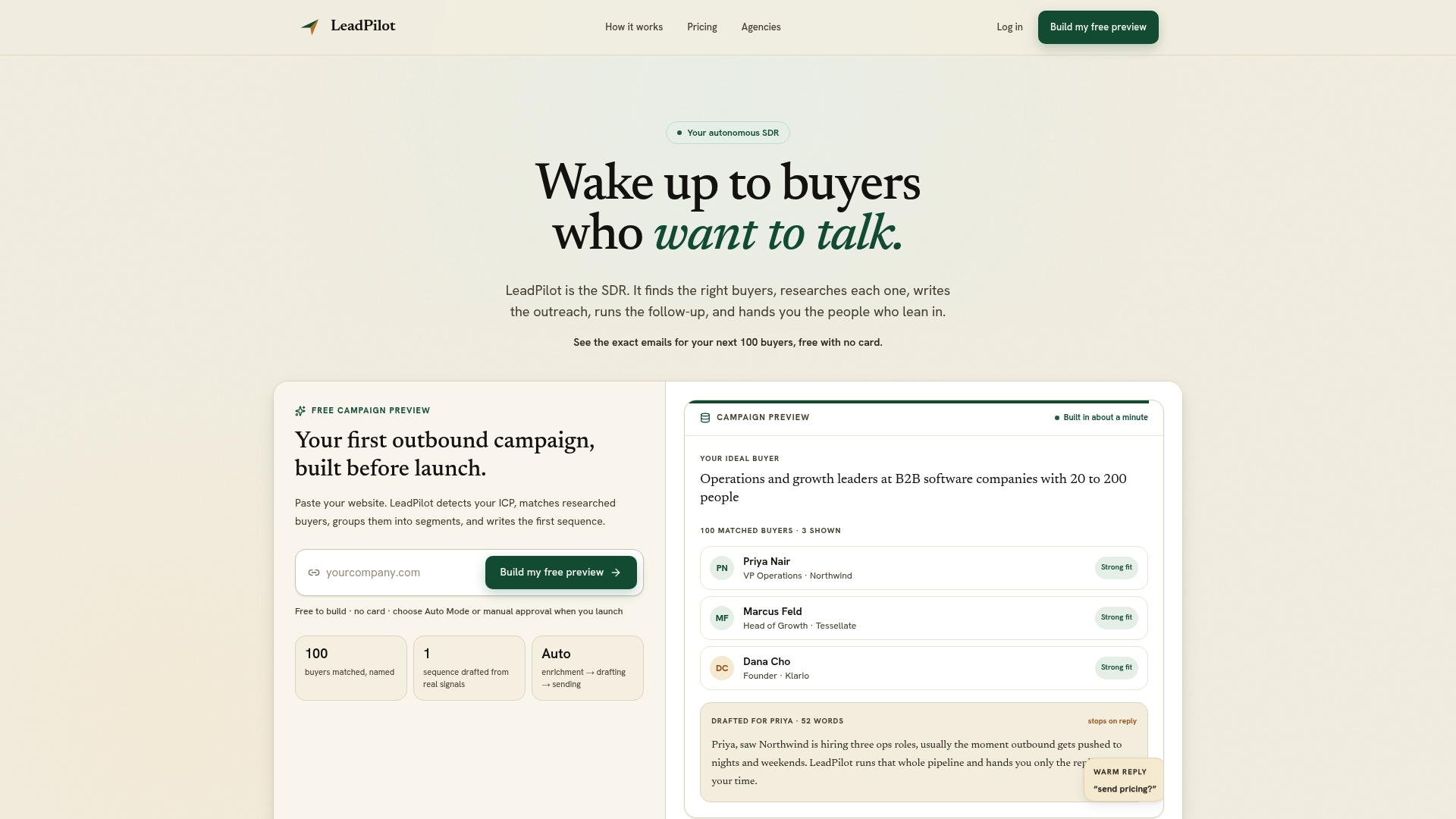
Runleadpilot handles the full outbound sales automation workflow from ICP identification through warm reply handoff. It reads your website, identifies your best-fit accounts, researches the right decision-makers, and writes personalized cold emails based on real business signals tied to each persona. Dedicated sending domains, automated follow-ups, and CRM-ready handoffs are all included. The AI SDR software runs the targeting and engagement layer so your team focuses on closing. Build a free campaign preview before committing to a single dollar.
FAQ
What is the main difference between an ICP and a buyer persona?
An ICP defines the best-fit companies to target using firmographic and situational data. A buyer persona describes the individual decision-makers and influencers inside those companies, capturing their role, motivations, and buying behavior.
Which should you build first, the ICP or the buyer persona?
Build the ICP first. Personas derived from contacts inside ICP-fit accounts are far more accurate and useful than personas built without a defined company-level filter.
How many buyer personas does one ICP typically require?
Each ICP typically maps to 6–13 buyer personas, reflecting roles such as Economic Buyer, Champion, Technical Validator, End User, and Procurement across the buying committee.
How do you encode ICP and personas in a CRM?
Place ICP criteria on the Account object and persona type on the Contact or Lead object. This setup enables automated lead scoring, routing, and sequence triggers based on both frameworks.
What is the biggest mistake teams make with ICP and buyer personas?
The most common mistake is mixing ICP and persona data into one document, which produces definitions too vague for targeting and too generic for messaging. Keep them separate and encode both in your CRM.