Decision Maker Titles That Sign at $25,000 for SDRs and Founders
Map decision maker titles to real buying authority. Prioritize outreach by deal size and buyer role, verify quickly, and scale with ethical automation.

Decision Maker Titles That Sign at $25,000 for SDRs and Founders
Target VPs, C-suite executives, and department heads with budget lines for economic authority. But the title on someone’s LinkedIn only tells you rank, not whether they can sign a purchase order. Prioritize titles by seniority and function, then confirm real authority through discovery, not assumption.
TL;DR:
- Decision makers with final signing authority are usually C-suite executives or VPs, while directors often evaluate and champion purchases but rarely approve budgets themselves.
- Title inflation varies by company size, so a director or VP at a startup may have full budget authority, unlike in large enterprises where approval typically passes through multiple layers.
- Large purchases over roughly $25,000 usually involve procurement and legal teams early, even if a VP or department head initially agrees.
- Effective outreach should target the appropriate department and seniority level, emphasizing specific signals like recent hires or job postings that indicate actual authority.
- Automation platforms can help identify real decision makers and draft personalized outreach, but verifying authority remains crucial before investing outreach effort.
Table of Contents
- Which Decision Maker Titles Match Each Seniority Level?
- Which Titles Handle Purchases in Each Department?
- How Do Titles Map to Real Buying-Committee Authority?
- How Do You Find and Verify a Decision Maker Fast?
- Does Company Size Change What a Title Actually Means?
- How Should Your Outreach Change by Buyer Role?
- Can Automation Actually Speed Up Safe Decision-Maker Research?
- Every Rep Overtargets the C-Suite. Here’s the Fix.
- Automate the Research, Not the Judgment Call
- Sources
Which Decision Maker Titles Match Each Seniority Level?
Every deal has a ceiling and a floor. The ceiling is whoever signs the check. The floor is whoever gets fired if the tool fails. Both matter and they’re rarely the same person.
At the top sits the C-suite: CEO, CFO, COO, CIO, CTO, and increasingly niche roles like Chief Revenue Officer or Chief People Officer. The Bureau of Labor Statistics notes that these roles vary widely by organization and often overlap with senior management functions rather than sitting in neatly separated lanes. A CFO at a 40-person startup might personally approve a $500 software subscription. A CFO at a 3,000-person enterprise won’t see a request that small; it never reaches their desk.
Below the C-suite, VPs and SVPs typically control department budgets in the five- to six-figure range. A VP of Sales owns the sales tech stack. A VP of Marketing owns demand-gen spend. These are your economic buyers for most mid-market deals, and they can usually approve without escalating.
Directors and managers sit one level down, and this is where sales teams misjudge authority most often. A director might evaluate, pilot, and champion a purchase internally, then hand it to their VP for final signoff. Treat directors as your strongest allies, not your final approver, unless the deal is small enough that they own the budget outright.
| Seniority Level | Example Titles | Typical Role in the Deal | Typical Approval Range |
|---|---|---|---|
| C-suite | CEO, CFO, COO, CTO | Final signoff, strategic fit | Decisions typically require high-level approval |
| VP / SVP | VP of Sales, VP of Marketing, SVP Operations | Economic buyer, budget owner | Controls substantial department budgets |
| Director | Director of IT, Director of Revenue Ops | Champion, evaluator, technical vetting | Evaluates and champions purchases, sometimes has smaller budget authority |
| Manager | Sales Manager, Marketing Manager | End-user advocate, requirements gathering | Usually advocates or users, rarely final approver |
These ranges shift by industry and geography, so treat them as a starting frame rather than a fixed rule. Prospeo’s directory of decision-maker titles breaks this down further by department, and the pattern holds across most B2B categories: managers surface the problem, directors validate the fix, and VPs or the C-suite release the money.
A few practical notes worth keeping in your outreach playbook:
- CEOs at small companies often act as their own CFO and IT buyer combined.
- COOs frequently own operational software purchases that don’t cleanly belong to any single department.
- “Head of” titles (Head of Growth, Head of Product) function like directors in authority but often report straight to a VP or founder.
- Procurement gets looped in earlier than most reps expect once a deal crosses roughly $25,000, even when a VP already said yes.
Which Titles Handle Purchases in Each Department?
Decision-maker titles cluster by function, and knowing which department owns your category saves weeks of misdirected outreach. Selling a CRM add-on to HR gets you nowhere. Selling it to a VP of Sales or a Director of Revenue Operations gets you a meeting.
Here’s how authority typically breaks down by function:
- IT and engineering: CTO or VP of Engineering for platform-level decisions; IT Director or Head of Infrastructure for tooling and security sign-off.
- Finance: CFO for anything touching budget forecasting, financial systems, or spend over five figures; Controller for smaller recurring purchases.
- Marketing: CMO or VP of Marketing for platform decisions; Marketing Ops Manager for day-to-day tool adoption.
- Product: VP of Product or Head of Product for roadmap-linked tools; Product Manager as the internal champion.
- HR: CHRO or VP of People for company-wide HR tech; HR Manager for point solutions.
- Operations: COO or VP of Operations for process and workflow platforms.
- Procurement: Head of Procurement or Chief Procurement Officer, who rarely initiates a deal but frequently blocks or delays one on contract terms.
- Legal: General Counsel, who signs off on data privacy and contract risk rather than product fit.
- Customer success: VP of Customer Success or CS Ops leads for retention and onboarding tools.
Technical purchases usually split into two buyers working in parallel: a technical buyer who vets whether the product actually works (often an IT Director or engineering lead) and a business buyer who owns the money and the outcome. Selling to only one of them stalls the deal. Forrester’s research on business buying confirms that modern B2B purchases run through committees, not single approvers, which is exactly why chasing one contact rarely closes anything on its own.
Pro Tip: For most sales tech and marketing tools, start with the VP or Director one level below the C-suite. They feel the pain daily, have enough authority to champion a pilot, and are far more likely to reply than a CEO buried in inbound noise.
How Do Titles Map to Real Buying-Committee Authority?
Gartner’s research on the B2B buying journey breaks committee purchases into distinct roles, and matching titles to those roles, not just to rank, is what separates a closed deal from a stalled one.
Four roles show up in nearly every committee-based deal:
- Economic buyer: controls the budget and gives final approval. Usually a VP, SVP, or C-suite executive, depending on deal size.
- Champion: wants the solution internally and pushes it through the org. Often a director or manager who feels the daily pain your product solves.
- Influencer: shapes the decision without controlling budget or blocking it. Frequently a senior individual contributor or a peer department head.
- Gatekeeper: controls access or introduces friction, often on security, legal, or procurement grounds. Common titles include IT Director, General Counsel, or Head of Procurement.
Confirming who plays which role takes a short verification checklist during discovery:
- Ask directly: “Who else needs to sign off before this moves forward?”
- Ask about budget cycles: “Is there existing budget for this, or does it need a new line item?”
- Watch for hedging language like “I’d need to run this by my team” versus confident language like “I can approve this.”
- Check whether the contact controls headcount or spend for the relevant department; both are strong authority signals.
- Note who gets copied on emails once the deal progresses; CC patterns reveal the real committee faster than titles do.
Escalate to the C-suite or procurement once the deal size crosses your buyer’s typical approval range, or once legal and security requirements enter the conversation. Trying to close a five-figure enterprise deal through a manager alone almost always backfires later in the cycle, when a gatekeeper you never engaged suddenly appears with a list of objections.
How Do You Find and Verify a Decision Maker Fast?
Finding a name is easy. Confirming that name actually controls budget is the part most outbound teams skip, and it’s the part that determines whether your open rate turns into a closed deal.
Start with a 60-second pass before you spend real time on a prospect:
- Read their LinkedIn headline and current title carefully; “Director of Operations” at a 15-person startup means something different than the same title at a 5,000-person firm.
- Check the company’s “About” or leadership page for org structure and reporting lines.
- Scan recent press releases or funding announcements for new hires in the relevant department; a newly hired VP is often actively evaluating tools.
- Search recent job postings on the company’s careers page; a posting for a “Marketing Ops Manager” that mentions budget ownership tells you spend already exists in that function.
If the contact clears that first pass, go deeper:
- Cross-reference procurement or vendor pages for existing tools in your category; a company already paying for a competitor product has budget precedent.
- Look at the org chart on the company website or on tools built for ICP and persona mapping to see who a title actually reports to.
- Check for language in job descriptions like “manages vendor relationships” or “owns P&L for [department],” both strong signals of real signing authority.
A lead-scoring framework can help rank contacts by likelihood of authority before you invest outreach time, especially when you’re working a long list and need to triage fast. And on the ethical side: stick to publicly available information, business email addresses, and professional networks. Scraping personal data or bypassing consent settings on platforms is both a compliance risk and a fast way to damage your sender reputation.
Does Company Size Change What a Title Actually Means?
The same title means wildly different things depending on where a company sits in its growth. A “Director of Marketing” at a 10-person startup often has full budget authority. The same title at a 2,000-person company usually reports through two more layers before anything gets approved.
Rough patterns by stage:
- Startups (under 50 employees): founders and “Head of” titles hold real authority; there’s often no VP layer at all.
- Scale-ups (50 to 500 employees): VPs and directors emerge as true economic buyers; the C-suite delegates smaller purchases.
- Enterprise (500-plus employees): SVPs, C-suite, and procurement all weigh in; directors mostly champion and evaluate rather than approve.
Title inflation is real, especially in tech and agencies, where “VP” sometimes describes someone managing a team of two. Indeed’s guide to executive titles points out that title meaning shifts by company size and industry, which is exactly why a title alone should never be your only qualifying signal. Finance and manufacturing tend to run more standardized hierarchies, so titles there track authority more reliably than in fast-growing tech or agency environments. As a heuristic: the smaller the company, the higher up the title ladder you should aim; the larger it is, the more you should aim one or two levels down from where you’d instinctively guess.
How Should Your Outreach Change by Buyer Role?
The same message sent to a CFO and a Director of Operations will underperform with at least one of them, because they’re evaluating completely different things.

Economic buyers respond to numbers: ROI, payback period, and how a purchase affects the metrics they’re measured on. Lead with cost savings or revenue impact, not features. Technical buyers care about integration, security, and whether the tool actually does what it claims; lead with proof, documentation, or a technical walkthrough. Champions need an internal story they can repeat to their own boss; give them a clear, quotable reason the tool matters, not just a feature list.
Subject lines and openers should mirror that split. A line built around a metric (“Cutting onboarding time by half at similarly sized teams”) works for an economic buyer. A line built around a technical detail (“How [category] tools handle SSO and data residency”) works for a technical buyer. A line built around daily friction (“The manual process eating your team’s Fridays”) works for a champion.
Before sending, run through a short personalization checklist:
- Reference a specific signal tied to their role: a recent hire, a job posting, a product launch, or a funding round.
- Match the framing to their likely priority: cost for economic buyers, fit for technical buyers, adoption for champions.
- Keep the ask small and role-appropriate; asking a director for a 30-minute call is reasonable, asking a CEO cold for the same is a harder sell.
- Avoid generic language that could apply to any title at any company; specificity is what earns a reply.
Pro Tip: Sales enablement content that only informs, without giving the reader a clear next step tied to their own authority level, rarely moves a deal forward. Always tie your message to a decision the recipient can actually make.
Can Automation Actually Speed Up Safe Decision-Maker Research?
Manually chasing title-to-authority signals across dozens of accounts eats hours that most lean sales teams don’t have. This is where a platform that reads a company’s own website, infers its ideal customer profile, and then sources and researches matching titles removes most of the guesswork described above, without skipping the verification step that actually matters.
The workflow that matters here mirrors exactly what this guide covers:
- Website-to-ICP inference that identifies which functions and seniority levels actually buy your category.
- Researched contacts pulled from public signals, not guesswork.
- Personalized email drafts built from real business signals tied to the recipient’s role.
- Managed sending domains and inboxes to protect deliverability.
- Automated follow-ups and reply handoff to a human once a prospect engages.
Even with automation, personalization and human review before sending still separate a reply from a spam-folder deletion. Automation should speed up the research and drafting, not replace the judgment call on who actually holds the budget.
Every Rep Overtargets the C-Suite. Here’s the Fix.
The biggest mistake I see in outbound campaigns is chasing the highest title on the org chart and ignoring the person who’ll actually champion the deal internally. C-suite executives get hundreds of cold emails a week and delegate almost everything below a certain dollar threshold anyway.
Run a 30-day experiment: target director-level champions with messaging built around their daily friction, not boardroom ROI language, and measure reply rate against your usual C-suite-first list. The difference usually shows up faster than people expect.
— Harsh
Automate the Research, Not the Judgment Call
Everything in this guide, mapping seniority to authority, splitting technical from economic buyers, verifying titles before you invest outreach time, is exactly the workflow Runleadpilot runs on autopilot. It reads your website to infer your ideal customer profile, sources and researches the matching decision-maker titles, and drafts personalized emails from real business signals instead of generic templates.
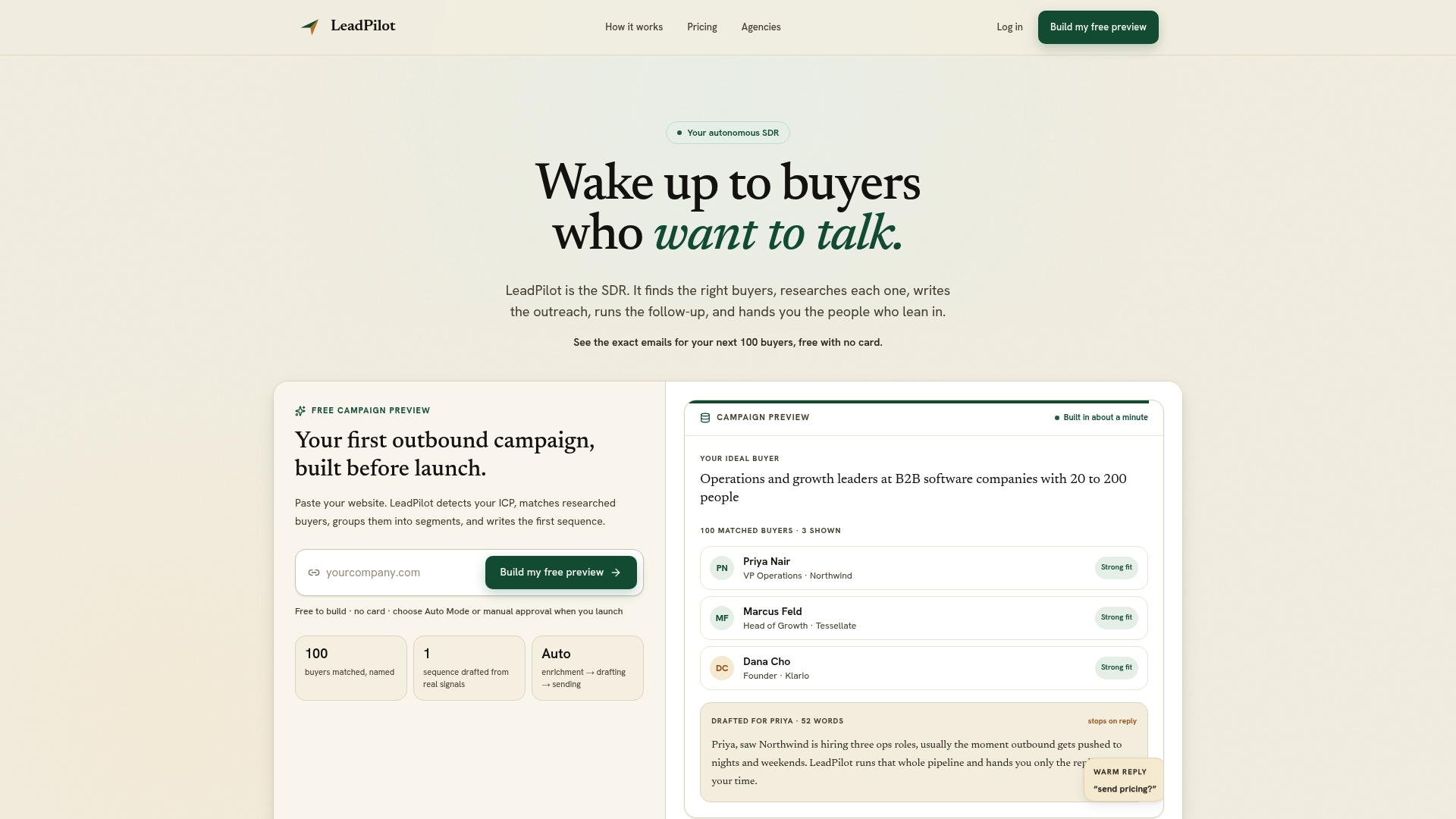
Deliverability is handled through dedicated sending domains and inboxes, follow-ups run automatically, and warm replies get handed straight to your team once a prospect engages, so the manual research this article walks through gets compressed into a workflow that runs in the background. See exactly how it works from website to warm reply, or build a free campaign preview to see which titles and companies it surfaces for your own product before committing to anything through Runleadpilot’s lead generation platform.
Sources
- Top Executives : Occupational Outlook Handbook : U.S. Bureau of Labor Statistics
- Forrester — The state of business buying 2024
- Decision Maker Job Titles: Complete B2B Directory (2026)
- Executive business position titles | Indeed