Best Clay Alternatives for B2B Sales Teams in 2026
Discover the best Clay alternatives for B2B sales teams in 2026. Find tools that enhance lead generation with minimal friction.

Best Clay Alternatives for B2B Sales Teams in 2026
What are the best Clay alternatives for B2B lead generation?
The strongest Clay alternatives include Apollo.io, ZoomInfo, Cognism, LeadPilot, Instantly, Lemlist, Lusha, LeadIQ, and Seamless.AI. Each solves a different piece of the outbound puzzle, from verified contact data to full SDR workflow automation. The right pick depends on your team size, compliance requirements, and how far along your go-to-market motion actually is.
Clay built its reputation as a flexible enrichment layer, pulling from over 100 data sources and letting RevOps engineers wire together custom workflows. The problem is that flexibility comes with a cost: technical overhead, credit unpredictability, and compliance risk from chaining together third-party APIs. Teams that outgrow that setup are looking for something that does more with less friction.
Here is a side-by-side view of the top contenders, organized by what they do best.

| Tool | Best For | Pricing | Pros | Cons |
|---|---|---|---|---|
| Apollo.io | Lean teams scaling cold outreach fast | From $49/month | Clean UI, built-in sequencing, transparent pricing | Data accuracy inconsistent at scale |
| ZoomInfo | Enterprise US contact depth | Annual contracts | Deep firmographics, buyer intent, org charts | Expensive, limited workflow flexibility |
| Cognism | Compliance-first global outbound | Custom (tiered plans) | Phone-verified data, GDPR-first compliance, DNC screening | Higher cost for smaller teams |
| LeadPilot | Founders and lean teams wanting full SDR automation | Subscription tiers | AI targeting, personalized sequences, warm reply routing, domain management | Managed model suits teams ready to delegate outbound |
| Artisan | All-in-one outbound automation | Custom | Automates prospecting and outreach end to end | Less flexibility for custom data workflows |
| PersistIQ | Multi-channel sequencing | Custom | Simple UX, flexible automation | Limited enrichment depth |
| Instantly | Cold email deliverability at volume | Tiered plans | Built-in warm-up, deliverability tools | Enrichment not native; needs pairing |
| Persana AI | Custom data sourcing beyond standard databases | Custom | Pulls from unconventional sources | Steeper learning curve |
| Freckle.io | Quick list building with minimal setup | Custom | User-friendly interface | Limited advanced features |
| Kuration AI | Niche data enrichment for marketing teams | Custom | Highly customizable sourcing | Narrower use case |
| Lusha | Affordable SMB contact enrichment | Free tier; paid plans | Chrome extension, CRM sync | Smaller database than enterprise tools |
| Seamless.AI | LinkedIn prospecting for SDRs | Free credits; paid plans | AI-powered contact finding | Data accuracy varies |
| LeadIQ | Trigger-based alerts and funding signals | Tiered plans | Hiring and funding signal integration | Smaller contact database |
| Lemlist | Personalized email campaigns | From $49/month | Dynamic sequences, LinkedIn and phone touches | Not a data enrichment tool |
| Ocean.io | Intent-driven lead generation | Custom | Buying signal enrichment | Less known; smaller ecosystem |
| Exa Websets | Custom web data extraction | API-based pricing | Flexible API-driven scraping | Requires technical setup |
| Floqer | Enrichment plus outbound in one platform | Custom | Built-in automation from data to outreach | Newer entrant; smaller track record |
| FullEnrich | Identity resolution with API integration | Custom | Strong API matching | Narrower use case |
| HubSpot Breeze Intelligence | Real-time firmographic enrichment for B2B marketers | HubSpot plan add-on | Form and ad enrichment, native HubSpot sync | Requires HubSpot subscription |
| Origami | Flexible CRM-synced outreach sequencing | Custom | CRM integration with outreach workflows | Limited standalone enrichment |
| Lead411 | Trigger-based prospecting with verified data | — | Funding and hiring alerts, verified contacts | US-centric coverage |
| UpLead | Credit-based contact database access | — | Wide coverage, pay-per-use credits | Credits run out fast at volume |
| Hunter.io | Fast email lookup and verification | Free tier; paid plans | Domain search, verification tools | No intent data or sequencing |
| Kaspr | LinkedIn contact enrichment for SMBs | Free tier; paid plans | Direct LinkedIn enrichment, CRM sync | Limited outside LinkedIn |
| Clearbit | Firmographic data and enrichment | Custom | DNC compliance, enriched profiles | Now largely folded into HubSpot Breeze |
| Fundraise Insider | Precision targeting for fundraising teams | Custom | High-value prospect targeting | Niche use case |
| Dex | Customizable enrichment workflows | API-based | API-centric flexibility | Requires technical resources |
| Folk | Slack-first contact management | Tiered plans | Slack integration, team collaboration | Not a full outbound platform |
| Attio | Full CRM schema control with enrichment | Tiered plans | Beautiful object views, schema flexibility | Steeper setup for non-technical teams |
| Affinity | Relationship intelligence for dealmakers | Custom | Automated pipeline, contact insights | Expensive; built for deal-heavy teams |
| Covve | Mobile contact management | Free tier; paid plans | Mobile-first, data updates | Limited outbound capabilities |
| Savvyy | Combined data and sales acceleration | Custom | All-in-one sales acceleration features | Newer platform; limited public track record |
Before committing to any of these, a few evaluation criteria cut through the noise:
- Compliance posture: Does the tool offer GDPR and CCPA coverage, DNC list checking, and data governance documentation?
- Data accuracy: Is the contact data phone-verified or sourced from live web crawls, or is it a static database refreshed quarterly?
- Pricing predictability: Credit-based models can spike unexpectedly at volume. Subscription plans with flat rates are easier to budget.
- Integration depth: Native connectors to Salesforce, HubSpot, Outreach, and Salesloft matter more than a long list of Zapier hooks.
- Workflow activation: Can the tool trigger outreach, update CRM records, and route replies, or does it stop at data delivery?
Why are B2B sales teams moving away from Clay in 2026?
Clay’s architecture is genuinely clever. Waterfall enrichment across 100-plus data sources, combined with a spreadsheet-like interface for building custom workflows, made it the tool of choice for RevOps engineers who wanted maximum control. The problem is that control requires maintenance, and most revenue teams are not staffed for it.
Here is what actually drives teams to look for alternatives:
- Compliance fragility. Clay’s API-driven waterfall enrichment creates compliance risk because each enrichment step relies on a different third-party vendor. Data quality and consent status are only as strong as the weakest link in that chain.
- Credit unpredictability. Clay’s usage-based pricing is manageable at low volume. As enrichment runs scale, costs become harder to forecast, especially when multiple API calls fire per contact.
- No native activation. Clay builds lists and enriches data. It does not send sequences, manage inboxes, route replies, or update CRM records on its own. Teams end up wiring in Apollo, Instantly, or Outreach to actually run the motion, adding cost and handoff points.
- Technical overhead. Building and maintaining Clay workflows requires RevOps or GTM engineering resources. Lean teams without that capacity hit a wall quickly.
- SaaS sprawl. Revenue teams running Clay alongside a sequencer, a CRM, an intent tool, and a deliverability platform are managing four or five subscriptions to do what a unified platform could handle in one. That fragmentation wastes budget and slows execution.
Stat callout: Sales teams that rely on fragmented tool stacks spend a disproportionate share of their operating budget on overlapping subscriptions, with predictable pricing consistently cited as the top reason teams switch to consolidated platforms.
The pattern is consistent: teams start with Clay for its flexibility, then realize they need a layer on top to actually activate the data. At that point, the question becomes whether to keep patching the stack or replace it with something that handles the full workflow.
How do the leading Clay alternatives compare on features and pricing?
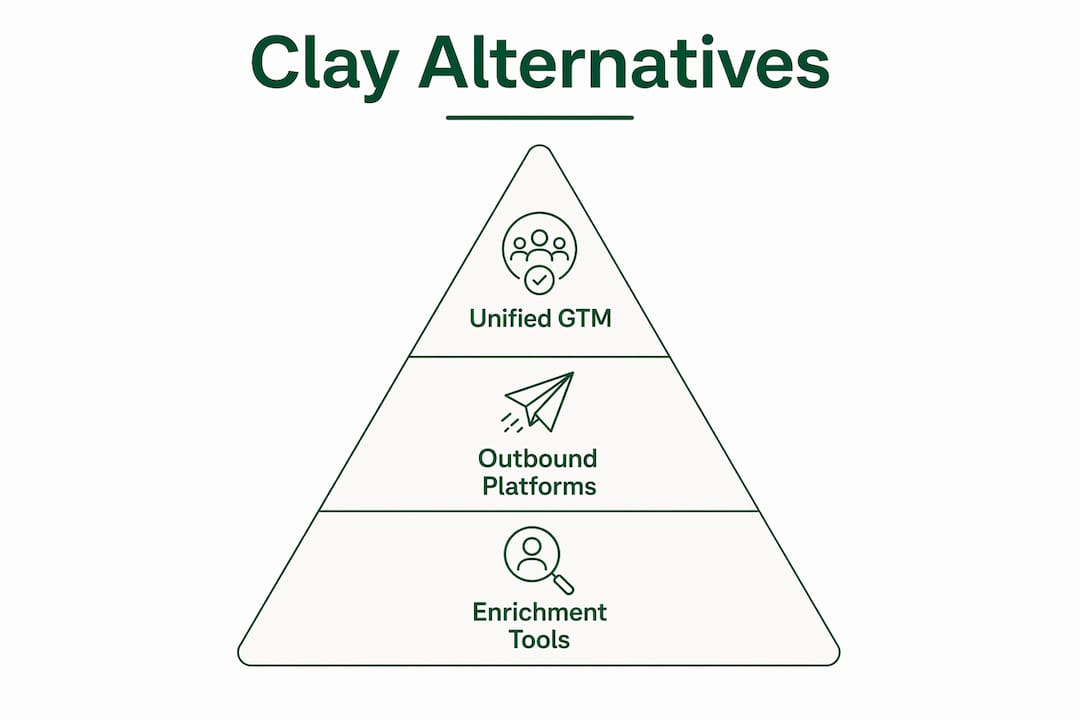
The market for Clay alternatives splits into three broad categories: enrichment-first tools, outbound activation platforms, and unified GTM systems. Knowing which category a tool belongs to tells you more about fit than any feature checklist.

Enrichment-first tools
Cognism sits at the top of this category for compliance-sensitive teams. Its Diamond Data screening covers phone-verified contacts across 14 countries, and every package includes DNC list checking. For teams running global outbound programs where a single compliance misstep carries legal weight, that verification layer is not optional. ZoomInfo occupies a similar space for US-centric enterprise buyers. The firmographic depth, org chart data, and buyer intent signals are hard to match, though the annual contract structure and cost make it a poor fit for teams that need flexibility.
Lusha and Kaspr serve the SMB end of this category. Both offer Chrome extensions that pull contact data directly from LinkedIn, with CRM sync built in. Lusha’s free tier makes it a common starting point for individual reps. Neither tool handles outreach or workflow automation.
Hunter.io is the fastest option for a single task: finding and verifying email addresses by domain. It does not offer intent data, sequencing, or enrichment beyond email. For teams that just need to confirm an address before sending, it gets the job done without the overhead of a full platform.
Outbound activation platforms
Apollo.io is the most widely adopted tool in this category, and for good reason. Starting at $49/month, it combines a contact database with built-in sequencing, basic CRM functionality, and email automation. For a lean sales team that needs to get an outbound motion running quickly, Apollo removes most of the friction. The trade-off is data accuracy at scale: Apollo’s database is large but not always current, and phone-verified contacts are less common than in Cognism or ZoomInfo.
Instantly focuses almost entirely on email deliverability and campaign management. Its warm-up infrastructure and deliverability tooling are genuinely strong, making it a natural pairing for teams that source contacts elsewhere and need a reliable sending layer. Lemlist takes a similar approach but adds dynamic personalization, LinkedIn touches, and phone steps to create true multi-channel sequences.
PersistIQ sits between these two: simpler than Lemlist, more flexible than a basic sequencer, and well-suited to sales reps who want multi-channel outreach without a steep learning curve.
Unified GTM platforms
LeadPilot takes a different approach from every other tool on this list. Rather than giving teams a database to query or a sequencer to configure, it manages the full SDR workflow from targeting through reply handoff. It reads a company’s website to identify the ideal customer profile, finds and researches matching decision-makers, writes personalized cold emails from real business signals, manages dedicated sending domains and inboxes, and routes warm replies to the human team. For founders and lean revenue teams that want outbound running without hiring an SDR or building a Clay workflow, that end-to-end coverage is the core differentiator.
Artisan and Floqer occupy a similar space, combining enrichment with outreach automation in one platform. Artisan focuses on early-to-mid-stage outbound with streamlined workflows. Floqer is newer but builds automation from data sourcing through outreach in a single interface.
Ocean.io adds intent signals to the mix, tying lead generation to buying behavior rather than static firmographic filters. For scaling GTM teams that want to prioritize accounts showing active interest, that signal layer changes how lists get built.
Specialized tools worth knowing
Several tools on this list serve specific use cases that the broader platforms do not cover well.
Lead411 and LeadIQ both specialize in trigger-based prospecting. Lead411 combines verified contact data with real-time funding and hiring alerts. LeadIQ does the same with a stronger focus on sales engagement workflows. For teams that time outreach around company events, both are more precise than a static database.
Persana AI and Kuration AI pull from unconventional data sources to build prospect lists that standard databases miss. Persana’s AI-driven sourcing is particularly useful for teams targeting niche verticals or job functions that are underrepresented in tools like ZoomInfo.
Exa Websets and Dex serve technically oriented teams that need custom web data extraction via API. Neither is a plug-and-play solution, but both offer flexibility that no off-the-shelf enrichment tool can match.
On the CRM and relationship management side, Attio, Affinity, Folk, and Covve each serve different needs. Attio gives power users full schema control with enrichment built in. Affinity specializes in relationship intelligence for deal-heavy teams. Folk integrates with Slack for collaborative contact management. Covve is mobile-first, built for salespeople who manage contacts on the go.
HubSpot Breeze Intelligence (formerly Clearbit) is the right call for B2B marketing teams already running on HubSpot. Real-time form enrichment and ad targeting enrichment work natively within the HubSpot ecosystem, making it a low-friction upgrade rather than a new platform to learn.
Origami, Savvyy, Fundraise Insider, and FullEnrich round out the list. Origami handles CRM-synced outreach sequencing. Savvyy combines data and sales acceleration features for growing teams. Fundraise Insider targets fundraising teams with precision prospect data. FullEnrich focuses on identity resolution via API, useful for marketing teams matching first-party data against third-party records.
Pro Tip: Before running a full platform evaluation, map your current workflow and identify the single biggest friction point. If it is data quality, start with Cognism or ZoomInfo. If it is activation, start with Apollo or LeadPilot. Replacing everything at once is rarely the fastest path to better results.
How to choose the right Clay alternative for your sales team
The most common mistake teams make when evaluating alternatives is treating this as a feature comparison exercise. It is not. The right tool depends on where your team is in its GTM journey, what you can actually operate, and what problem you are solving first.
Start with your real constraint
Ask what is actually breaking. If the answer is “we don’t have enough contacts,” the problem is data coverage, and tools like ZoomInfo, Cognism, or UpLead address it directly. If the answer is “we have lists but nothing is getting sent,” the problem is activation, and Apollo, Instantly, or LeadPilot are more relevant. If the answer is “we’re spending too much time managing tools,” the problem is consolidation, and a unified platform beats adding another point tool.
Match the tool to your team’s operating capacity
A RevOps engineer can build and maintain a Clay workflow. A founder running sales alongside everything else cannot. The same logic applies to alternatives. Cognism requires someone to manage lists and push contacts into a sequencer. LeadPilot handles that entire loop. Apollo sits in the middle: easy to start, but it still requires someone to build sequences, monitor deliverability, and manage replies.
Key criteria to evaluate:
- Compliance requirements: If you sell into regulated industries or contact European prospects, GDPR and CCPA coverage is non-negotiable. Cognism’s governed AI and DNC screening set the standard here.
- Data accuracy needs: Phone-verified data costs more but converts better. If your team cold calls, Cognism or Lead411 are worth the premium. If you only send email, Apollo or UpLead may be sufficient.
- Integration fit: Check whether the tool connects natively to your CRM and sequencer, or whether you will need Zapier to bridge the gap. Native integrations with Salesforce, HubSpot, and Outreach are the baseline for most US sales teams.
- Pricing model: Subscription pricing with flat rates is easier to budget than credit-based models that spike at volume. If your enrichment runs are high-frequency, model out the cost at your actual usage before committing.
- Scalability: A tool that works for a two-person team may not handle a 20-person team’s volume without a plan upgrade or architectural change. Ask vendors directly what happens to pricing and performance as you scale.
Run a parallel test before cutting over
The switching cost from Clay is not the data export. CSV exports are straightforward. The real cost is rebuilding workflows, retraining the team, and reconnecting integrations. Running the new tool in parallel for a few weeks before cutting over reduces that risk considerably. Most platforms offer trial periods or free tiers that make this feasible.
Pro Tip: Test the new tool on a live segment of your actual ICP, not a demo dataset. The difference between a tool that looks good in a demo and one that performs on your real accounts only shows up when you run it against your actual workflow.
How GTM maturity shapes the choice of data enrichment tools
The right Clay alternative at a 5-person startup is almost never the right choice at a 200-person sales organization. GTM maturity changes what a team needs from its tools, and most comparison guides ignore that entirely.
Lean teams: flexibility and speed
Early-stage teams need to move fast and stay lean. The priority is getting outbound running with minimal setup, not building a perfect data infrastructure. Apollo’s transparent pricing and built-in sequencing make it the default starting point for most lean teams. LeadPilot is the stronger choice for founders who want outbound running without dedicating time to managing it. The managed model handles targeting, personalization, domain management, and reply routing, so the team stays focused on closing rather than configuring.
Scaling mid-market teams: unified workflows
As teams grow, the cost of fragmentation compounds. A scaling team running Clay for enrichment, Apollo for sequencing, Instantly for deliverability, and a separate CRM is managing four billing relationships, four sets of integrations, and four potential points of failure. Signal-driven activation platforms that unify enrichment, intent data, CRM updates, and outbound execution reduce that operational drag. Factors.ai is the clearest example of this approach: it captures intent signals, syncs context into the CRM, and triggers outreach when timing aligns, all from one system.
Enterprise teams: data depth and governance
Large organizations prioritize data accuracy, compliance documentation, and integration with existing enterprise systems. ZoomInfo’s firmographic depth and buyer intent signals are hard to match for US-centric enterprise sales. Cognism is the stronger choice for teams with global outbound programs where compliance documentation matters. Both require annual contracts and dedicated admin resources, which is appropriate at enterprise scale.
Technical GTM engineering teams
Some organizations have the engineering resources to build custom GTM infrastructure. For these teams, tools like Exa Websets, Dex, and Persana AI offer API-driven flexibility that off-the-shelf platforms cannot match. The trade-off is build time and maintenance overhead. Pairing a flexible enrichment layer with a unified activation platform tends to outperform either approach alone.
The broader trend across all maturity stages is consolidation. Running fewer tools that do more tends to deliver better results than assembling a stack of best-in-class point solutions that require constant maintenance to keep in sync.
Runleadpilot handles the full outbound workflow—not just the data
Most of the tools compared above solve one part of the outbound problem. You still need to wire them together, manage deliverability, write sequences, and handle replies. Runleadpilot takes a different route entirely.
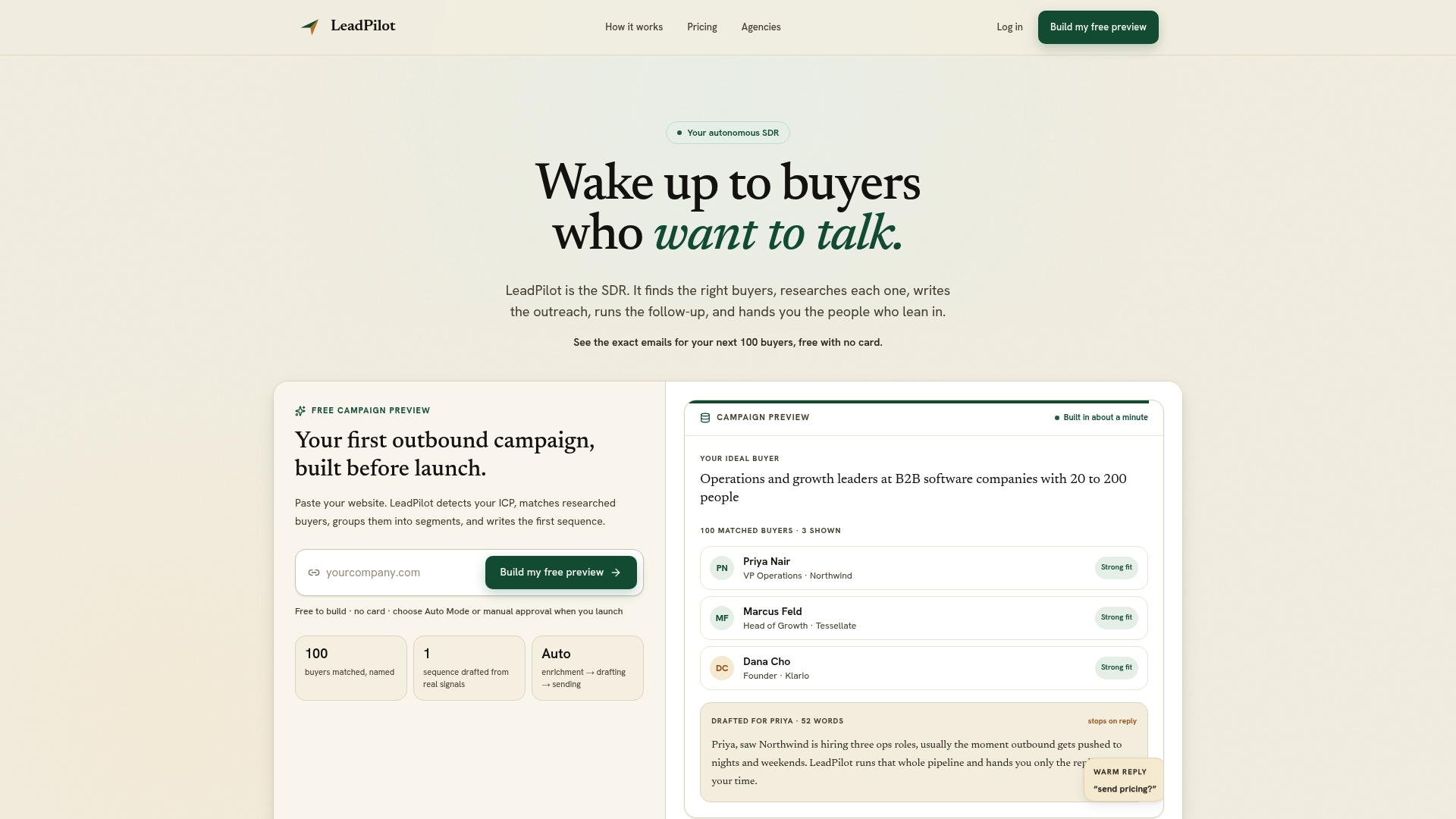
Runleadpilot is built for founders and lean revenue teams who want outbound running without hiring an SDR or becoming a RevOps engineer. It reads your website to identify your ideal customer profile, finds and researches matching decision-makers, writes personalized cold emails from real business signals, manages dedicated sending domains and inboxes for deliverability, runs follow-ups automatically, and routes warm replies to your team. The AI SDR workflow covers targeting through reply handoff in one subscription, with no credit system to manage and no separate sequencer to configure.
For agencies running outbound across multiple clients, Runleadpilot supports multi-client workspaces with consolidated billing. You can build a free campaign preview before launching, so you see exactly who gets targeted and what gets sent before committing. If the tools compared above feel like they require more operational overhead than your team can absorb, managed outbound automation is worth a look.
Key Takeaways
The strongest Clay alternative is the one that matches your team’s GTM maturity, not the one with the longest feature list.
| Point | Details |
|---|---|
| Compliance drives tool choice | Cognism’s phone-verified data and DNC screening across 14 countries set the standard for compliant global outbound. |
| Apollo leads for lean teams | Apollo.io starts at $49/month with built-in sequencing, making it the fastest path to outbound for small teams. |
| Unified platforms beat stacked tools | Signal-driven platforms that connect enrichment, intent, and activation reduce operational drag as GTM scales. |
| Pricing predictability matters at scale | Subscription models with flat rates are easier to budget than credit-based systems that spike with enrichment volume. |
| Runleadpilot covers the full SDR workflow | For founders and lean teams, Runleadpilot manages targeting, personalization, domain management, and reply routing in one platform. |