Best Apollo Alternatives for AI-Managed Outbound in 2026
Discover the best Apollo alternatives for AI-managed outbound in 2026. Boost your outreach with platforms that leverage real-time business signals.

Best Apollo Alternatives for AI-Managed Outbound in 2026
Which Apollo alternatives actually deliver better outbound results?
The short answer: AI-managed platforms that build outreach from live business signals, not static contact lists. LeadPilot leads that category by reading your website, detecting your ideal customer profile, researching matching decision-makers, and writing personalized cold emails before you’ve touched a single spreadsheet.
Apollo.io built its reputation on a large contact database with manual LinkedIn task reminders. That model has a ceiling. Static databases often yield lower reply rates, while signal-driven platforms achieve higher reply rates. That gap compounds fast across a quarter.
Pro Tip: Prioritize platforms that trigger outreach from behavioral signals, not just firmographic filters. A prospect who just hired a VP of Sales or expanded into a new market is worth ten cold names pulled from a filtered list.
Here’s how the leading options stack up on the dimensions that actually move pipeline:
| Feature | LeadPilot | Apollo.io | Static DB tools |
|---|---|---|---|
| AI management | Full SDR workflow managed | Sequences + manual tasks | None |
| Lead sourcing | Signal-based, website ICP detection | — | Filtered lists |
| Email personalization | AI-written from real business signals | Templates + merge fields | Manual or template |
| Follow-up automation | Automated, multi-step | Sequence-based | Manual |
| Data compliance | Managed, verified contacts | GDPR/CCPA claimed | Varies widely |
| Campaign preview | Free preview before purchase | No equivalent | None |
| Pricing model | Subscription by buyer volume | Per-seat + credit tiers | Per-seat or list |
Table of Contents
- How LeadPilot compares with Apollo and other AI-managed outbound sales alternatives
- How to evaluate and choose the right AI-managed outbound sales platform
- Why AI-managed outbound platforms outperform static lead databases
- Pricing models and total cost of ownership of Apollo alternatives
- The outbound shift most teams are still underestimating
- LeadPilot gives lean teams a full outbound engine without the headcount
- Key Takeaways
How LeadPilot compares with Apollo and other AI-managed outbound sales alternatives
Apollo’s core architecture is a database first, execution layer second. You search a contact list, build a sequence, and manually log LinkedIn tasks. The platform lacks automated LinkedIn outreach, which means reps still handle the most time-consuming prospecting steps themselves.
LeadPilot flips that model entirely. It detects your ICP from your website, researches matching decision-makers using live signals, and generates personalized cold emails tied to real business events, not generic merge fields. The platform then manages dedicated sending domains and inboxes, runs multi-step follow-ups automatically, and routes warm replies directly to your team. Your reps engage prospects who have already responded, not cold names.

Multi-channel tools that combine email and LinkedIn sequences do outperform single-channel approaches on deliverability and reply rates. LeadPilot’s managed infrastructure handles the domain warming and inbox rotation that most teams skip, which is exactly where deliverability breaks down.
| Capability | LeadPilot | Apollo.io |
|---|---|---|
| ICP detection | Automated from website | Manual filter setup |
| AI prospect research | Yes, signal-based | No |
| LinkedIn automation | Yes | Manual reminders only |
| Managed sending domains | Yes, dedicated | No |
| Warm reply routing | Automated handoff | Manual review |
| Compliance management | Built-in | Self-managed |
| Free campaign preview | Yes | No |
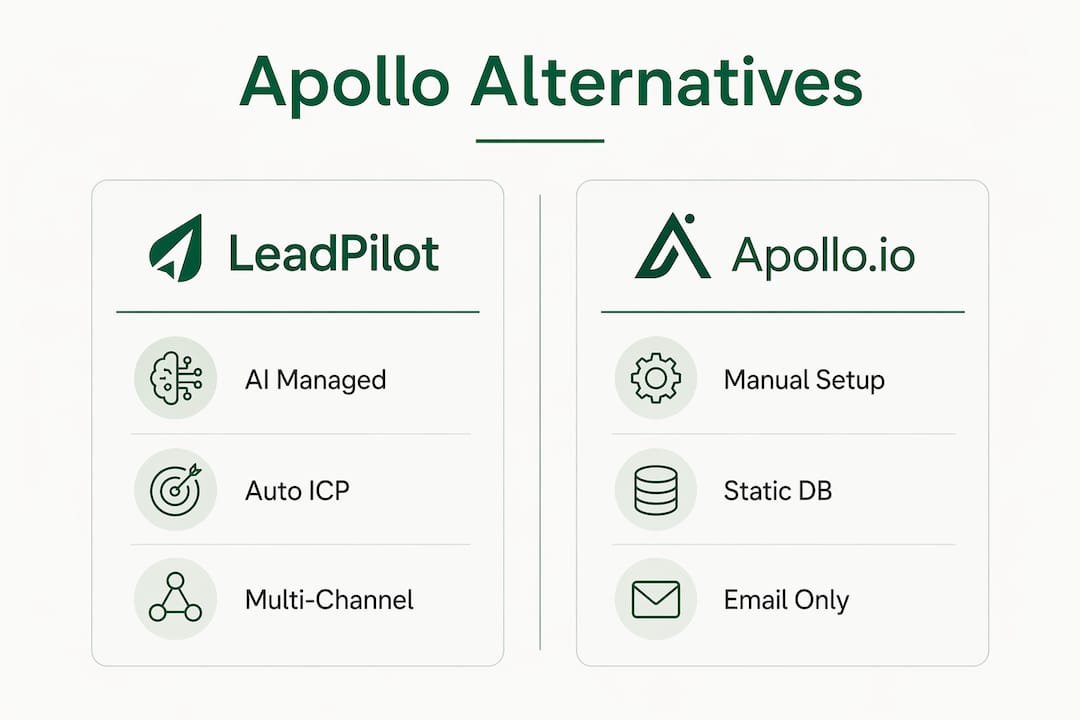
On pricing, Apollo charges per seat plus credits for exports and enrichment. Costs scale unpredictably as your team grows or your contact volume increases. LeadPilot’s subscription is structured around the number of researched buyers and sending capacity, which makes monthly spend easier to forecast.
How to evaluate and choose the right AI-managed outbound sales platform
Not every platform that claims AI actually manages the workflow. Here’s what to pressure-test before committing:
- AI sophistication: Does the platform detect your ICP automatically, or do you configure it manually? Does it write emails from real signals or fill templates?
- Lead quality and verification: Verified contacts reduce bounce rates and protect sender reputation. High-volume outreach with unverified data inflates bounce rates and risks sender penalties.
- Data compliance: GDPR and DNC screening matter even for US-focused teams, especially if you prospect into regulated industries or EMEA markets.
- Integration capabilities: Check native CRM connections. A platform that syncs cleanly with your existing stack, whether HubSpot, Salesforce, or a lighter CRM, saves hours of manual data reconciliation. Pairing outbound tools with a solid SaaS RevOps strategy compounds the efficiency gains.
- Platform usability: A free campaign preview before purchase is a strong transparency signal. If a vendor won’t show you what a campaign looks like before you pay, that tells you something.
- Scalability: Agencies managing multiple clients need consolidated billing and multi-workspace support. Solo founders need a platform that runs without a dedicated ops person.
- Support and onboarding: Managed platforms should handle setup for you. If onboarding requires a week of internal configuration, the “managed” label is marketing.
Pro Tip: Separate your data sourcing layer from your execution layer when possible. A specialized enrichment tool feeding a purpose-built sequencer often outperforms an all-in-one platform that does both adequately but neither exceptionally.
Why AI-managed outbound platforms outperform static lead databases
Static databases become stale the moment they’re built. Job titles change, companies pivot, and the contact who was a VP of Sales six months ago is now at a different firm. AI-driven platforms that update based on real-time behavioral signals maintain relevance that a filtered export simply cannot.
Reply rates from static databases are generally low, while signal-based outbound platforms tend to reach significantly higher reply rates. That’s a 3x–6x difference in pipeline generated from the same sending volume.
The advantages compound beyond reply rates:
- Behavioral targeting: AI detects hiring signals, funding rounds, product launches, and leadership changes, qualifying prospects before the first email sends.
- Continuous verification: Contacts are checked against current data, not a snapshot from last quarter.
- Deliverability protection: Accurate, verified data means lower bounce rates. Unverified static databases drive bounce rates up and trigger spam filters, damaging sender reputation over time.
- Compliance by default: Platforms built around signal-based sourcing tend to apply verification and consent checks as part of the data pipeline, not as an afterthought.
- Sender reputation longevity: Managed domain warming and inbox rotation, combined with accurate data, sustain deliverability across long campaigns rather than degrading after the first few hundred sends.
The shift from broad database filtering to signal-led engagement is the defining outbound trend of 2026. Teams still running cold lists through a basic sequencer are competing against platforms that already know which prospects are in-market.
Pricing models and total cost of ownership of Apollo alternatives
Apollo’s pricing looks accessible at entry level but scales awkwardly. The per-seat model adds up as teams grow, and credit consumption for enrichment, exports, and mobile data creates unpredictable monthly costs. The Organization tier requires annual commitment with a three-seat minimum, which locks smaller teams into spend they may not need.
AI-managed platforms like LeadPilot price around buyer volume and sending capacity rather than seats, which aligns cost directly with output. You pay for researched prospects and managed outreach, not for licenses that sit idle. Agencies benefit from consolidated billing across client workspaces rather than multiplying per-seat costs.
Enterprise data platforms such as ZoomInfo carry annual contracts in the range of $14,995–$39,995, built for large sales organizations with dedicated RevOps support. That’s the right tool for a 50-rep team with complex account mapping needs. It’s the wrong tool for a 10-person startup that needs pipeline this quarter.
Total cost of ownership goes beyond the subscription line. Factor in the time your team spends on manual tasks the platform doesn’t handle: list cleaning, domain setup, inbox warming, follow-up scheduling, and reply triage. A managed platform that handles all of those steps has a lower real cost than a cheaper tool that offloads them back to your team.
The outbound shift most teams are still underestimating
The conventional wisdom says you need a big database. More contacts, more coverage, more pipeline. That logic made sense when outbound was a numbers game. It doesn’t hold when inbox providers have gotten aggressive about filtering, when buyers ignore anything that reads like a template, and when sender reputation is the actual bottleneck.
The teams winning outbound in 2026 aren’t the ones with the largest lists. They’re the ones whose emails arrive, get read, and feel relevant enough to warrant a reply. That requires verified data, personalization tied to real signals, and sending infrastructure that doesn’t get flagged on the third campaign.
LeadPilot’s approach, reading your website to define your ICP and then building outreach from live business signals, addresses all three. It’s not a database you search. It’s a system that runs the SDR workflow for you, from targeting through warm reply handoff, while protecting the deliverability that makes the whole thing work.
The platforms that treat compliance and data accuracy as features rather than defaults will keep losing sender reputation. That’s not a prediction. It’s already happening to teams that chose volume over verification.
LeadPilot gives lean teams a full outbound engine without the headcount
Most founders and small sales teams face the same problem: Apollo and similar tools hand you a database and a sequencer, then leave the actual SDR work to you. List building, domain setup, email writing, follow-up scheduling, reply management. That’s a part-time job before you’ve had a single sales conversation.
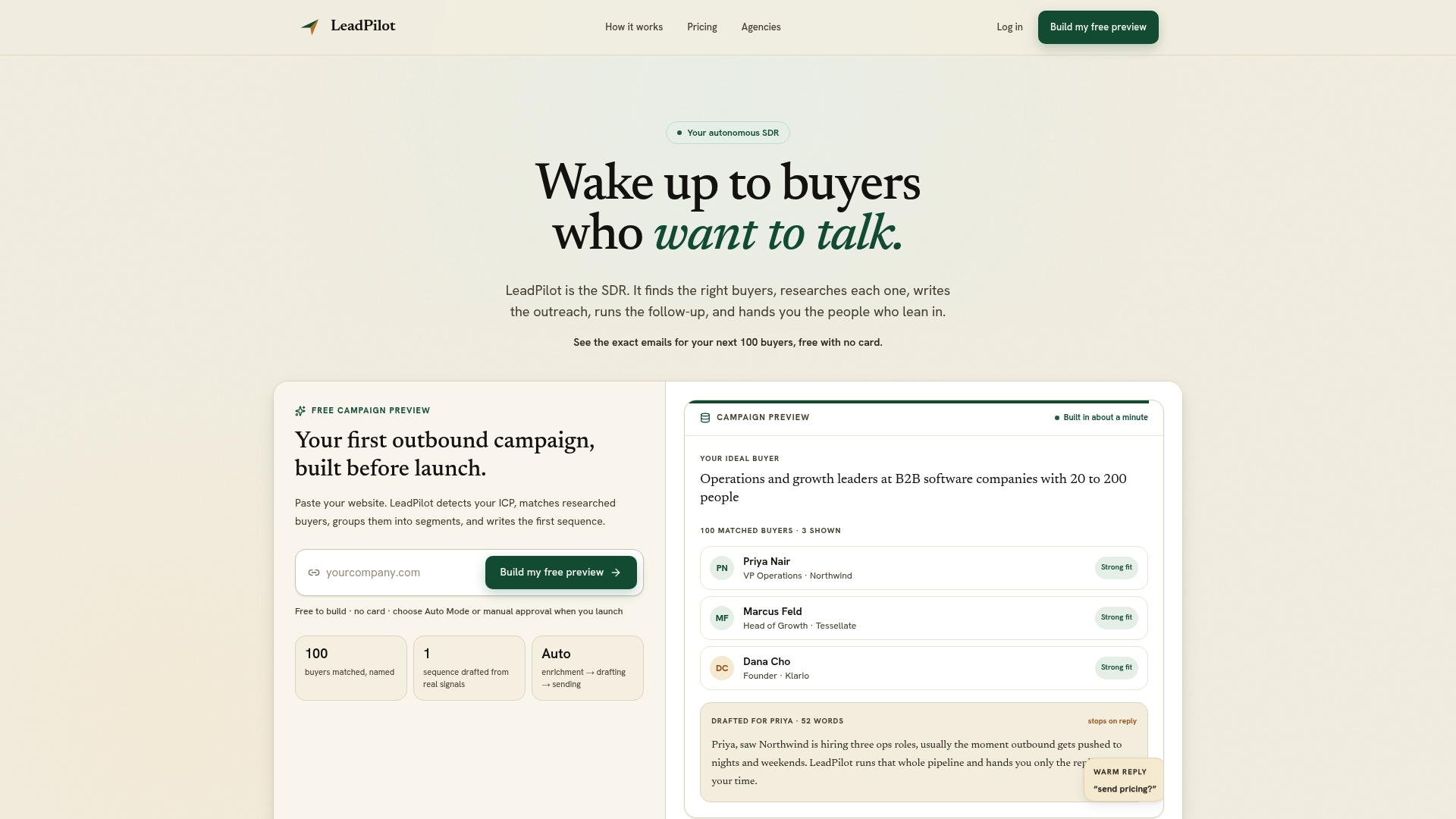
Runleadpilot is built for exactly this situation. It reads your website, identifies your ideal buyers, researches decision-makers from live signals, writes personalized cold emails, manages your sending domains, runs follow-ups, and routes warm replies to your team. You handle the conversations. The platform handles everything before them.
It fits founders running outbound without a dedicated SDR, lean sales teams that need pipeline without adding headcount, and agencies managing outbound for multiple clients from a single workspace. Before you commit, you can build a free campaign preview and see exactly what your outreach would look like. No contract required to evaluate it. Start your preview at runleadpilot.com/outbound-sales-automation.
Key Takeaways
AI-managed outbound platforms that source leads from live signals and handle the full SDR workflow deliver reply rates of 6–10%, compared to just 1–3% from static database tools like Apollo.
| Point | Details |
|---|---|
| Signal-based reply rates | Signal-driven platforms deliver 6–10% reply rates, while static databases average just 1–3%. |
| Apollo’s core limitation | Apollo relies on a database-first model with manual LinkedIn tasks and no automated outreach. |
| Managed infrastructure matters | Dedicated sending domains and inbox warming protect deliverability across long campaigns. |
| Total cost of ownership | Seat-plus-credit pricing models create unpredictable costs; buyer-volume pricing aligns spend with output. |
| Runleadpilot’s position | LeadPilot automates the full SDR workflow from ICP detection to warm reply handoff, and offers a free campaign preview before purchase. |